Gala Planning Guide: From First Goal to Final Thank-You

Gala Planning Guide: From First Goal to Final Thank-You
To plan a gala, write down one clear purpose, set a budget with a contingency, secure the venue and a committee 9 to 12 months out, lock the program about three months out, rehearse before the doors open, and thank every guest within two weeks. Everything else is detail, and the details are what this guide covers: who does what, in what order, and where galas usually go wrong.
We wrote it for nonprofit teams, corporate hosts and volunteer committees planning their first or fifth gala. Use it as a working checklist and adjust the dates to your own calendar.
TL;DR
- Write the gala’s purpose in one sentence the whole committee agrees on, then use it to approve or reject every later decision.
- Book the venue, the committee and headline sponsors 9 to 12 months ahead. Book catering, entertainment and production about 6 months ahead. Lock the program, menus and seating about 3 months ahead.
- Budget fixed and variable costs separately, and add a contingency line before you sell a single ticket.
- Run a full rehearsal at the venue at least 48 hours before guests arrive, and keep one person as the day-of decision-maker.
- Send personal thanks, and tax acknowledgments for donors, within two weeks. Stewardship decides whether guests come back next year.
Table of Contents
- Start with one sentence of purpose
- Build the budget before the guest list
- The gala planning timeline
- Choose the venue and read the contract
- Vendors: catering, entertainment, production
- Design the program and the run of show
- Guest experience: invitations, check-in, arrival
- Fundraising moments and tax paperwork
- Perspective: why a gala needs one system, not six tabs
- Event day and the rehearsal
- Follow up and measure what happened
- Plan your gala with Jubiliq
- FAQ
- Sources
Start with one sentence of purpose
Before you look at a single venue, decide what the gala is for. Raising money, thanking clients, celebrating a milestone and recognizing members are different events with different budgets, guest lists and programs. One planning firm advises documenting the objective in a creative strategy that acts as a filter for every later decision. A venue hall that fits 600 is wrong if your goal is an intimate evening for 120 major donors.
Boil that strategy down to a single sentence. One banquet venue recommends that the whole committee agrees on it, and we agree. A good sentence has a number and an audience: “Raise $150,000 for our scholarship fund from 250 guests and 12 sponsors.” When a committee member suggests a live band that eats a third of the budget, you can check it against the sentence rather than argue about taste.
Then fix three things in writing:
- The measure of success. Net revenue, attendance, new donors, sponsor renewals, or a mix.
- The decision-maker. One person has final say on money; another owns the program.
- The committee. Small subcommittees (sponsorship, auction, program, guest experience, volunteers) move faster than one large group.
Build the budget before the guest list
A gala budget is easier to defend when it separates costs that stay fixed from costs that grow with each guest. Hyatt’s gala guide suggests that purpose and audience shape the budget, with a contingency line included from the start.
| Cost type | Examples | How it behaves |
|---|---|---|
| Fixed | Venue rental, AV and lighting, décor, entertainment, printing, insurance | Same at 150 guests or 300 |
| Variable | Food, beverages, staffing ratios, rentals per seat, favors | Rises with every confirmed guest |
| Revenue costs | Payment processing, auction item costs, ticketing fees | Rises with sales |
| Contingency | Weather, no-shows, late vendor changes | Set aside up front, spent only if needed |
Three habits keep the numbers honest:
- Price per guest, not per event. Divide your total variable costs by expected attendance to find your real cost per seat, then set ticket prices and table levels from that.
- Plan sponsorship early. A 2026 guide from a hospitality school recommends approaching headline sponsors 9 to 12 months out, so the money is committed before you sign big contracts. If you need templates, our guides to gala sponsorship levels and sponsorship packages give copy-ready tiers.
- Track actuals weekly. A budget that is only reviewed at the committee meeting drifts. Log every deposit and invoice as it happens.
The gala planning timeline
Here is a working checklist built on Hyatt’s timing recommendations, which place the venue and committee at 9 to 12 months, catering, entertainment, speakers and production at about 6 months, and program, menus, seating and vendor logistics at 3 months. We added the tasks that in our view belong between those milestones.
9 to 12 months out
- Write the purpose sentence, the goal and the budget.
- Form the committee and name subcommittee chairs.
- Shortlist and tour venues, then sign a contract.
- Pick two or three date options and check them against holidays, school calendars and competing local events.
- Approach headline sponsors.
6 months out
- Book catering, entertainment, speakers and production.
- Open ticket and table sales, or send save-the-dates.
- Launch the event page so guests have one place for details.
- Start collecting auction and raffle items if you are running them.
3 months out
- Lock the program, the menu options and the seating approach.
- Confirm vendor delivery schedules, load-in times and power or AV needs.
- Recruit volunteers and assign specific roles.
- Send a second wave of invitations and sponsor recognition drafts.
2 weeks out
- Finalize the guest count and dietary needs with the caterer.
- Complete the written run sheet. Our post on locking the gala program timeline two weeks out walks through the format.
- Brief staff, volunteers and key vendors on their roles.
Event week
Hyatt’s guide lists a site visit, rehearsal, final guest-count review, staff briefing and emergency-procedure review for this week. Add a weather plan and a printed day sheet for every lead.
Within 2 weeks after
- Send personal thank-you notes and donor acknowledgments.
- Hold a debrief and compare results with your original goal.
If your gala is corporate and you want a phase-based version with sustainability standards built in, our corporate event checklist goes further.
Choose the venue and read the contract
A venue is the biggest fixed cost and the hardest decision to reverse. The guidance from Memorial Sloan Kettering’s gala toolkit is practical: weigh location, get every fee in writing, ask about restrictions on outside food and drink, check noise and occupancy limits, confirm day-of support, and tour in person before signing.
Add these checks from the Hyatt guidance on capacity, accessibility, transport, parking, AV, catering and guest flow:
- Capacity at your layout. A room that holds 400 standing may seat 220 at rounds with a stage and a silent auction.
- Accessibility. Step-free entrance, accessible restrooms, reserved seating near exits, and a clear path to the stage.
- Arrival. Parking, valet, rideshare drop-off and shuttle options. For larger groups, guidance on event transportation planning helps you think through pickups and timing.
- Load-in and AV. Ask what time vendors can enter, where power is, and who runs the sound.
- Cancellation and attrition terms. Know your guaranteed minimums before you sign.
Vendors: catering, entertainment, production
Vendor contracts are where gala budgets are won or lost. Confirm each vendor’s delivery schedule, load-in window, staffing and cancellation terms in writing, and make sure each one knows who to call on the day.
Catering. Decide between plated, stations or family style based on your program. A plated dinner gives you a captive audience for speeches and an auction paddle raise. Stations encourage mingling but scatter attention. Ask for dietary options early and put the responsibilities in the contract; our list of five duties to put in writing for caterers covers what to demand. For large parties with allergies and accessibility needs, see our notes on large party planning.

Music and entertainment. Live music sets the tone for arrival and dinner, but the contract needs to cover set lengths, breaks, sound requirements and what happens if a performer cancels. This guide to corporate event music contracts shows how to make those terms clear.
Production. Lighting, sound, stage and screens should be briefed against your run sheet, not just your décor concept. Agree who has authority to change the program on the night.
Design the program and the run of show
The program is the evening’s spine. Most successful galas follow a rhythm: arrival and reception, seated welcome, dinner with a short story or video, the ask or auction, entertainment, and a warm close. Keep the formal remarks short. Galas that run long lose guests before the most important moment.
The run of show is the document behind it. It lists every cue by minute, with the person responsible, the equipment needed and the fallback. GEO Events reports that a professional run-of-show for a 500-person gala typically spans 15 to 20 pages. You do not need that for 150 guests, but you do need a written version, and everyone must work from the same copy. Our post on locking your run of show 48 hours before doors explains how to handle last-minute changes without chaos.
A simple run-of-show row looks like this:
| Time | Cue | Owner | Notes |
|---|---|---|---|
| 6:00 p.m. | Doors open, check-in staffed | Volunteer lead | Separate VIP table |
| 7:15 p.m. | Guests seated, lights dim | Stage manager | Music fades out |
| 7:20 p.m. | Welcome and mission story | Board chair | 5 minutes maximum |
| 8:10 p.m. | Paddle raise | Emcee and auctioneer | Counters ready, QR code on screen |
Guest experience: invitations, check-in, arrival
Guests judge a gala in its first ten minutes. Check-in is where most people feel either welcomed or processed.
- Use digital check-in. MSK’s toolkit recommends technology such as QR codes for check-in and a single decision-maker on event day.
- Make top supporters feel seen. The same toolkit suggests a VIP check-in table so top-tier sponsors feel valued on arrival.
- Send arrival information early. Include parking, dress code, timing, and what to do about dietary restrictions. MSK also recommends planning weather contingencies and specific volunteer roles before the day.
- Plan for winter. If your gala is in a cold month, one banquet venue advises staffing the coat check, keeping the entrance clear and communicating if roads are bad.
A consistent flow of invitations, reminders and updates keeps response rates up. Our guest communication plan shows how to sync RSVPs and include guests with different needs.
Fundraising moments and tax paperwork
If your gala raises money, plan the moments that ask for it. Most galas combine ticket and table sales, sponsorships, a live or silent auction, a paddle raise and online giving during the night. Each has its own handoffs: who processes payments, who records bids, who tracks pledges.
The paperwork matters too. In the United States, the IRS says a charity must give a written disclosure to donors who make a quid pro quo contribution above $75, meaning a payment that is partly a gift and partly for goods or services such as a dinner. The statement needs a good-faith estimate of the value of what the donor received. The same page notes a penalty of $10 per contribution, up to $5,000 per fundraising event, unless there was reasonable cause. Ask your accountant or tax adviser how to value dinners, auction items and sponsor benefits for your organization.

The Chronicle of Philanthropy suggests sending tax-deduction information for auction purchases, sponsorships and table purchases within two weeks after the event. Build that into your run of show.
Perspective: why a gala needs one system, not six tabs
We built Jubiliq because the pain of a gala is rarely one big problem. It is the guest list in one spreadsheet, the budget in another, vendor emails in a third place, and a run sheet that someone prints at the last minute and nobody updates.
Our view is that a gala planner should be able to see the whole event at once: who has RSVP’d, what has been paid, which vendor has not confirmed, which tasks are late. That is why our planning interface adapts to the event type. For a fundraising gala it surfaces tickets, sponsorships, donations, seating and catering. It hides tools that belong to a wedding or a golf outing.
We also believe the day sheet is not an afterthought. A printable, current day sheet that matches the live plan keeps volunteers, vendors and board members reading from the same page. Real-time updates and financial tracking mean the committee argues about decisions, not about whose version is right.
HCRF
Event day and the rehearsal
On the day, your work is mostly done. What remains is testing the plan against reality.
- Rehearse at the venue. GEO Events recommends a full production rehearsal at least 48 hours before to find failures in lighting, audio or timing. If it is not possible, do a sound check on the day, as Moonlight Banquet Hall advises, and a full rehearsal if the program is complex.
- Walk it as a guest. The Chronicle’s timeline recommends an attendee-style walkthrough: check-in staffed, auction and meal transitions timed, the program sequenced around dinner. It catches missing signage, bad setups and flow problems.
- Brief everyone. Staff, volunteers and vendors each need their role, the run sheet and the name of the single decision-maker.
- Have an emergency plan. Review exits, first-aid contacts and weather fallback during event week.
Follow up and measure what happened
The gala does not end when the last guest leaves. MSK’s toolkit stresses that fundraising continues through long-term stewardship to keep guests engaged until the next event. A practical post-event routine:
- Within 48 hours: a short thank-you message with a photo or video while the evening is fresh. GEO Events notes that the window to share content is brief.
- Within two weeks: personalized thanks to attendees, volunteers and sponsors, tax acknowledgments, and a staff and volunteer debrief.
- At the debrief: compare final net revenue and attendance with your original targets, note what to change, and file the run sheet and contracts for next year.
Keep the numbers simple: gross revenue, total costs, net revenue, cost per guest, new donors, sponsor renewals.
Plan your gala with Jubiliq
Jubiliq is an event planning platform that handles the pieces above in one place: guest lists with RSVP tracking, budgeting, vendor and contract management, task scheduling, seating and catering workflows, ticket and sponsorship sales, donation handling, segmented email blasts, a real-time progress dashboard and a printable day sheet.
Pricing is simple. The Starter plan costs $0 per event and fits planning-only use or events without paid tickets. The Organizer plan charges 2% per paid registration, plus Stripe fees, so you pay when tickets sell. Enterprise is for organizations running multiple events, with custom pricing.
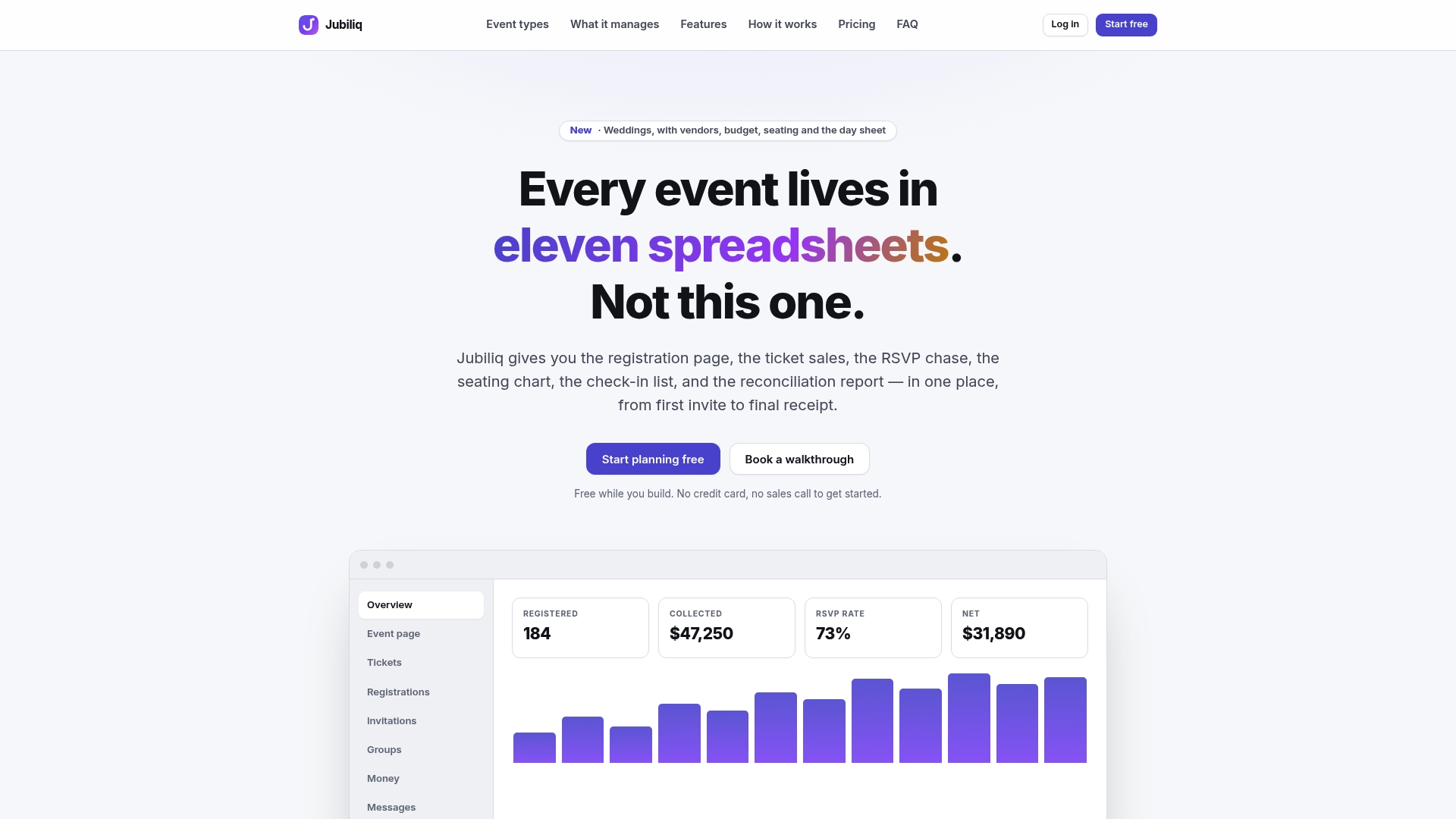
See the plans and start your gala on Jubiliq, or browse more checklists on our blog.
FAQ
How far in advance should you plan a gala?
Start 9 to 12 months ahead, when you set the goal, form the committee, secure the venue and approach headline sponsors. Catering and entertainment follow at about six months, and the program locks at about three months. A smaller gala can compress this, but good venues and sponsors commit early.
What is the first step in planning a gala?
Write one sentence that states the purpose, the audience and the target result. Share it with the committee and get agreement before you book anything. It becomes the test for the venue, the budget and the program.
What should a fundraising gala checklist include?
Include the goal and budget, committee roles, venue contract, sponsorship outreach, ticket sales, vendor confirmations, program and run sheet, volunteer briefing, check-in plan, rehearsal, donor acknowledgments and a debrief. Make sure each task has an owner and a due date.
When should you thank donors and send tax receipts?
Send personal thanks quickly, ideally within days, and complete acknowledgments within two weeks. In the U.S., charities must give a written disclosure for quid pro quo payments above $75. Confirm the details with your accountant.
Sources
- How to Plan a Corporate Gala, GEO Events
- How to Plan a Gala Event, Hyatt Meetings & Events
- Gala Tool Kit, MSK Giving
- A Timeline for Organizing a Black-Tie Fundraising Gala, The Chronicle of Philanthropy
- Corporate Gala Planning Checklist, Moonlight Banquet Hall
- Gala Event Planning: Steps, Budget and Checklist, Swiss Education Group
- Substantiating charitable contributions, IRS