Sponsorship Packages: Prospectus Templates + Nonprofit Tax Notes

Sponsorship Packages: Prospectus Templates + Nonprofit Tax Notes
Start with three or four sponsorship tiers, priced so the top level costs roughly three to four times the bottom level, and build every benefit around what the sponsor’s team will actually walk away with. A sponsorship package is a written offer that trades a fixed payment for defined marketing and access benefits, and the ones that renew are built around measurable sponsor outcomes, not logo placement.
TL;DR:
- Setting the top sponsorship price at three to four times the bottom tier creates a justifiable range that encourages upgrades without oversaturating options.
- Sponsors prioritize qualified leads, decision-maker access, brand alignment, or memorable experiences over passive visibility like logo placement alone.
- High-value benefits such as speaking slots or private meetings should be limited to top tiers, while standard benefits like logo displays can be used for entry-level packages.
- Building a clear, written benefit inventory with measurable KPIs helps justify pricing and increases sponsor satisfaction and renewal likelihood.
- Using a simple one-page checklist to confirm deliverables and documenting all promises prevent common organization mistakes that lead to sponsor dissatisfaction and missed renewals.
Table of Contents
- What Goes Into Sponsorship Packages That Convert
- What Sponsors Actually Want From Your Event
- Structuring Sponsorship Levels: Four Tiers, Three Tiers, or à la Carte
- Building Your Sponsorship Benefits Inventory
- Pricing Sponsorship Packages: Anchors, Ratios, and Sanity Checks
- Sponsorship Prospectus Essentials and Sample Templates
- Fulfillment, Reporting, and Getting Sponsors to Renew
- Tax Rules Nonprofit Organizers Can’t Skip
- The Checklist Every First-Time Organizer Skips
- Where Jubiliq Fits Into Your Sponsorship Workflow
- Sources
- FAQ
What Goes Into Sponsorship Packages That Convert
Before you touch a price or a benefits list, you need three inputs sitting in front of you: your audience data, an honest inventory of what you can actually deliver, and a real number for what fulfillment costs. Skip that step and you end up pricing on guesswork.
Sponsors buy leads and access first, visibility second. That single shift in thinking, treating your event as a media property with measurable reach rather than a banner opportunity, changes how you write every benefit description that follows.
Here’s the fast checklist to run before you draft anything:
- Pull audience numbers: attendee count, job titles, geographic spread, past engagement rates.
- Inventory every sellable asset: stage time, signage, email sends, booth space, data.
- Calculate the real cost to fulfill each benefit, including staff time.
- Set your top-tier price first, then build down from it.
- Write one measurable KPI per major benefit before you finalize pricing.
Pro Tip: Sponsors increasingly rank measurement as their biggest frustration with sponsorship deals. A 2025/2026 study from WFA and Lumency found brands are raising governance and KPI expectations faster than they’re raising measurement budgets, meaning the organizer who hands over a clean report has a real edge over one who doesn’t.
Nearly 88% of marketers now identify events as a key revenue driver, which is exactly why sponsorship deserves the same rigor you’d apply to any other line of revenue. Treat your package like a product with a price, not a favor you’re asking a company to do you.
What Sponsors Actually Want From Your Event
Sponsors rarely say it out loud, but almost none of them are buying your logo wall. They’re buying one of four things: qualified leads, face time with decision makers, brand alignment with your audience, or a direct experience their prospects will remember. Everything else is packaging.
Lead generation tops the list for most B2B sponsors. A sponsor at a regional trade show doesn’t care that their name appears on your printed program; they care whether your attendee list contains fifty people who could plausibly buy their product. Decision-maker access matters most for high-ticket sponsors, think financial services or enterprise software, who would rather get fifteen minutes with your board chair than fifteen thousand impressions on a banner. Brand fit drives consumer-facing sponsors: a running shoe company sponsoring a 5K cares less about lead counts and more about being seen in the right emotional context. Experiential engagement, sampling, demos, interactive booths, wins with sponsors who need people to physically touch or try their product.
What sponsors consistently undervalue is passive visibility with no way to measure it. A logo on a website banner that nobody can tie to a click, a mention in a program nobody reads twice, a name on a step-and-repeat with no photo tracking. If a benefit can’t be counted, screenshotted, or reported back to a sponsor’s marketing director, it’s dead weight in your package, no matter how good it looks on paper.
The fix is simple: validate goals before you price anything. Three questions get you most of the way there:
- What does success look like for you six months after this event?
- Who on your team needs to be in the room, and why?
- How will you report this sponsorship internally to justify renewing it?
A short outreach script works better than a formal survey for most first-time conversations. Something like: “Before we send a proposal, can I ask what you’re hoping to get out of a sponsorship like this, leads, visibility, or something else?” That one question, asked early, will reshape your entire package before you write a single price.
Pro Tip: If a prospective sponsor can’t answer what success looks like for them, don’t build them a custom package yet. Send your standard tiers first. Custom builds for undefined goals waste your time and rarely close.
Structuring Sponsorship Levels: Four Tiers, Three Tiers, or à la Carte
Most organizers default to a four-tier structure, and there’s a reason it’s the industry norm rather than just a habit: it gives sponsors enough room to self-select their budget without overwhelming them with choices. Here’s a workable template you can adapt:
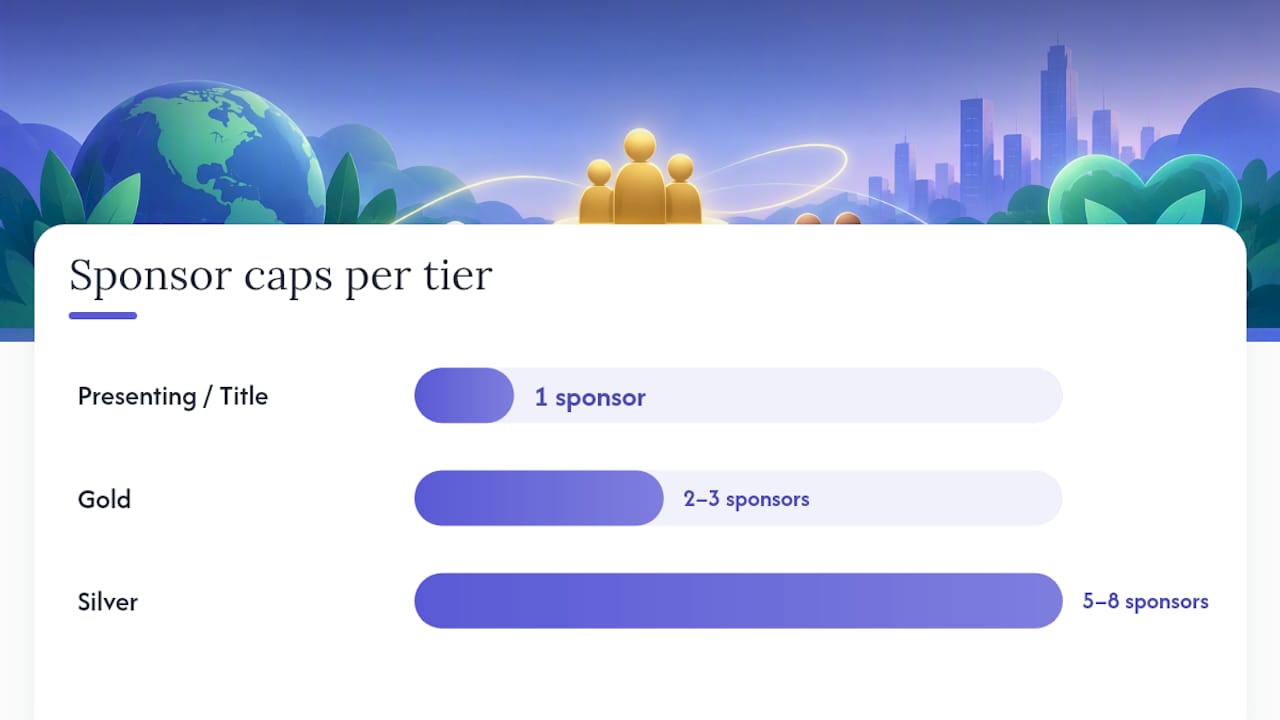
- Presenting or Title tier (one sponsor only): full-event naming rights, stage speaking slot, private meeting room access, opt-in attendee data. Priced at your ceiling, typically 3 to 4 times your lowest tier.
- Gold tier (two to three sponsors): premium exhibit placement, featured email mention, five comp registrations, logo on all signage.
- Silver tier (five to eight sponsors): standard exhibit space, shared email mention, two comp registrations, logo on event website.
- Bronze or Community tier (open, uncapped): logo on program and website, social media shoutout, one comp registration.
If four tiers feel like overkill for a smaller event, collapse to three: Presenting, Partner, and Supporter. A three-tier model closes faster because sponsors spend less time comparing near-identical middle tiers, and you spend less time explaining the difference between Gold and Silver to a prospect who just wants a quick yes.
À la carte or modular pricing works best when your sponsors are wildly different in size or interest. A tech conference might sell a fixed Gold tier to a mid-size software company while separately selling a lanyard sponsorship, a Wi-Fi naming sponsorship, and a lounge sponsorship as standalone line items. Industry guidance backs this up: pairing fixed tiers with standalone add-ons captures sponsors who want customization without diluting what your core tiers are worth.
Whatever structure you pick, protect the top tier with real scarcity. Cap it at one or two sponsors, name it something that signals exclusivity (Presenting, Title, Signature), and never let a lower tier accumulate so many extra add-ons that it starts to rival the top tier’s value. Scarcity is what justifies the 3 to 4x price gap; without it, sponsors will always negotiate down to your middle tier.
Building Your Sponsorship Benefits Inventory
Every benefit you sell falls into one of three value bands, and knowing which band a benefit belongs in is what keeps your tiers honest.
High-value benefits are the ones sponsors will pay the most for because they’re scarce and directly tied to their goals: a speaking slot on the main stage, a private meeting room for one-on-one conversations with attendees, or an opt-in list of attendee contact information. These belong exclusively in your top one or two tiers. Give them away too freely and you’ve destroyed the reason anyone pays for Presenting status.
Medium-value benefits fill your middle tiers: dedicated exhibit space, a featured mention in your event email newsletter, and a handful of complimentary registrations. These are visible and useful, but they’re replicable, meaning you can offer them to several sponsors without any one sponsor feeling shortchanged.
Standard benefits round out your entry-level tier: logo placement on the event website and printed program, a thank-you mention from the stage, and a scheduled social media post. They cost you almost nothing to fulfill and give smaller sponsors a legitimate reason to say yes.
- High-value: speaking slots, private meeting space, opt-in attendee lists, exclusive category rights
- Medium-value: exhibit space, featured email placement, comp registrations, session naming rights
- Standard: logo placement, verbal thank-yous, social media mentions, program ads
The biggest mistake organizers make when writing benefit descriptions is vagueness. “Logo on website” tells a sponsor nothing about reach. “Logo on event website, averaging 4,000 unique visitors in the 60 days before the event” tells them something they can actually evaluate against their marketing budget. Attach a number, a timeframe, or a format to every benefit whenever you have one available.
Pro Tip: Write your benefit descriptions the way you’d write ad inventory for a media kit. A sponsor’s marketing team is comparing your event against other places they could spend that same budget, so give them the same specificity a magazine or podcast would.
Pricing Sponsorship Packages: Anchors, Ratios, and Sanity Checks
Set your top-tier price before you touch anything else. Anchoring high gives every lower tier room to look reasonable by comparison, and it’s the single fastest way to raise your average deal size without adding a single new benefit.
Keep your top-to-bottom ratio in the 3x to 4x range. If your bottom tier sells for $1,500, your top tier should land somewhere between $4,500 and $6,000. Go much wider than that and your middle tiers start feeling like filler; go narrower and you leave money on the table from sponsors who would have paid more for exclusivity.
Three value-based techniques help you justify a number beyond gut feeling:
- Estimated lead value: if your attendee list contains 300 qualified prospects and a sponsor’s average deal is worth $10,000, even a 2% conversion rate justifies a price well above your fulfillment cost.
- Media-equivalent comparison: price a booth or email mention against what a comparable ad buy costs in your industry’s trade publications or LinkedIn campaigns.
- Historical conversion data: if last year’s Gold sponsor closed three deals traceable to your event, lead with that number in this year’s renewal conversation.
Offer a discount, typically 10% to 15%, for sponsors who commit before a set early-bird deadline, and consider multi-payment terms for larger packages rather than requiring full payment upfront. Build in a planned annual increase of 5% to 10% so your pricing keeps pace with rising fulfillment costs and you’re not stuck justifying a sudden jump three years from now.
Run one sanity check before you finalize any tier: does the sponsorship fee comfortably exceed what it costs you to fulfill? Add up staff hours, printed materials, comp registration value, and any direct costs tied to a benefit. If a $2,000 tier costs you $1,400 to fulfill once you count everything, you’re not running a sponsorship program. You’re running a break-even favor with extra paperwork.
Sponsorship Prospectus Essentials and Sample Templates
A sponsorship prospectus is the document a prospect reads before they ever talk to you, and it needs to answer every objection they’d raise in a sales call. At minimum, include:
- Event overview: what it is, when, where, and expected format (in-person, hybrid, virtual)
- Audience profile: attendee count, demographics, job titles, past attendance trends
- Historical data: prior sponsor results, attendance growth, media reach if applicable
- Sponsorship levels with clear benefit breakdowns and pricing
- Application deadlines and payment terms
- A named contact person with direct email and phone number
Structure your tier comparison as a simple grid with benefits listed down the left column and your tier names across the top, checkmarks or quantities filled into each cell. Keep the categories in the order sponsors care about most: audience access benefits first, then visibility benefits, then hospitality perks like comp tickets. Adapting a university-tested prospectus toolkit as a starting layout will save you hours versus building one from scratch.
Two quick examples show how the same structure flexes across very different events:
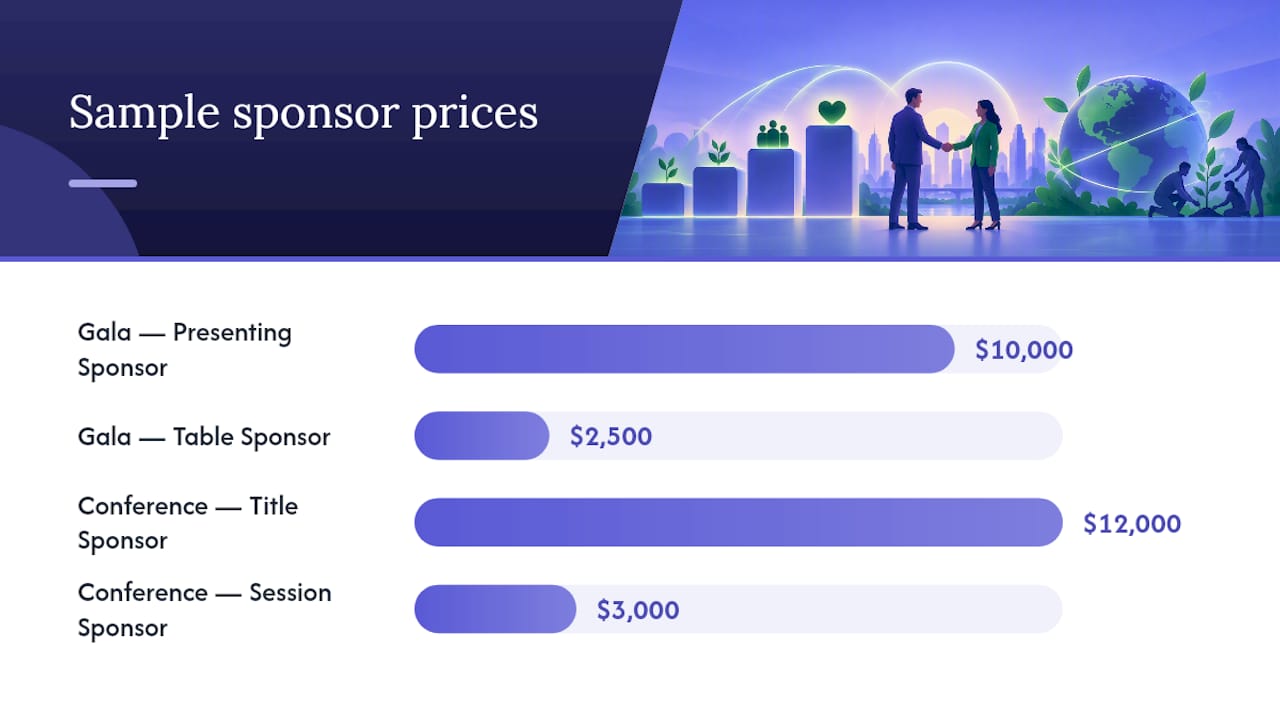
Nonprofit fundraiser gala. Presenting Sponsor at $10,000: stage remarks, ten seats at the head table, logo on all print and digital materials, opt-in donor list. Table Sponsor at $2,500: one reserved table for eight, program listing, social media mention. Send the prospectus 90 days out, follow up at 60 days, lock commitments by 30 days before the event.
Mid-size professional conference. Title Sponsor at $12,000: keynote introduction, branded lanyards, private breakfast meeting with speakers. Session Sponsor at $3,000: naming rights on one breakout track, exhibit table, two comp passes. Open the prospectus six months out to capture budget-planning cycles that run on annual calendars.
Real pricing benchmarks across sports, conferences, and nonprofit events, collected by SponsorFlo, are worth reviewing before you finalize your own numbers, since seeing what comparable events charge helps you avoid pricing too far outside your category’s norm.
Fulfillment, Reporting, and Getting Sponsors to Renew
A sponsorship package is only as good as your ability to deliver every line item on time, and this is where most first-time sponsorship programs quietly fail.
- Build a fulfillment timeline the moment a contract is signed. Assign one staff owner per sponsor and list every benefit with a deadline: logo files due 60 days out, comp registration codes sent 30 days out, stage introduction script finalized one week before the event.
- Track deliverables in a shared system, not someone’s memory. Assigning a single accountable owner per sponsor and running fulfillment off a shared checklist measurably cuts missed deliverables and drives higher renewal rates the following year.
- Report results within two weeks of the event. Include qualified leads generated, meetings held, engagement metrics like booth visits or session attendance, and estimated impressions across signage and digital placements.
Pro Tip: Keep your sponsor report to one page. A dense ten-page recap gets forwarded to nobody; a clean one-pager with three or four hard numbers gets forwarded straight to the budget approver.
Measurement is the top frustration sponsors report in WFA and Lumency’s 2025/2026 global sponsorship study, so the organizer who shows up with a clear report, even a modest one, stands out against a field of competitors who send nothing at all. Set your renewal cadence around that report: send it, wait a week, then follow up with next year’s early-bird pricing while the results are still fresh in their mind.
Tax Rules Nonprofit Organizers Can’t Skip
The IRS treats sponsorship income differently depending on what you promise in return. A payment counts as a qualified sponsorship payment, generally not taxable, when it’s acknowledged with the sponsor’s name, logo, or general slogan and carries no comparative or qualitative language about their product. The moment a benefit crosses into advertising, exclusivity claims, calls to action, or direct links to a sponsor’s sales page, that portion of the payment can trigger unrelated business income tax, or UBIT.
Common triggers worth watching:
- Granting exclusive category rights (“Official Airline Sponsor”) tied to promotional language
- Including calls to action like “Visit our booth for 20% off”
- Linking directly to a sponsor’s e-commerce or sales page from your event materials
- Making any part of the payment contingent on attendance figures or performance metrics
The Council of Nonprofits recommends putting every sponsorship in writing, documenting exactly what benefits were exchanged for what payment. Many sponsorships blend a non-taxable acknowledgment portion with a smaller taxable advertising portion, so separating and valuing each piece in your agreement matters more than trying to force the whole deal into one category. When a sponsor pushes for exclusivity language or performance-based payment terms, that’s the moment to loop in an accountant or tax attorney rather than guess.
The Checklist Every First-Time Organizer Skips
The gap between a sponsorship program that renews and one that fizzles after year one usually comes down to three preventable mistakes. First, overpromising fulfillment: naming benefits in the prospectus that nobody on the team is actually staffed to deliver. Second, under-documenting what was promised, so six months later neither side agrees on what the contract covered. Third, treating measurement as an afterthought instead of building it into the plan from day one.
The fix for all three is the same: a one-page checklist you run before you send a single prospectus. Confirm every promised benefit has a named owner, confirm every agreement is in writing with specific deliverables, and confirm you know what number you’ll report back to the sponsor before the event even starts.
Centralizing your sponsor list, fulfillment tasks, and financial tracking in one place, rather than spreading them across spreadsheets, email threads, and sticky notes, removes most of the administrative drag that causes these mistakes in the first place. The organizers who renew sponsors year over year are rarely the ones with the flashiest benefits. They’re the ones who never lose track of what they promised.
— HCRF
Where Jubiliq Fits Into Your Sponsorship Workflow
Jubiliq is built for the operational side of sponsorship, the part that swallows hours once your tiers are priced and your prospectus is out the door. It consolidates ticket and sponsorship sales, budget tracking, and vendor or asset management in one adaptive interface, so you’re not juggling a separate spreadsheet for fulfillment deadlines, a separate tool for sponsor payments, and a separate inbox for asset requests.
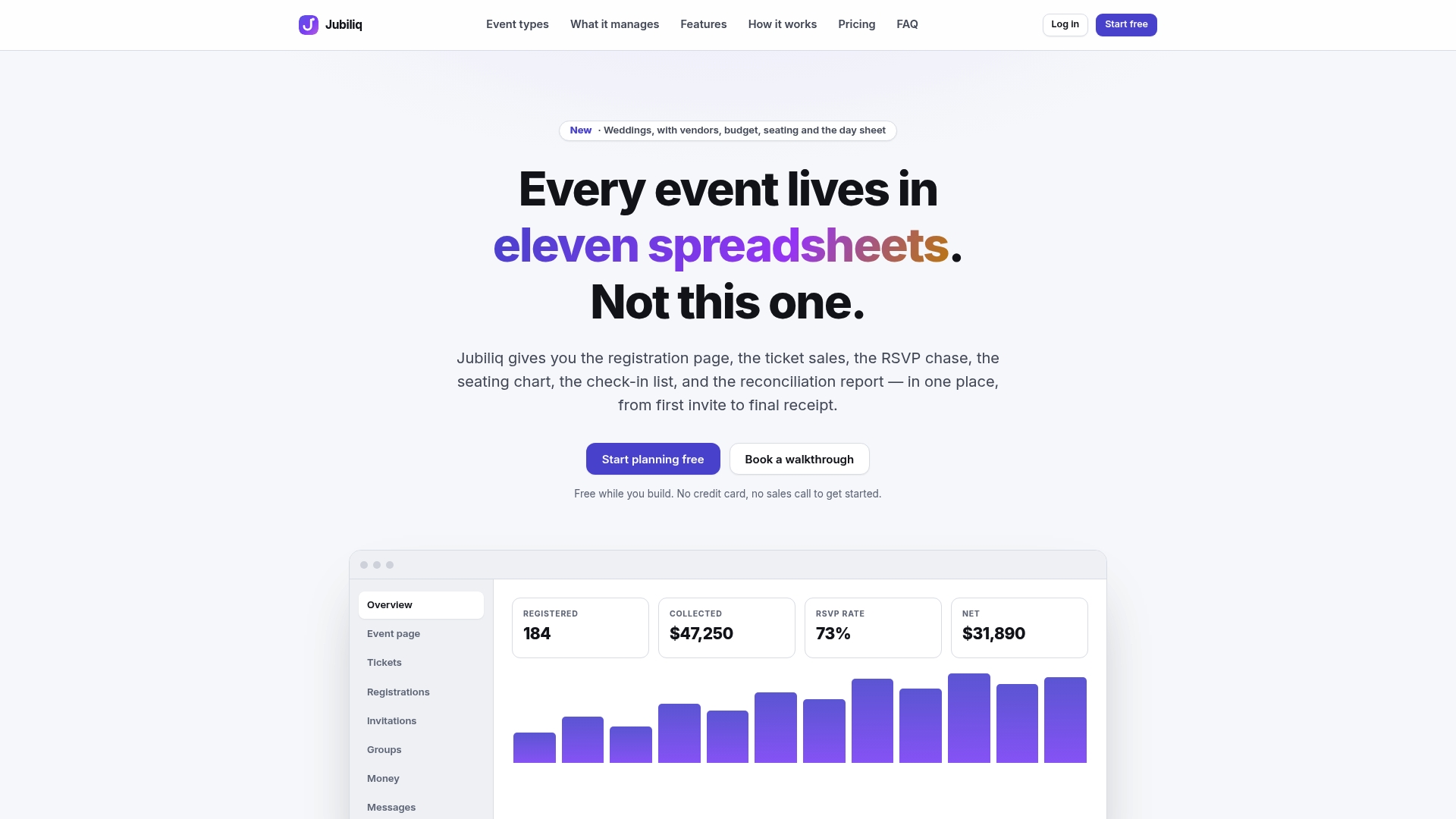
Because it surfaces real-time progress dashboards and exportable reports, you can pull qualified-lead and engagement numbers sponsors expect to see without rebuilding a report from scratch every renewal cycle. Printable day sheets keep fulfillment owners aligned on exactly when each sponsor benefit, a stage introduction, a comp registration code, a booth setup, needs to happen. For events selling paid registrations, fees apply per paid registration with no separate software cost; planning-only use and events without paid tickets may stay on a free tier. Visit Jubiliq to see how the platform maps to your next sponsorship cycle.
Sources
- Advertising or qualified sponsorship payments | Internal Revenue Service
- Tax treatment of income received from corporate sponsorships | National Council of Nonprofits
- Event Sponsorship Packages: Tiers, Pricing & Examples (2026) | i4a
FAQ
What Should Be Included in a Sponsorship Package?
A complete sponsorship package needs a clear benefit list tied to tier level, specific pricing, fulfillment deadlines, and measurable deliverables like lead counts or impressions. It should also state what’s exclusive to the top tier versus shared across lower tiers, so sponsors understand exactly what they’re paying more or less for.
How Do You Find Companies to Sponsor Your Event?
Start with companies already spending money to reach your audience elsewhere, current vendors, past attendees’ employers, or advertisers in your industry’s trade publications. Reach out directly with a short outreach script asking what they want out of a sponsorship before you pitch a specific tier, since that one conversation shapes which package you should even offer them.
What Is the Average Cost of a Sponsorship?
Costs vary enormously by event size and audience, but a workable pricing structure keeps the top tier priced at roughly three to four times the bottom tier. Smaller events typically price tiers with a top:bottom ratio in that range, while mid-size conferences price title sponsorships significantly higher.
What Are Some Examples of Event Sponsorship Packages?
A four-tier structure, Presenting, Gold, Silver, and Bronze, works across most event types: nonprofits often price Presenting tier at the highest level with stage remarks and a donor list, while Bronze includes program logo mentions. Platforms like Jubiliq can help organizers manage the ticket and sponsorship sales side of these tiers once they’re built, alongside budget tracking for fulfillment costs.
How Many Sponsorship Tiers Should an Event Have?
Three to four tiers is the sweet spot for most events, giving sponsors enough choice without creating decision fatigue. Fewer than three limits your pricing flexibility, and more than four tends to slow down the sales conversation without adding real value.