Lock Run of Show Two Weeks Out: Gala Program Timeline for Planners

Lock Run of Show Two Weeks Out: Gala Program Timeline for Planners
The fastest way to guarantee a smooth gala program is to set your event date, then work backward using fixed milestone windows: 12 to 6 months, 6 to 3 months, 3 to 1 month, and a final two weeks before doors open. Lock your detailed run-of-show two weeks out, not two days out. Below you will find a month-by-month checklist, copyable run-of-show templates, a minute-by-minute sample schedule, and a post-event stewardship plan to carry you through.
TL;DR:
- The critical 6 to 3-month window requires moving the run-of-show from a draft to a detailed plan to ensure vendor coordination and timing accuracy.
- Program segments like awards and auctions should be carefully timed and placed at energy peaks to maximize guest engagement and pacing.
- A printable day sheet with precise timings and vendor contacts is essential for smooth execution and minimizing last-minute confusion.
- Fundraising efforts should begin at least 6 months out and focus on early sponsorship and ticket sales, with pledges collected immediately post-event for higher recovery.
- Lock the final run-of-show two weeks prior to the event and conduct a full AV rehearsal to avoid cascading last-minute technical and scheduling issues.
Table of Contents
- Your month-by-month gala timeline from 12 months to event day
- Gala program elements and how long each should run
- Three run-of-show templates you can copy and adapt
- Your minute-by-minute day-of schedule and day sheet essentials
- Fundraising and sponsorship timing that keeps money moving
- Rehearsal and technical run-through planning
- Post-event stewardship from 48 hours to two weeks out
- How Jubiliq maps to each phase of the timeline
- A planner’s take on cutting last-minute risk
- Try the timeline tools built for gala night
- FAQ
- Sources
Your month-by-month gala timeline from 12 months to event day
Every strong gala program starts with a date and a committee willing to own deadlines. Working backward from that date, rather than forward from “whenever we get to it,” is what separates a program that flows from one that stalls at the podium.
- 12 months out: Define objectives, set the budget ceiling, form the planning committee, and lock your date and venue. Assign one owner per workstream (fundraising, program, logistics, marketing) so no task has two owners or none.
- 9 to 6 months out: Secure key vendors, including venue contracts, caterer, AV production, and entertainment. Begin sponsor outreach and finalize your ticketing structure and pricing tiers.
- 6 to 3 months out: Finalize the menu and draft program sequence, set your seating strategy, and build the first version of your run-of-show. Launch major marketing pushes, including save-the-dates and early-bird ticket sales.
- 3 to 1 month out: Confirm every vendor contract in writing, finalize speech and award content, schedule rehearsals, and send print materials (programs, signage, table cards) to production.
- Final two weeks: Confirm every vendor by phone or email daily, produce the final printable day sheet, run a full AV rehearsal, and brief volunteers on their specific roles.
- Day before and day of: Handle load-ins, staging, and final walkthroughs. Treat this window as execution only, since no new decisions should be made this late.
The gap most planners underestimate is the 6-to-3-month window. This is when your run-of-show should move from a rough outline to a document vendors can actually build timing around. Caterers need plated-service windows to staff kitchens correctly, and AV teams need cue sheets to program lighting and sound, so treat this draft as a working contract rather than a placeholder. If your menu planning involves outside catering guidance, a resource like this catering guide for planners can help you understand service-style timing before you lock vendor contracts.
By the 3-to-1-month mark, your committee should be confirming rather than deciding. Any speech still being drafted, any award category still undecided, any sponsor benefit still unconfirmed becomes a fire drill in the final two weeks. Pushing those decisions earlier is the single biggest lever for a calm final stretch.

Gala program elements and how long each should run
A gala program is a sequence of trade-offs between hospitality, fundraising, and pacing. Each element has a typical duration range, and sequencing them well keeps attention high and giving strong.
- Welcome and registration (30 to 45 minutes): Staggered arrival with name badges and seating assignments ready at check-in.
- Cocktail hour (45 to 60 minutes): Mingling, silent auction browsing, and sponsor recognition displays.
- Plated service (generally about an hour or more): Courses timed to overlap with remarks rather than compete with them.
- Remarks and welcome speech (5 to 10 minutes): Short, scripted, and placed before guests are deep into their meal.
- Awards or recognition segment (10 to 20 minutes): Grouped together rather than scattered throughout the program.
- Live auction or fund-a-need ask (often about twenty minutes or longer): Placed at peak energy, typically after dessert service begins.
- Entertainment (a quarter-hour or more in length): Positioned to transition guests from the ask into the closing mood.
- Closing remarks (briefly lasting a few minutes): Thank-yous, next-step calls to action, and a clear end signal.
Transitions matter as much as the segments themselves. Build 2 to 3 minute buffers between each element for your MC to reset the room, and script those transition lines in advance rather than improvising them. Conference and gala schedules that use precise timed blocks with clearly labeled breaks tend to keep audiences oriented and reduce overruns, a principle that applies just as well to a 200-person fundraiser as to a multi-day conference.
Pro Tip: Give your MC a printed cue card with hard start times for each segment, not just a running order, so they can adjust pacing in real time without guessing.

Three run-of-show templates you can copy and adapt
Your run-of-show is the single document every vendor, volunteer, and speaker references on event night. Pick the template closest to your event length and adjust the segment lengths to your program.
- Short format (approximately 2 hours): Arrival and registration (6:00 to 6:30 PM), cocktail reception (6:30 to 7:00 PM), welcome and brief program (7:00 to 7:20 PM), the ask or appeal (7:20 to 7:40 PM), closing and send-off (7:40 to 8:00 PM). This works well for corporate recognition events or lunchtime galas where guests expect a tight footprint.
- Standard format (3 to 4 hours): Registration and cocktails (6:00 to 7:00 PM), seated dinner service in courses (7:00 to 8:00 PM), welcome remarks and awards (8:00 to 8:20 PM), live auction (8:20 to 8:50 PM), entertainment block (8:50 to 9:20 PM), closing and dancing or social time (9:20 to 10:00 PM). This is the most common structure for fundraising galas, balancing service, program, and social time.
- Extended format (4-plus hours): Cocktail reception with staged entertainment (6:00 to 7:00 PM), dinner service (7:00 to 8:15 PM), program with awards and remarks (8:15 to 8:45 PM), intermission (8:45 to 9:05 PM), live auction and fund-a-need (9:05 to 9:45 PM), extended entertainment or performance segment (9:45 to 10:30 PM), closing (10:30 to 10:45 PM). Sample Opéra national de Paris gala programming shows how multipart evenings use intermissions, for example a program with staged segments separated by 20-minute intervals to keep pacing comfortable across a longer evening.
Whichever template you start from, note your AV cues and staffing assignments directly on the document rather than keeping them in a separate file. One source of truth prevents the most common day-of confusion: someone working from an outdated version.
Your minute-by-minute day-of schedule and day sheet essentials
A 3-hour gala needs a schedule precise enough that your catering captain, AV tech, and MC are never guessing what happens next.
- 5:30 PM: Vendor load-in complete, AV check finished, floral and signage placed.
- 6:00 PM: Doors open, registration and cocktail hour begin.
- 7:00 PM: Guests seated, first course served.
- 7:30 PM: Welcome remarks, 8-minute mark on the MC cue card.
- 7:50 PM: Awards segment, entrees cleared during presentation.
- 8:15 PM: Live auction opens, dessert service begins simultaneously.
- 8:45 PM: Entertainment transition, closing remarks follow.
- 9:00 PM: Program ends, social time or send-off begins.
Your printable day sheet should travel with one designated point person, usually the event lead or stage manager, who uses it to triage issues in real time rather than searching for answers across multiple documents.
| Day sheet item | Purpose |
|---|---|
| Vendor contact list | Direct phone numbers for caterer, AV, florist, rentals |
| Run-of-show timing | Minute-by-minute program with MC cues |
| Floor plan | Table numbers, stage placement, exits |
| Guest dietary notes | Allergy and meal preference flags by table |
| Emergency procedures | Medical contact, nearest exit, venue manager line |
Fundraising and sponsorship timing that keeps money moving
Fundraising galas carry a parallel timeline to the program itself, and missing these windows costs real revenue.
- 9 to 6 months out: Begin major sponsor solicitation, since sponsorship deliverables like logo placement and program ads need lead time to produce.
- 6 to 4 months out: Open early-bird ticket sales tied to your first marketing push.
- 4 to 2 months out: Shift to general ticket pricing and ramp email and social promotion.
- Final 2 to 4 weeks: Run last-minute ticket sales and close your RSVP list for catering counts.
- Night of: Capture pledges and fund-a-need commitments with a clear collection process, whether paper cards or mobile giving.
- Within 1 to 2 weeks post-event: Send invoices for outstanding pledges while the event is still fresh in donors’ minds.
Tying pledge collection to your post-event stewardship window, rather than treating it as a separate task, is what keeps completion rates high instead of letting commitments go stale.
Rehearsal and technical run-through planning
Rehearsals exist to catch problems before an audience does, not to introduce new ideas the night before.
- 1 to 2 days before: Full AV run-through with the venue, including sound checks for every microphone, slide and video cues, and lighting transitions.
- Day-of, before doors: Quick mic checks with the MC, speakers, and award presenters, typically 30 to 45 minutes.
- Attendee list: Event lead, AV technician, MC, and any speaker or presenter with a scripted segment.
- Contingency authority: Name one person, usually the event lead, with final say on any last-minute program edit so no two people are giving conflicting instructions to the stage.
Pro Tip: Write a one-line backup plan for your top three failure points, mic drop, AV glitch, and a late speaker, so your team reacts instead of improvising under pressure.
Post-event stewardship from 48 hours to two weeks out
What happens after the applause stops often determines whether donors come back next year. Treating stewardship as a timeline with its own deadlines, rather than an afterthought, protects both relationships and revenue.
- Within 48 hours: Send personalized thank-you messages and follow up on any outstanding pledges while the event is still top of mind.
- Week one: Segment donors by gift size or involvement level and send tailored acknowledgment letters.
- Week one to two: Deliver promised benefits, including tickets, receipts, or recognition items, and begin planning your next ask.
- Ongoing: Track pledge completion rate and donor retention rate on a regular cadence, not just once a year.
Immediate, personalized follow-up within the first 48 hours to two weeks is one of the factors practitioners point to as critical for donor retention and payment completion, according to stewardship guidance from CFRE. Experienced organizers treat this window as carrying as much weight as the event night itself.
How Jubiliq maps to each phase of the timeline
Every milestone in this guide corresponds to a workflow we built our platform around. We centralize RSVPs, vendor contracts, guest lists, budgets, and task assignments in one place, so the 12-month committee kickoff and the final two-week vendor confirmations live in the same system instead of scattered spreadsheets.
Our adaptive interface surfaces the workflows relevant to gala planning specifically, hiding tools that would otherwise clutter the setup. When it comes time to execute, we generate a printable day sheet directly from your run-of-show, and real-time financial tracking speeds reconciliation of ticket sales, sponsorships, and pledges during the stewardship window that follows. You can read more about how Jubiliq’s planning tools fit together on our site.
A planner’s take on cutting last-minute risk
Working backward from your date and locking the run-of-show two weeks out is not a formality. It is the single habit that prevents a cascade of small decisions from colliding on event night. Our one addition: run a 10-minute daily check-in with your top three vendors during the final two weeks. It catches problems while they are still small.
— HCRF
Try the timeline tools built for gala night
Running this timeline manually across spreadsheets, email threads, and sticky notes works until it does not. We built Jubiliq so the milestones in this guide, from 12-month kickoff to the final day sheet, live in one adaptive workspace that only shows you what a gala actually needs.
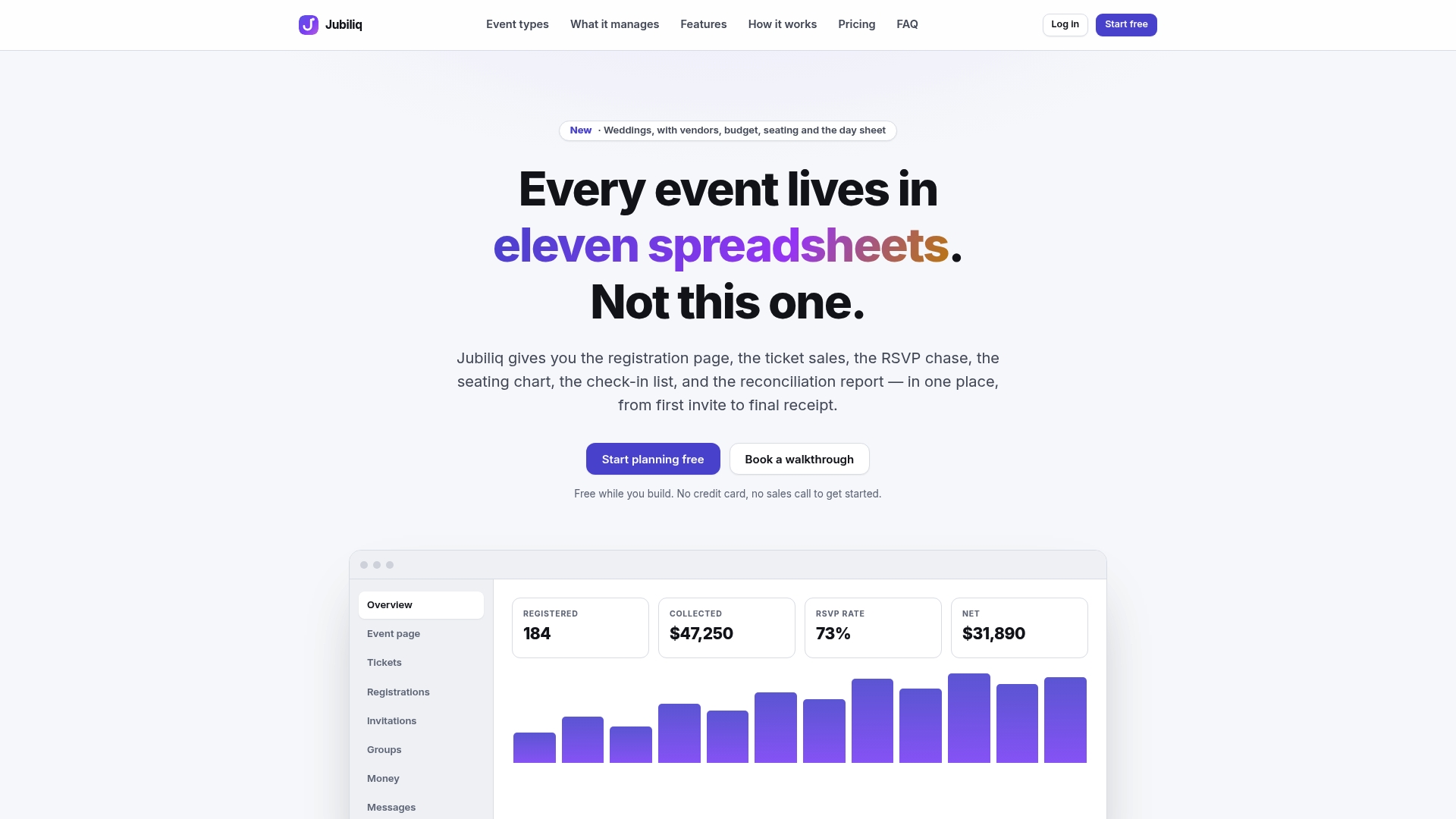
- Track vendor contracts, RSVPs, and budgets against the month-by-month timeline in real time.
- Generate a printable day sheet straight from your finalized run-of-show.
- Handle ticket sales, sponsorships, and donation tracking without a separate payment tool.
Our Starter plan is free for events without paid tickets, including planning-only mode, while the Organizer plan charges 2% per paid registration for galas selling tickets or collecting donations. Enterprise pricing is available on request for organizations running multiple events. See the full breakdown on our plans page and find the fit for your next gala.
FAQ
What are the 7 stages of event planning in order?
Most frameworks describe research, design, planning, coordination, evaluation, and the event itself as core stages, though exact lists vary by source. For a gala specifically, the practical sequence in this guide, from 12-month goal-setting through post-event stewardship, covers the same ground in timeline form.
How long do galas usually last?
Gala programs commonly run between 2 and 4 hours, depending on whether dinner service, a live auction, or entertainment segments are included. Shorter corporate recognition galas may run closer to 2 hours, while fundraising galas with multiple courses and a live auction often extend to 3 or 4 hours.
What should be included in a gala dinner program?
A gala dinner program typically includes registration, a cocktail hour, plated or buffet service, welcome remarks, an awards or recognition segment, a fundraising ask such as a live auction, entertainment, and closing remarks. Sequencing these elements with clear transition times keeps the evening paced and keeps giving energy high during the ask.
What are the 5 stages of event planning?
A common simplified model breaks event planning into research, design, planning, coordination, and evaluation, though organizations describe these stages differently. Applied to a gala, this maps onto setting objectives and budget early, drafting the program and run-of-show, confirming vendors and rehearsals, executing the event, and completing post-event stewardship.
When should I lock the final run-of-show before a gala?
The final run-of-show should be locked two weeks before the event, once vendor contracts, speeches, and award content are confirmed. Locking it later leaves too little time for a full AV rehearsal and volunteer briefing, which are critical for catching timing conflicts before guests arrive.