Raise More in 60–90 Minutes: Virtual Gala Ideas Fundraisers Can Run

Raise More in 60–90 Minutes: Virtual Gala Ideas Fundraisers Can Run
Virtual galas can outperform in-person events on cost-per-dollar-raised when you pick the right format, lock down two or three revenue streams, and run them through a platform with built-in donation tools. Start now: choose a fundraiser-friendly concept over a flashy one, decide whether tickets, auctions, or sponsorships carry the night, and pick a platform that integrates donation flows directly into the stream. Some event platforms handle the planning side of that equation, from RSVPs to budget tracking, so the production side isn’t fighting the logistics side.
TL;DR:
- Virtual galas raise significant funds with proper platform integration for donations, especially when focusing on one or two revenue streams rather than multiple options.
- Silent auctions and peer-hosted house parties consistently generate high revenue with minimal effort and logistics, making them highly effective formats.
- Keeping the program brief, varied, and interactive within 60 to 90 minutes helps maintain attendee engagement and encourages participation in donations.
- Smaller galas under 150 households often succeed with free registration and strong asks, while larger events can charge up to $250 per ticket for better revenue potential.
- Rehearsing with the full team and selecting one impactful interactive element significantly increases the chances of meeting fundraising goals.
Table of Contents
- Virtual Gala Ideas Ranked by Impact and Effort
- Building a Run-of-Show That Doesn’t Lose the Room
- How the Money Actually Moves
- Keeping Attendees Active Instead of Passive
- The Roles and Checklist That Keep the Night From Breaking
- Where Jubiliq Fits the Checklist
- Turning One Night Into a Full Year of Donor Relationships
- What a Realistic Budget Actually Looks Like
- Making Sure Every Donor Can Actually Participate
- Getting the Word Out Before the Night Arrives
- Giving Virtual Attendees a Reason to Show Up in Person Too
- A Practitioner’s Takeaway on What Actually Moves the Needle
- Get Your Next Gala Off the Spreadsheet
- Sources
- FAQ
Virtual Gala Ideas Ranked by Impact and Effort
Not every virtual gala idea deserves equal stage time. Some formats raise real money with a two-person team and a laptop; others need a production crew and a five-figure budget. Here’s how the strongest concepts stack up, ranked loosely from the lowest lift to highest.
- Livestream gala program (medium effort, high revenue potential). A hosted broadcast with a program book, honoree segment, and live ask replicates the traditional gala experience online. Upwardly Global’s 2020 virtual gala program shows how sponsor listings and fireside chats translate cleanly to a digital program book. Sponsor tie-in: a “presented by” segment bumper before each transition.
- Remote dinner or delivery kits (medium effort, medium to high revenue). Ship a curated meal or cocktail kit ahead of the event so guests eat together on camera. Execution tip: cap kit logistics to a single shipping zone unless you have real fulfillment support. Sponsor idea: a local restaurant or beverage brand covers kit cost for a logo placement.
- Silent auction (low effort, high revenue). Mobile bidding platforms make this one of the most reliable formats, and it runs almost entirely on autopilot once items are loaded. This is the format SimplyGiv flags as a strong return for modest setup work.
- Live auction or paddle raise (medium effort, high revenue). Pair a livestream auctioneer with mobile bidding for big-ticket items. Execution tip: rehearse the auctioneer’s camera transitions separately from the tech rehearsal.
- Virtual tasting or cooking class with kits (medium effort, medium revenue). A sommelier or chef leads a live session using ingredients mailed in advance. Sponsor idea: the kit supplier gets a dedicated shout-out and a discount code for attendees.
- Talent show or concert segment (low to medium effort, medium revenue). Board members, alumni, or local musicians perform short sets between fundraising asks.
- Themed costume or decade night (low effort, medium revenue). A costume theme (decades, colors, “black tie optional”) adds shareability without adding cost.
- Peer-hosted house parties (medium effort, high revenue potential). Volunteers host small watch parties in their own homes and solicit gifts from their personal networks, multiplying your reach without multiplying your production budget.
- Virtual tours or mission moments (low effort, medium revenue). A two-minute pre-recorded segment showing your program in action, dropped mid-program right before the ask.
- Gamified donation challenges and leaderboards (low effort, medium to high revenue). Team-based giving competitions with a live leaderboard tap into friendly competition and peer pressure.
- Raffles and prize drawings (low effort, medium revenue). Sell raffle tickets ahead of time and draw winners live on stream for a low-lift revenue boost that requires almost no rehearsal.
Building a Run-of-Show That Doesn’t Lose the Room
A virtual gala program works best at 60 to 90 minutes, broken into short, varied segments rather than long speeches, according to SmartWorks Events. Attention drops fast online, so pace the ask, the entertainment, and the auction close so no single block runs more than 10 minutes.
A 60-minute model:
- Welcome and mission moment video (5 minutes)
- Program host segment with honoree recognition (10 minutes)
- Live ask with real-time donation thermometer (8 minutes)
- Entertainment or talent segment (15 minutes)
- Live auction close and paddle raise (12 minutes)
- Sponsor thank-yous and closing (10 minutes)
A 90 minute model adds a second entertainment block, a breakout networking window for VIP donors, and a longer live auction segment split across two categories.
Pro Tip: Schedule your VIP donor breakout during the entertainment segment, not during the ask. Sponsors get a dedicated small-group moment without ever competing with your biggest fundraising minute.
How the Money Actually Moves
Ticket pricing depends on audience size and format. Smaller galas (under 150 households) often do better with free registration and a strong ask, since a ticket price can suppress reach without adding much net revenue. Larger galas (300+ households) can charge $75 to $250 per ticket and still hit strong attendance, especially when a portion is framed as tax-deductible.
Silent auctions and mobile bidding need one non-negotiable rule: tell bidders to use two devices during the live segment, one to watch the stream and one to bid. Tab-switching on a single phone is the single biggest source of lost bids and frustrated donors during a live close.
Your live-ask script should follow a simple arc: a specific story, a specific number (“$50,000 unlocks X”), a specific action (“text GIVE to…”), and a visible progress update. QR codes on screen, text-to-give shortcodes, and an embedded donation page cut the number of taps between “moved” and “paid.”
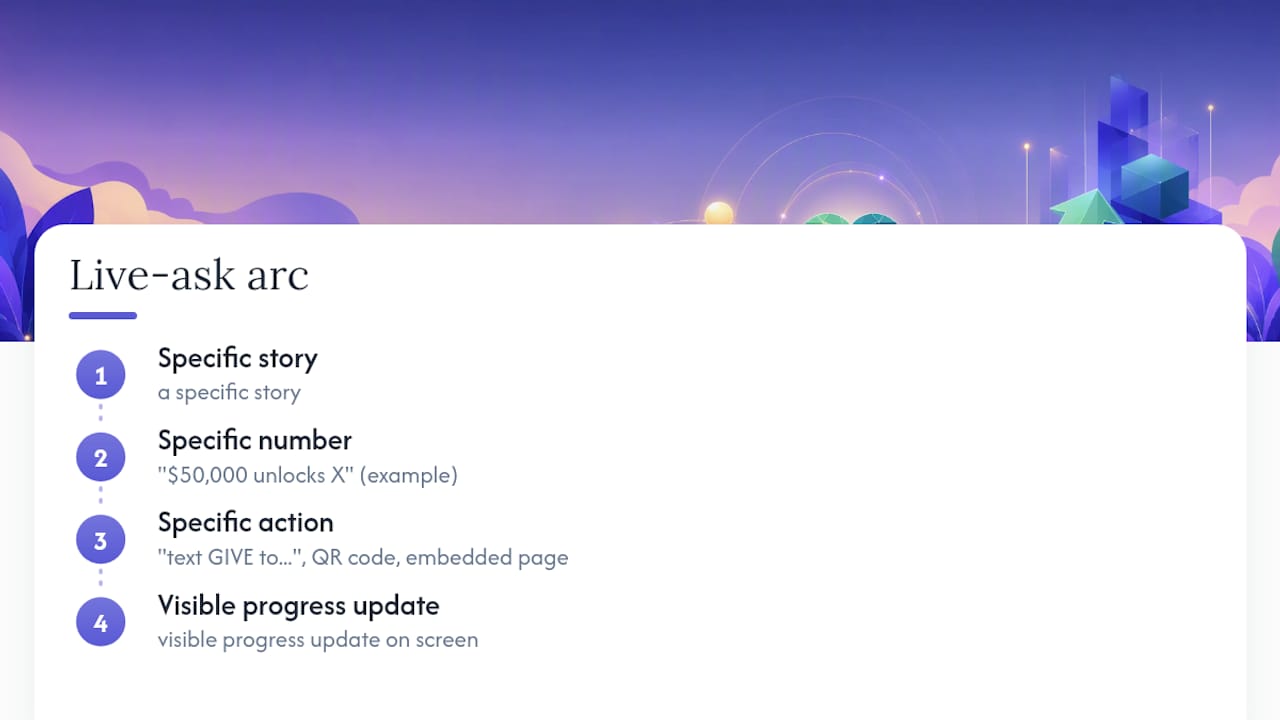
Virtual galas can raise significant money at a fraction of in-person overhead because storytelling, live asks, and auctions are combined with a platform that handles donations without redirecting guests to a separate tab.
Sponsorship packages translate well virtually: a $5,000 tier might include a branded pre-show slide and a mention during the ask, while a $15,000 tier could include a dedicated breakout room, logo placement on kit boxes, and a video message played mid-program.
Keeping Attendees Active Instead of Passive
The gap between a virtual gala that raises real money and one that quietly loses its audience almost always comes down to interaction design, not production budget. Interactive games, live talent, breakout networking, and real-time donation dashboards turn viewers into participants instead of an audience watching a webinar.
Before you pick a platform, confirm it covers:
- Stable streaming with a tested backup connection
- Native or embedded donation integration, not a link that opens a new tab
- Live chat and polling tools
- Breakout room support for VIP or sponsor small-group moments
- Closed captioning for accessibility
Zoom’s breakout room tools work well for sponsor-hosted small-group sessions, and most major streaming platforms now offer a comparable feature. On the production side, a two-camera setup (host wide shot plus a close-up) and a lower-third graphic during every ask keep the donation message visible even for guests half-watching on a second screen. A live poll question (“Where should the matching gift go?”) right before the ask can lift engagement without costing you a production minute.
The Roles and Checklist That Keep the Night From Breaking
A virtual gala needs five roles at minimum: a producer running the show clock, an emcee, a tech lead monitoring feeds and chat, an auctioneer if you’re running a live auction, and a moderator watching donor questions and tech issues in real time.
- Confirm ticketing, kit shipping deadlines, and sponsor asset delivery six weeks out.
- Run one full technical rehearsal with the emcee, producer, tech lead, and auctioneer on the same call to test feeds and donation links, a step SmartWorks Events flags as essential.
- Test your internet redundancy plan, including a backup connection and a secondary streaming device.
- Send reminder emails at one week, one day, and two hours before start time.
If AV setup feels unfamiliar territory for your team, a resource like DJC Engineering’s boardroom AV guidance covers the wiring and redundancy basics that apply just as well to a home studio setup as a corporate boardroom.
Where Jubiliq Fits the Checklist
Every item on that production checklist has a planning counterpart, and that’s where most of the actual organizer hours go. Jubiliq consolidates RSVP and ticketing, budget tracking, vendor and sponsor contracts, and task scheduling into one adaptive interface that hides fields irrelevant to a fundraiser. A printable day sheet covers the run-of-show for your producer and emcee, and real-time updates mean your development director isn’t reconciling three spreadsheets the morning after the ask.
Turning One Night Into a Full Year of Donor Relationships
The gala ends, but the donor relationship shouldn’t. Send a thank-you email within 24 hours that includes a final total raised, a short thank-you video from your honoree, and a specific line about what the money funds.
Segment your outreach by giving level and behavior. First-time donors need a welcome sequence introducing your mission beyond the gala. Auction winners need fulfillment confirmation and a receipt. Lapsed donors who tuned in but didn’t give need a softer follow-up, maybe an invite to a smaller virtual info session rather than another ask.
Pull your chat transcript and poll responses for genuine engagement signals. Someone who answered every poll and stayed for the full 90 minutes is a stronger cultivation prospect than someone who logged in and left after ten. A quick post-event survey, three questions maximum, tells you which segments landed and which ones lost people, data you’ll want before you plan next year’s program.
Set a 90-day stewardship calendar: a personal thank-you call from a board member for major donors within two weeks, an impact update at 60 days, and an early save-the-date for next year’s event at day 90. Donor retention lives or dies in that window far more than in the gala itself.
What a Realistic Budget Actually Looks Like
Virtual galas cost less than in-person events, but “less” doesn’t mean “free.” Budget line items typically include a streaming platform or production service, an auction/bidding tool, kit shipping if you’re using one, honorarium or emcee fees, and marketing spend for promotion.
A modest virtual gala for a few hundred households can incur several thousand dollars in costs, mainly platform fees and shipping if managed internally. Larger productions with professional services and shipped kits may cost significantly more.
Track everything against net revenue, not gross. A gala that brings in $80,000 against $15,000 in costs nets $65,000, a number worth comparing honestly to an in-person event with venue and catering costs that often eat a much larger share of the take. Keep a live budget tracker so your board isn’t surprised by a shipping overage discovered after kits already went out.
Making Sure Every Donor Can Actually Participate
An accessible virtual gala reaches more donors and avoids leaving money on the table. Closed captioning should be non-negotiable, most streaming platforms support it natively now, and it helps hard-of-hearing guests and anyone watching with the sound off in a noisy house.
Screen-reader compatibility matters for your donation page and auction site specifically, since a broken tab order or an image without alt text can quietly block a donor mid-transaction. Test your bidding platform and donation form with a screen reader before the event, not during it.
Consider time zones honestly if your donor base spans regions. A single 7 p.m. Eastern start time might be convenient for your staff and inconvenient for a third of your list. Offering a shortened rebroadcast or an on-demand recording extends your fundraising window for anyone who couldn’t attend live.
Sensory considerations count too: flashing graphics, sudden loud music stings, or rapid scene cuts can be genuinely difficult for some viewers. A calmer visual pace costs nothing and excludes no one.
Getting the Word Out Before the Night Arrives
Promotion for a virtual gala runs on a longer timeline than most organizers expect, ideally starting six to eight weeks before the event. Segment your email list by giving history and send different messages to major donors, past attendees, and cold prospects rather than one generic blast.
Peer-to-peer sharing tends to outperform organizational posting. Give board members and volunteers a simple social media kit, a graphic, a suggested caption, and a personal link, so their networks see a friend’s invitation rather than a nonprofit’s ad. That peer-hosted house party idea covered earlier works double duty here: hosts naturally promote to their own circles as part of hosting.
Text reminders convert better than email alone for final-week nudges. A short text the morning of the event with the link and start time catches people who never opened your emails. Track registration numbers weekly against a target curve, if signups stall three weeks out, that’s your signal to add a second promotional push, not wait and hope.
Giving Virtual Attendees a Reason to Show Up in Person Too
A hybrid element extends your reach without turning the whole event into a logistics project. A donor kit mailed ahead of time, a branded glass, a candle, a small local business gift, gives remote guests something tangible to hold during toasts and auction moments, and it doubles as a subtle sponsor placement if a local business supplies it.

For organizations running any in-person component alongside the virtual stream, a check-in system built for venues, like the tools covered by EntryWatch, keeps arrival and kit pickup organized without a manual sign-in table.
Consider a small satellite gathering option: a handful of watch parties hosted by board members in different cities, each streaming the same program. This captures some of the energy of an in-person gala while keeping your central production simple. Ship auction preview materials or program books to your top donor tier specifically, a printed piece in hand tends to drive higher bids than a PDF attachment ever does.
A Practitioner’s Takeaway on What Actually Moves the Needle
Start with one interactive element done well, a live poll, a donation thermometer, a single breakout room, rather than five features done halfway. Rehearsal time matters more than any single production choice; a program that’s been run through once end to end with the full team beats a more ambitious one that’s never been tested live. Treat your first virtual gala as a fast-iteration experiment: pick one idea from this list, run it this month with a small donor group, and use what you learn before your next big ask.
— HCRF
Get Your Next Gala Off the Spreadsheet
Some event planning platforms are built to handle the planning load a virtual gala creates: RSVPs, sponsor contracts, kit shipping deadlines, and a live budget all in one adaptive workspace instead of five disconnected files.
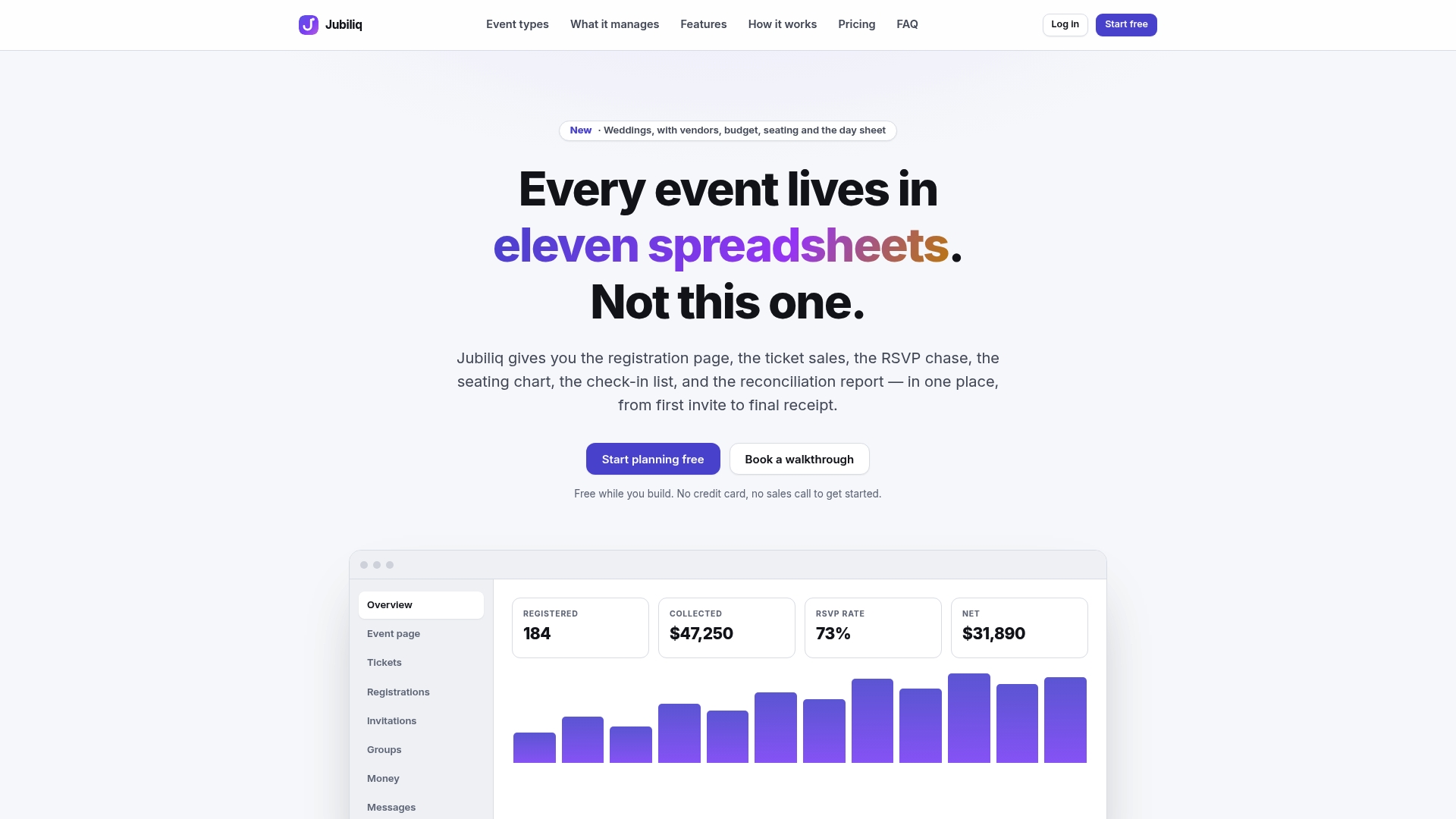
Instead of juggling a ticketing tool, a separate spreadsheet for sponsors, and a shared doc for the run-of-show, some platforms adjust their interface to a fundraiser event and hide unrelated fields. A printable day sheet can give your producer and emcee one page to work from on the actual night, and real-time updates mean you’re not reconciling numbers from memory the morning after. Try building your next event’s planning template and see how much of that checklist runs itself.
Sources
- Virtual Gala Ideas for an Engaging Event - Qgiv
- 20 Creative Fundraising Virtual Event Ideas for Nonprofits in 2026 - SimplyGiv
- How to plan an engaging virtual gala program — Sarah the Auctioneer
FAQ
What are some creative ideas for a virtual party?
Themed costume nights, remote cooking or tasting classes with mailed kits, and gamified team challenges with a live leaderboard all work well for keeping a virtual crowd engaged.
What are some virtual event ideas beyond a standard gala?
Peer-hosted watch parties, livestream talent shows, virtual tours of your program’s work, and raffles with a live drawing all extend a standard gala format into something more interactive.
What makes a virtual charity event or gala idea genuinely unique?
The strongest concepts pair a memorable moment, a live auction close, a surprise talent segment, a mission video, with a frictionless donation flow so the emotional peak converts immediately into a gift.
What is the most profitable fundraising event format?
Silent auctions and simple formats like raffles and money pools tend to deliver strong returns for relatively low setup effort, while live auctions and full gala programs can raise more overall but require more production investment.
How do I host a virtual gala without a big production budget?
Lean on a livestream platform with built-in donation and bidding tools, like the approach Jubiliq supports for planning and day-of logistics, and prioritize one strong interactive segment over five underdeveloped ones.