Corporate Invite Wording: Examples and a Fill-In Template

Corporate Invite Wording: Examples and a Fill-In Template
Good corporate invite wording does three jobs in about 100 words: it tells the guest who is hosting and why they were chosen, gives every logistical detail they need to say yes, and makes replying effortless. Pick a tone that fits your relationship with the guest (formal for executives and galas, casual for team and customer mixers), then add the host, event, date, time, place, dress code and one clear way to RSVP. Everything below shows how, with lines you can adapt.
TL;DR
- Open with the host and an invitational line, then the event name and purpose. Guests decide in seconds whether it is for them.
- Include date, start and end time, full address, attire, and directions or parking. These are the details guests most often have to ask about.
- Give one main RSVP method and a reply-by date. Two options are fine, three get messy.
- Match the call to action to the tone: “Kindly respond” for formal, “Save your spot” for casual.
- Track replies in one place from the first send so reminders go only to people who have not answered.
Table of Contents
- What every corporate invitation needs
- Choose your tone first: formal or casual
- Wording for specific corporate events
- Writing the RSVP line
- Make the wording warm without losing professionalism
- A fill-in template you can use today
- Common mistakes to avoid
- Perspective
- Track replies from the first send
- Run the invitation and the RSVPs in Jubiliq
- FAQ
- Sources
What every corporate invitation needs
Before choosing a single phrase, make sure the invitation carries the facts. UCLA’s Events Office lists the basic elements of a formal invitation: the host’s name, an invitational line such as “requests the pleasure of your company,” the type, name and purpose of the event, the date, the hour, the place, reply instructions, attire, directions and disabled-access information.
Translated into a checklist you can use for a client dinner, a product launch or a company holiday party:
| Element | What to write | Why it matters |
|---|---|---|
| Host | Company name, or a named executive for a personal touch | Tells the guest who is asking |
| Invitational line | “cordially invites you,” “we would be delighted to host you” | Sets the tone |
| Event name and purpose | “Annual Customer Appreciation Dinner” | Guests know what they are committing to |
| Date and time | Day of the week, date, start and end time | Avoids “how long is this?” emails |
| Location | Venue name, street address, parking or transit note | Saves day-of phone calls |
| Attire | “Business casual,” “Black tie optional” | Removes the most common worry |
| Accessibility | Step-free entrance, accessible parking, contact for needs | Makes every guest welcome |
| RSVP | Deadline plus one method | Gives you a headcount to plan from |
| Extras | Plus-one policy, dietary requests, agenda highlights | Cuts follow-up questions |
If your list of guests is small and the event is a plated dinner, add a line asking about dietary needs. Our guide on what to track in a dietary restrictions list shows which questions are worth asking at the RSVP stage.
Choose your tone first: formal or casual
Tone decides every other word. Oakland University’s style guide describes formal invitations as third person, with phrases like “The honor of your presence is requested,” dates and times spelled out, and “Kindly respond by” for the reply. Casual invitations use “You’re Invited” or “Join us,” and first person is fine.
A simple rule: the further the social distance between host and guest, the more formal the wording. A first-time prospect, a board member or a government partner gets formal. Your own team, long-standing customers and a rooftop mixer get casual. If you are unsure, go one step warmer than a legal notice and one step more formal than a text to a friend.
The call to action has to match. A formal invitation that ends with “Grab your spot” feels off, and so does a playful invitation that ends with “Kindly confirm your attendance.”

Formal wording examples
Use these for executive dinners, galas, award ceremonies and anniversary receptions.
- Classic: “[Company Name] requests the pleasure of your company at the [Event Name] on Thursday, March 12, at six o’clock in the evening, [Venue], [Address]. Business attire. Kindly respond by March 2 to [email protected].”
- Reception: “We are pleased to invite you to an evening reception celebrating the opening of our new headquarters.”
- With a guest: “[Company Name] cordially invites you and a guest to a dinner in honor of [Honoree].”
- Subject line for email: “You Are Invited: Leadership Breakfast on May 14.” These two example lines come from a formal versus casual email comparison.
Notice the pattern: host first, verb of invitation, event, date, place, attire, reply.
Casual wording examples
Use these for team events, customer meetups, launch parties and open houses.
- Direct: “Join us for our spring launch event on Thursday, April 16, 5:30 to 8:00 p.m. at [Venue]. Drinks and food on us. Save your spot by April 9.”
- Warm: “We’re opening our new space, and we’d love for you to join us.”
- Soft close: “Hope to see you there. Let us know if you can make it.”
- Subject line: “Join us for our spring launch event.”
Casual does not mean vague. Keep the date, time, place and reply deadline in every version.
Wording for specific corporate events
The same skeleton flexes for different occasions. Change the invitational line, the purpose sentence and one or two details.
Business dinner
“[Executive Name] and [Company] would be delighted to host you for dinner on [Date] at [Restaurant], [Address]. Cocktails begin at 6:30 p.m., with dinner at 7:00. Business attire. Please let us know by [Date] if you will join us, and tell us about any dietary needs when you reply.”
A dinner has a fixed headcount, so the reply-by date should be earlier than for a reception, and the dietary request belongs in the invitation. If you are deciding between service styles, see plated versus buffet.
Cocktail reception
“Please join us for cocktails and conversation to celebrate [Occasion]. [Day], [Date], 5:30 to 7:30 p.m., [Venue], [Address]. Light bites and drinks provided. Business casual. RSVP by [Date].”
Give an end time. For a standing reception it tells guests they can drop in after work and leave when they like, which raises acceptance.
Client appreciation or VIP event
“You have been a valued partner this year, and we would like to say thank you in person. Please be our guest at [Event], [Date], [Venue]. A reserved seat is waiting for you. Kindly reply to [Name] at [email] by [Date].”
Personal names, a named contact and “reserved seat” language signal that the invitation is not a mass mailing. For a deeper approach, see our VIP guest management playbook.
Company holiday party or offsite
“Our annual holiday party is on [Date] at [Venue]. Food and drinks are on us, and you bring the festive cheer. Partners and guests are welcome: please include their name when you RSVP. Reply by [Date].”
If the event includes travel or an overnight stay, add the logistics in the invitation itself. Ideas for planning a corporate retreat in a destination city show how much a guest needs to know about venue and activities before they commit.
Fundraising gala or ticketed event
“Join us for our annual gala supporting [Cause]. Reception at 6:00 p.m., dinner and program at 7:00. Black tie optional. Tickets are $[amount] and tables of ten are available. Reserve yours at [link] by [Date].”
When guests pay, the “reply” becomes a purchase, so the link must go straight to registration, not to a general page.
Writing the RSVP line
The RSVP line is the part most invitations get wrong. It should answer four questions: reply by when, by what method, with what information, and what happens if I do not.
Copy-ready lines in the same spirit as common RSVP wording guides:
- “Please RSVP to [email protected] by April 10.”
- “RSVP by Friday, April 10, by replying YES to this message.”
- “Seats are limited. Register by April 10 to confirm your spot.”
- “Plus ones are welcome. Please include your guest’s name when you RSVP.”
That guide’s one rule is worth keeping: choose one main RSVP method. Two options are acceptable, but three produce a messy inbox and a headcount nobody trusts.
Set the deadline with your caterer or venue in mind, not your own comfort. Many venues want a final headcount well before the event, so build the reply-by date backward from that.
Reconfirm and remind
The Gates Foundation’s guidance on sending effective invitations recommends delivering invitations through existing relationships where possible, mixing in-person, phone, email and hard-copy invitations, and asking invitees to reconfirm 24 to 48 hours before the event even if they already accepted. For a client dinner, that can be a personal note from the account owner after the formal invitation.
For non-responders, a short sequence works better than one nudge. We lay out six templates in RSVP reminder emails to send 7 to 14 and 3 to 5 days out.

Make the wording warm without losing professionalism
The same Gates Foundation guidance suggests a catchy subject line, a personal, direct and warm opening, key words in bold or italics, headlines to divide the invitation, and a closing with name, job title, company and signature. Applied to corporate wording:
- Lead with the benefit or occasion in the subject line. “You’re invited: Customer Appreciation Dinner, May 14” beats “Event Invitation.”
- Use the guest’s name. “Dear Maria” earns more attention than “Dear Valued Customer.”
- Be warm in one sentence, then be exact. “We would love to see you there” is enough. The details do the rest.
- Keep catchy phrases short and specific. “An evening of food, music and good company” works. Puns and exclamation marks stack up quickly and weaken a formal invitation.
- Close with a person. A name, title and direct email feel more trustworthy than “The Events Team.”
A rule of thumb: one playful phrase per invitation at most, and none if the guest list includes people you have never met.
A fill-in template you can use today
Copy this, replace the brackets, then delete any line that does not apply.
Subject: You are invited: [Event Name] on [Month Day]
Dear [First Name],
[Company Name] would be delighted to welcome you to [Event Name], [one sentence on the purpose].
When: [Day], [Month Day], [Start] to [End] Where: [Venue], [Street Address, City]. [Parking or transit note.] Attire: [Business casual / Business formal / Black tie optional] Accessibility: [Step-free entrance and accessible parking are available. Contact [Name] for any needs.]
Please RSVP by [Date] at [link or email]. [Plus ones are welcome: include your guest’s name.] [Tell us about any dietary needs when you reply.]
We hope you can join us.
[Name], [Title], [Company]
Keep it to one screen. If it needs scrolling on a phone, move extra detail (agenda, speaker bios, hotel blocks) to an event page and link to it.
Common mistakes to avoid
- Missing end time. Guests cannot plan the evening without it.
- No attire guidance. It is the most frequently asked question.
- A reply-by date with no reason. “So we can finalize catering” gives guests a reason to answer on time.
- Mixed tone. A formal opening with a slangy close reads as careless.
- Replies scattered across email, text and voicemail. You cannot send an accurate headcount to a caterer from five inboxes.
- Forgetting the plus-one rule. State it plainly either way.
Our broader guide to event invitation wording for every occasion has more examples for weddings, parties and fundraisers if your calendar includes more than corporate events.
Perspective
Most invitation problems are not wording problems. The sentence is fine, but the replies come back to three places, the guest list lives in a spreadsheet, and the reminder goes to people who already answered.
We build Jubiliq around the idea that the invitation is the first step of the whole event, not a separate task. The planning interface adapts to the event type, so a corporate dinner shows the tools a corporate dinner needs, such as RSVP tracking, seating, catering, vendors and a printable day sheet, and hides the ones it does not. When wording, replies, budget and day-of details sit in one place, a headcount is a number you can read, not one you assemble.
Write the invitation carefully. Then give the answers somewhere to land.
HCRF
Track replies from the first send
Wording gets the yes. A system keeps it. For corporate events that matters more as lists grow: past about 20 guests, a spreadsheet and an inbox start to disagree. We cover the habits that hold up in RSVP tracking organizers can rely on and in a guest communication plan that keeps invitations, reminders and updates in sync.
Run the invitation and the RSVPs in Jubiliq
Jubiliq is an event planning platform for corporate events, galas, fundraisers, golf outings, weddings and large parties. It handles guest lists with RSVP tracking, segmented email blasts, budgeting, vendor management, task scheduling, seating and catering workflows, and a printable day sheet. You can publish an event website or stay in planning-only mode.
Pricing follows the event. The Starter plan is $0 per event, and events without paid tickets, such as company dinners and planning-only events, are free. The Organizer plan charges 2% per paid registration plus Stripe fees for ticketed events and sponsorships. Enterprise is available for organizations running multiple events, with custom pricing.
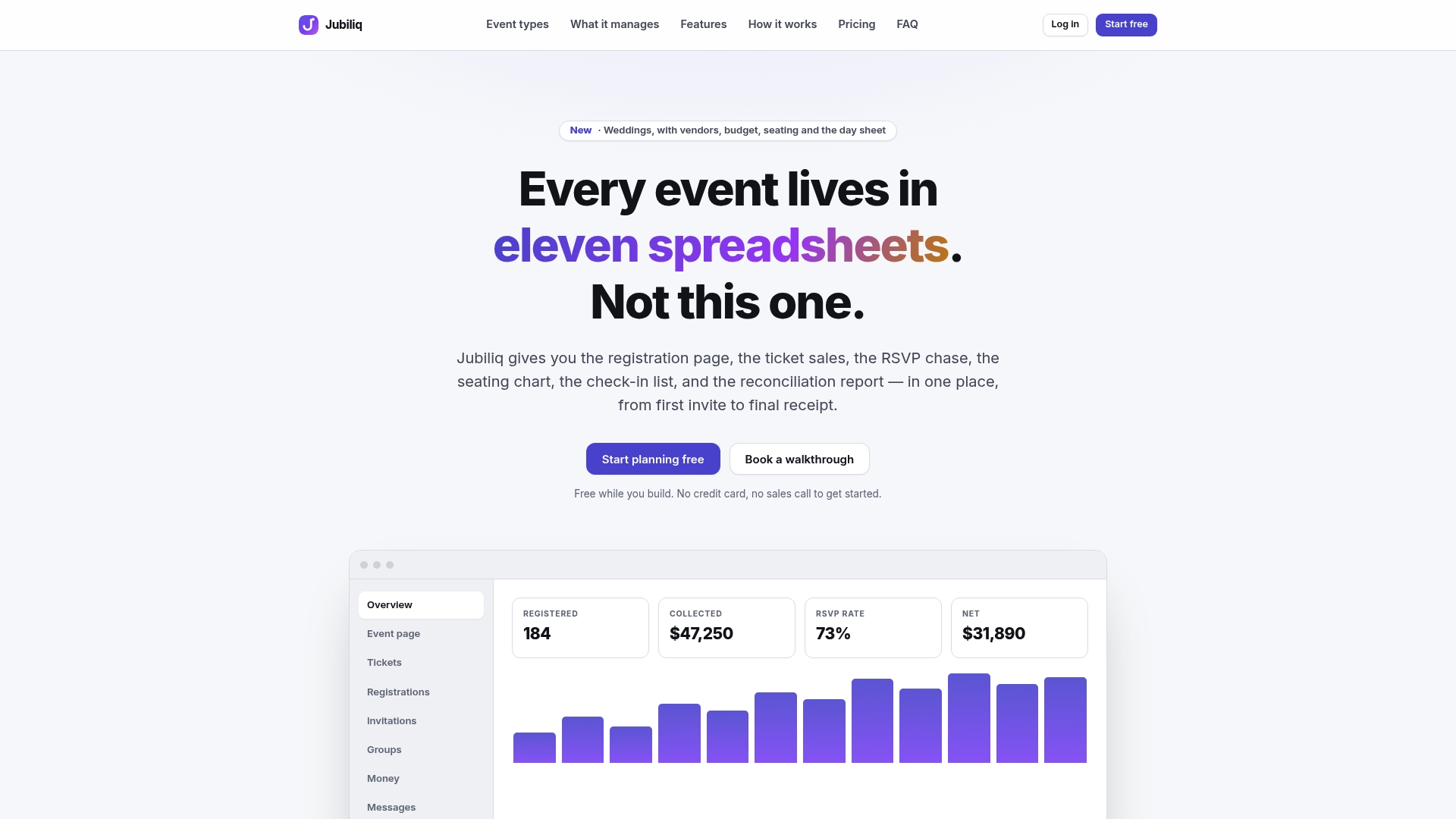
Send your next invitation and see every reply in one dashboard at jubiliq.com.
FAQ
What do you write on a corporate event invitation?
Write the host, an invitational line, the event name and purpose, date, start and end time, address, attire and a reply instruction with a deadline. Add accessibility information and parking or transit directions. Keep the tone consistent from subject line to sign-off.
How formal should corporate invitation wording be?
Follow the relationship. Use third-person phrases like “requests the pleasure of your company” for executives, galas and first-time guests. Use “Join us” and first person for teams and established customers. Match the RSVP line to the tone you chose.
How far ahead should I send a corporate invitation?
Send early enough that guests can clear their calendars and you can meet your venue or caterer’s headcount deadline, then work backward from that date to set your reply-by date. Larger, formal or travel-dependent events need more lead time than a casual after-work mixer. A short reminder sequence and a reconfirmation 24 to 48 hours before the event help close the gap.
How do I word an RSVP request?
Name one method and one date: “Please RSVP to [email protected] by April 10.” Add what to include, such as a guest’s name or dietary needs. For a formal tone use “Kindly respond by,” and for a casual one “Let us know if you can make it.”
Sources
- Review the Basic Elements of an Invitation, Reply Card and Map Insert, UCLA Events Office
- Invitation Style Guide, Oakland University
- Sending Effective Invitations, Bill & Melinda Gates Foundation
- Event invitation RSVP wording guide
- Plan an engaging corporate retreat in Colorado Springs