How to Collect Donations at Events: A Practical Plan

How to Collect Donations at Events: A Practical Plan
The way to collect donations at an event is to decide before the day how guests will give, make every option take under a minute, and record each gift in one place as it happens. Do that and the money, the donor details and the receipts all line up afterward. Jubiliq is built for this: donation handling, ticket and sponsorship sales, RSVPs and a printable day sheet live in one planning workspace, and events without paid tickets are free to run.
This guide covers gala hosts, golf outing organizers, corporate teams with a cause, and anyone adding a giving moment to a wedding or large party. It follows the order you will actually work in: goal, methods, event-day setup, tracking and receipts.
TL;DR
- Set a dollar goal and a single clear ask first. Guests give more easily when they know what the money does.
- Offer more than one way to give: online form or QR code, card, and a live appeal. Keep cash and checks for guests who prefer them.
- Match the method to the event: a paddle raise at a gala, a donation add-on at ticket checkout for a golf outing, a simple QR code at a party.
- Record every gift against a guest name on the day, so receipts and thank-yous take hours, not weeks.
- U.S. nonprofits owe written acknowledgments for gifts over $250, and for payments over $75 when the donor receives something in return.
Table of Contents
- Start with a goal and one clear ask
- Choose how guests can give
- Match the method to the event
- Set up the event day
- Track every gift as it comes in
- Receipts, thank-yous and the U.S. tax rules
- Measure the result and keep what worked
- Collect donations with Jubiliq
- Our view: giving should be part of the plan, not an add-on
- FAQ
- Sources
Start with a goal and one clear ask
Before choosing a payment tool, decide what you are raising and why. A gala guide from Alex’s Lemonade Stand Foundation recommends setting a fundraising goal with SMART targets, building a budget and recruiting a committee with defined responsibilities. SMART means specific, measurable, achievable, relevant and time-bound. In practice that is a sentence like “$15,000 by the end of the night, to fund 30 youth league scholarships.”
Three numbers make the goal usable:
- Total target, net of costs. A $20,000 gross goal with $8,000 in expenses is a $12,000 event.
- Ticket and sponsorship revenue you expect before the night.
- The gap you need guests to close with gifts on the day.
The gap is your donation ask. Divide it by a realistic number of givers. If you need $6,000 and expect 60 of 120 guests to give, the average gift is $100. Use that to set suggested amounts, such as $50, $100, $250 and a custom field.
The same logic works for smaller occasions. A bride who wants guests to contribute to a honeymoon fund or a charity in lieu of gifts, or a corporate team that wants to raise money for a client’s chosen charity, needs the same three things: a number, a reason and a simple way to give. Our fundraiser planning checklist turns the goal into a timeline running to the day sheet.

Choose how guests can give
People differ in how they like to pay, so give them several routes. A Manitoba government guide to special-event fundraising stresses offering multiple ways to give rather than relying on one channel. Here are the methods that work at most events.
| Method | Best for | What to plan |
|---|---|---|
| Donation added at registration or ticket checkout | Galas, golf outings, corporate events | Suggested amounts and a custom field on the registration form |
| Online donation page reached by QR code | Every event type | Codes on tables, screens and signs, with one line on the cause |
| Card payment on a device or laptop | Galas, auctions, large parties | Reliable internet and a volunteer assigned to the station |
| Live appeal (raise the paddle) | Galas, dinners | A speaker, a story and a tally on screen |
| Cash and checks | Older donors, small parties | A locked box, a sign-in sheet and two people to count |
| Sponsorship | Corporate and golf events | Tiers with clear benefits, sold ahead of the event |
A few notes on getting these right.
Ask at registration. The easiest donation is the one made while a guest is already paying for a ticket. Jubiliq handles ticket and sponsorship sales and donations in the same flow, so a guest can add a gift as they register and you do not need a second system.
Make the QR code do one job. The code should open a donation page, not your home page. Put it where guests wait: at the bar, at each table, on the slides during the program. Add a short line about what a gift achieves.
Keep traditional options. Not every guest uses a phone to give. Cash and checks still matter to some donors, and keeping them alongside cards means nobody is turned away. Just give them a process, covered below.
Match the method to the event
Fundraising galas
Galas are where layered giving pays off. The Alex’s Lemonade Stand Foundation guide suggests opening the silent auction online a few days before the event and holding a raise-the-paddle appeal after the live auction. Early online bidding builds momentum, and the paddle raise captures direct gifts when the room is most engaged.

Separate the three streams in your records: ticket sales, auction purchases and straight donations. They are treated differently for tax purposes, as explained below. Auction items with broad appeal, such as luxury vacation packages for auctions, tend to be the lots people bid on at the top of the room. For the close of the auction, see our silent auction checkout steps, and for the order of the evening, the gala program timeline. The full arc, from goal to thank-you, is in our gala planning guide.
Golf outings
Golf events earn from several places at once: entry fees, hole sponsorships, mulligans, raffles and a dinner. Put the donation option in the registration form so every golfer sees it, and sell sponsor tiers before the event, not at the first tee. Lock the fundraising goal early; our golf tournament planning playbook walks through that sequence.
Corporate events
Corporate teams hosting client events often add a giving element: a charity partner, a matching pledge or a donation in each guest’s name. Keep the ask light. A single QR code on the table and a short mention from a senior host is usually enough, and registration data tells you who attended so the follow-up goes to the right people.
Weddings and large parties
A wedding or party is the simplest case. If you want guests to donate to a cause instead of buying gifts, put the link on the event website and print the QR code on the program or table cards. Because these events have no paid tickets, you can plan them in Jubiliq without a fee.
Set up the event day
The collection system fails on the day for ordinary reasons: no connection, no volunteer, no plan for a rush at the end. Work through these before doors open.
Assign owners. Every giving station needs one named person. The Manitoba guide advises planning for event scale, venue permissions, accessibility, volunteers and contingencies. Put names and times in the run of show, and print it on the day sheet.
Protect card details. The Community Foundation of the Ozarks recommends that event card donations be taken on laptops with wireless internet so volunteers never handle donors’ card details. Guests enter their own card on a secure page, and volunteers only guide them.
Capture guest details in advance. A SHRM Foundation fundraising resource guide recommends pre-registration and collecting guest contact details. When every guest is already in your list with an email address, each gift attaches to a known person. Jubiliq’s RSVP and guest list tools hold those details from the first invitation.
Test everything. Check Wi-Fi in the room where donors will actually stand, charge devices, and keep a paper backup: pledge cards, a cash box and a sign-in sheet. If the connection drops, the paper process keeps the evening going and someone enters the gifts later.
Make it accessible. Place stations where wheelchair users can reach them, use large print on signs, and offer a person who can help guests who do not use phones.
Handle cash properly. Keep it locked and never unattended. The UK Fundraising Regulator’s 2025 code, written for UK charities but a sound model anywhere, says cash should be kept secure until banked and, where possible, counted by two unrelated people, with banked totals checked against the income record. Count at the venue, sign the tally together and bank the next business day.
Track every gift as it comes in
The goal of tracking is simple: at the end of the night, you can say who gave what, by which method, and the totals match your bank and card reports. A workable system has four parts.
- One master list. Guests, ticket buyers, sponsors and donors in one record, not four spreadsheets.
- A gift log for offline money. Cash, checks and pledge cards entered by name and amount, initialed by the person who took them.
- A live total. A dashboard you can check mid-event, so the emcee knows how close you are to the goal.
- An export. A CSV you can hand to your accountant or load into your bookkeeping.
Jubiliq’s real-time progress dashboards and CSV export for accounts cover the last two. For the full method, including what to log and when to reconcile, see our donation tracking system for events.
Reconcile within a few days. Compare your gift log with the card processor’s report and the bank deposit. Any gap is easier to explain when volunteers still remember the night.
Receipts, thank-yous and the U.S. tax rules
Donors expect a thank-you, and U.S. donors who itemize need documentation. This section applies to U.S. 501©(3) organizations; rules elsewhere differ.
A January 2026 summary from Keiter CPA states that 501©(3) organizations must provide written acknowledgments for contributions over $250 and disclose the fair-market value of goods or services. The threshold is $75 when the donor receives goods or services in connection with the payment. State charitable-solicitation rules also apply, so check your state’s registration requirements before you ask for money.
That second threshold is what catches event organizers. A $150 gala ticket that includes a $60 dinner is a partly deductible payment, and the receipt should show the $60 value. The Community Foundation of the Ozarks explains that ticket and golf-entry payments may be only partly deductible when attendees receive meals, green fees or merchandise. The same page says raffle and 50/50 payments are not deductible, and auction payments may be deductible only above the item’s assigned value.
A quick reference:
| Payment | Typical treatment |
|---|---|
| Straight donation, no benefit | Fully deductible; written acknowledgment if over $250 |
| Gala ticket with dinner | Deductible portion is the amount above the dinner’s fair-market value |
| Golf entry with green fees and meal | Same: subtract the value of what the golfer receives |
| Auction item | Deductible only above the item’s assigned value |
| Raffle or 50/50 ticket | Not deductible |
This is general information, not tax advice. For your organization’s specific situation, confirm the wording with your accountant or tax adviser. Our guide to the $250 rule and donation receipts shows what an acknowledgment should contain.
Send thank-yous within a week while the evening is fresh. A personal note to your largest donors and a short group message to everyone else work better than a delayed form letter. Segmented email blasts make that easy: one message for donors, another for sponsors, another for attendees who did not give.
Measure the result and keep what worked
After the event, review a short list of numbers: gross and net revenue against your goal, attendance, average gift, number of first-time donors, sponsor revenue, and which giving method brought in the most. Write down two things to repeat and two to change. Next year’s committee will thank you, and your next goal will be based on real figures instead of guesses.
Collect donations with Jubiliq
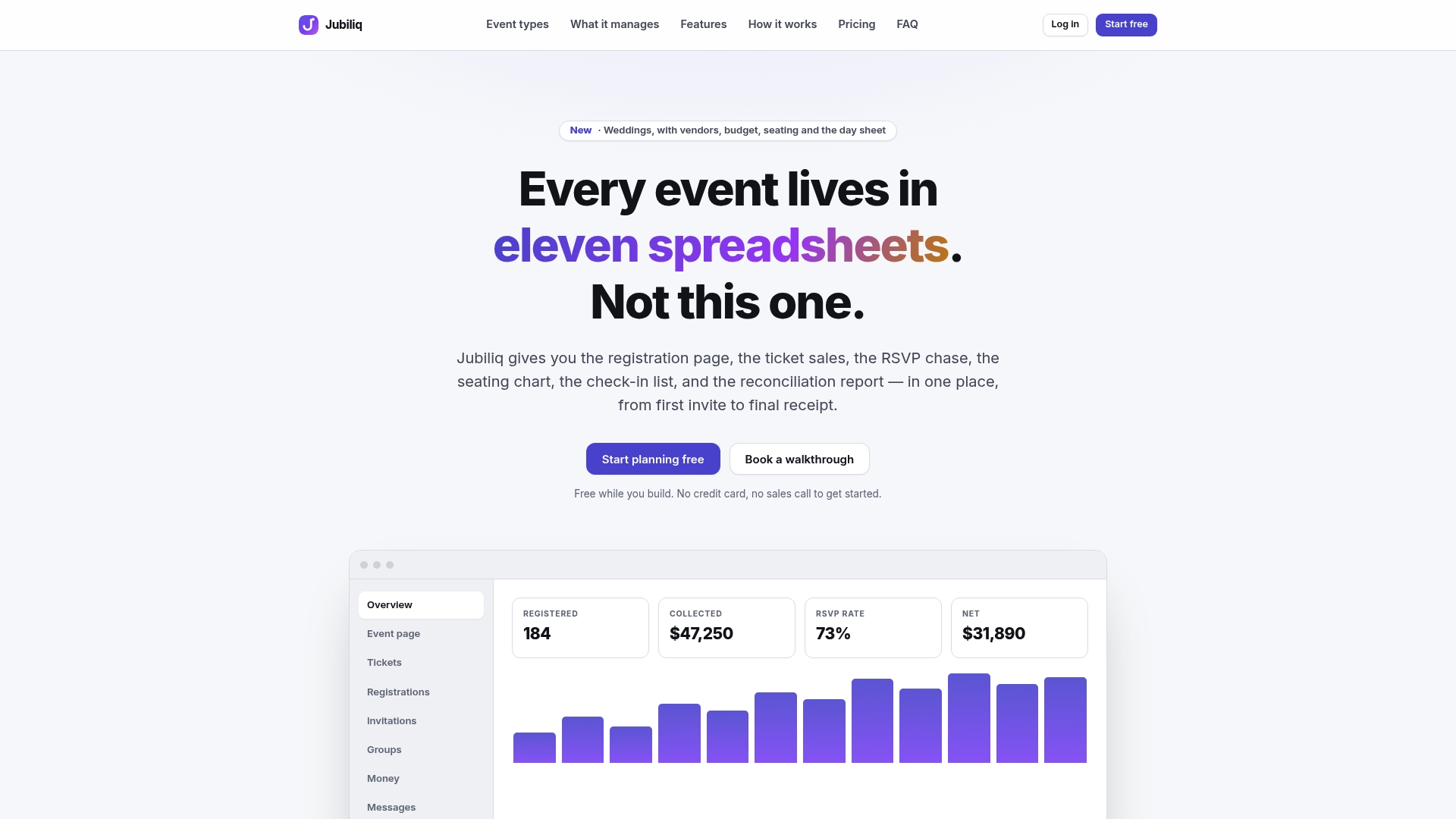
If you are running a gala, golf outing, corporate event or party, Jubiliq gives you one place for the whole job: guest lists and RSVP tracking, ticket and sponsorship sales, donation handling, vendor and task management, real-time dashboards and a printable day sheet. The interface adapts to your event type and hides tools you do not need.
Pricing is simple. The Starter plan is $0 per event, and events without paid tickets, such as weddings, parties and planning-only events, are free. The Organizer plan charges 2% per paid registration, plus Stripe fees. Enterprise is custom for organizations running many events. You can see the plans on Jubiliq’s pricing and plans page.
Our view: giving should be part of the plan, not an add-on
Most event giving goes wrong because it is bolted on at the end: a QR code is printed the week before, a spreadsheet is started at the door, and receipts are rebuilt from memory a month later.
We built Jubiliq on the opposite idea. The guest list, the budget, the vendors, the ticket sales and the donations should sit in one place, and the interface should show you only what your kind of event needs. A wedding planner does not need sponsorship tiers. A golf tournament host does.
When every registration, sponsorship and gift is recorded where the rest of the plan lives, you can see progress in real time, print one day sheet for your volunteers and export clean records for your accounts afterward. That is how we think organizers should work: fewer tools, fewer handoffs, and more attention on the guests in front of them.
HCRF
FAQ
What is the easiest way to collect donations at an event?
Add a donation option to your registration or ticket form and put a QR code to the same page on tables and slides. Guests give on their own phones in under a minute, and every gift is recorded against their name. Keep a cash box for guests who prefer it.
Do I need to give donors a receipt?
If you are a U.S. 501©(3), you must give a written acknowledgment for contributions over $250, and for payments over $75 when the donor receives goods or services. The acknowledgment should state the value of what they received. Ask your accountant to confirm the wording for your organization.
Are gala tickets and raffle entries tax deductible?
Only part of a gala ticket is usually deductible: the amount above the value of the meal and other benefits. Raffle and 50/50 payments are not deductible, and auction purchases are deductible only above the item’s assigned value. Your receipts should reflect this.
How should we handle cash donations?
Keep cash locked, never leave it unattended, and have two unrelated people count and record it together. Bank it promptly and check the deposit against your gift log. Pair this with a sign-in sheet so each cash gift is tied to a donor name.
Can a wedding or private party collect donations?
Yes. Put a donation link on the event website, print a QR code on programs or table cards, and tell guests where the money goes. Weddings and parties without paid tickets can be planned in Jubiliq at no cost.
Sources
- Alex’s Lemonade Stand Foundation: Holding a Gala/Cocktail Event
- Manitoba government: Guide to Special Events Fundraising
- Community Foundation of the Ozarks: Fundraiser Resources
- SHRM Foundation: GiveSmart Resource Guide, 2025 update
- Fundraising Regulator: Code of Fundraising Practice, 2025
- Keiter CPA: Nonprofit Event Fundraising and Tax Exempt Recordkeeping
- Elite Travel: Luxury Charity Vacation Packages for Auctions