Donation Tracking for Events: A Practical System

Donation Tracking for Events: A Practical System
Donation tracking means recording every gift the moment it happens: who gave, how much, how it arrived, what it was meant for, and whether the donor has been thanked. At an event, that record has to cover cash in a basket, cards at a table, checks in an envelope, pledges shouted from a stage and a case of wine delivered to the back door. This guide gives you a system that handles all of them, from the fields you need to the reconciliation you finish a week later.
TL;DR
- Record each gift at the time you receive it, with donor, amount, date, source and intended use. Standardize the fields so every gift type looks the same.
- Treat cash, online gifts, pledges and in-kind gifts as separate categories. Reconcile each one on its own.
- Keep gross donations separate from processing fees, and match your records to bank and processor statements after the event.
- In the U.S., send a written acknowledgment for any single gift of $250 or more, and thank every donor quickly.
- A spreadsheet works for a small event. Once gifts come from many channels, a platform that connects registration, payments and reporting saves hours.
Table of Contents
- Why tracking matters more at an event
- What to record for every donation
- Tracking each type of gift
- Spreadsheet or software?
- Where Jubiliq fits
- Reconciling after the event
- Receipts and acknowledgments
- A tracking plan you can set up in a week
- Our perspective
- Frequently asked questions
- Sources
Why tracking matters more at an event
A fundraising event compresses a year of giving into a few hours. Dozens of volunteers touch money, guests pay through different channels, and nobody has time to write things down properly. That is exactly when records go wrong.
The Association of Fundraising Professionals treats gift tracking as an internal-control and stewardship process: clear ownership, standardized entry and timely acknowledgment make administration smoother and donor relationships stronger. Good tracking also tells you something strategic. When you record gifts by campaign, appeal or source, you learn which asks actually worked: the paddle raise, the table sponsorships, the online page, or the raffle.
The cost of sloppy records is practical. Missing cash, receipts that do not match what the donor gave, and a treasurer who cannot explain the difference between ticket revenue and donations all start with a gift that was never written down. Organizations that handle this well usually have the clearest routine, not the biggest budget.

What to record for every donation
The AFP policy guide is specific about the basics: enter gifts promptly and accurately into your donor database and accounting system, record the intended use (unrestricted or restricted), record the gift source, and produce a daily gift report. It also says to standardize entry across gifts, pledges and in-kind gifts.
For an event, turn that into a short field list:
| Field | Why it matters |
|---|---|
| Donor name and contact | Needed for receipts, thank-yous and follow-up |
| Amount and date | The core of the record |
| Payment method | Cash, check, card, online, pledge or in-kind |
| Source | Ticket, table sponsorship, paddle raise, online page, raffle, direct gift |
| Intended use | Unrestricted, or a named program or fund |
| Goods or services received | Required to word a tax receipt correctly |
| Receipt or thank-you sent | Tells you who still needs follow-up |
| Recorded by | Gives each entry an owner |
The source field deserves extra care. A $200 guest ticket is not the same as a $200 gift. If a guest pays $150 for a dinner and adds $50 on top, you have two things to track. Keep ticket sales, sponsorships and pure donations in separate columns or categories from the start, and your reports will not need to be untangled later.
Tracking each type of gift
Cash
Cash is the hardest to protect, because it has no automatic trail. The UK Fundraising Regulator’s Code of Fundraising Practice, effective 1 November 2025, sets out cash procedures covering counting, recording and banking without delay. It says unsecured cash must not be left unattended, cash should be secured until banked, and counting and recording should be done by two unrelated people where possible. That is a UK rule, but it is a sound standard for any organization, wherever it operates.
A workable routine:
- Give each cash station a numbered bag or box and a named volunteer.
- Count at the end of the night with two people, neither of whom is related to the other, and sign the count sheet together.
- Enter each station’s total in your system the same night, split by category: general donations, tickets, raffle, merchandise.
- Deposit as soon as possible. If the bank is closed, lock the cash in a safe with restricted access.
Card and online gifts
These are the easiest to track because the processor creates a record for you. The risk is the opposite one: the gift exists in a payment dashboard but not in your donor records, or the other way around. Pick one place where every gift lands. If you use an event platform, online ticket purchases, donations and sponsorships should write to the same guest or donor record automatically.
Keep the gross amount and the processing fee as two separate numbers. Your accountant will want to see what donors gave, not just what reached the bank.
Checks
Log each check when it arrives: payer, check number, amount, and what it is for. Checks often come in after the event, with a note saying “for the gala” and no more detail. Record the date received, not the date on the check, and ask the donor about intended use if it is unclear.
Pledges
A pledge made from the stage is a promise, not money. Document it at the moment it is made: donor, amount, payment date, and any conditions. Accounting guidance generally treats an unconditional pledge as a receivable, while a conditional pledge has to stay on a watch list until its condition is met. Ask your accountant how to book each type, since the treatment depends on your organization’s accounting rules.
Track pledges in their own status column (promised, invoiced, paid) so you can see what is still outstanding in the weeks after the event. Pledge follow-up is where many organizations quietly lose money.
In-kind gifts and donated services
When someone donates goods, record a detailed description, the quantity, the fair market value, the donor’s details and how the item will be used. Flag these as a distinct gift type so they do not inflate your cash totals. A donated auction package is worth tracking, but it is not cash in the bank.
For donated services, the Foundation for Public Opinion and Community Finance guidance on contributions says to record the date, the activity, the volunteer hours and the programs or activities supported, for services that qualify.
One point trips up many first-time organizers: a receipt for an in-kind gift should describe the item, but the charity does not assign it a dollar value. The donor determines value for their own tax filing. Our guide to donation receipts for U.S. nonprofits and donors covers the wording in more detail.
Spreadsheet or software?
You can start with a simple ledger. A basic version needs these columns: date, donor name, amount and type, purpose, and receipt sent (yes or no). For a small dinner or a first golf outing, that is enough, as long as one person owns it and every volunteer reports to that person.
A spreadsheet starts to strain when:
- Gifts arrive through several channels at once (ticket page, donation form, cash, checks, auction checkout).
- Several volunteers need to enter data at the same time.
- You need to send acknowledgments quickly, in bulk, with the correct wording.
- You want to compare this year’s event to last year’s by source.
At that point, the extra work of copying between tools causes more errors than it prevents. The better setup is a single system in which registration, payments, sponsorships and donations share one record.
Where Jubiliq fits
Jubiliq is an event planning platform, and donation handling is one of its features, alongside ticket and sponsorship sales, guest lists with RSVP tracking, budgeting, vendor management and a printable day sheet. For a fundraiser, that means the people who bought tickets, the sponsors who signed up and the donors who gave online sit in the same place as your task list and budget.
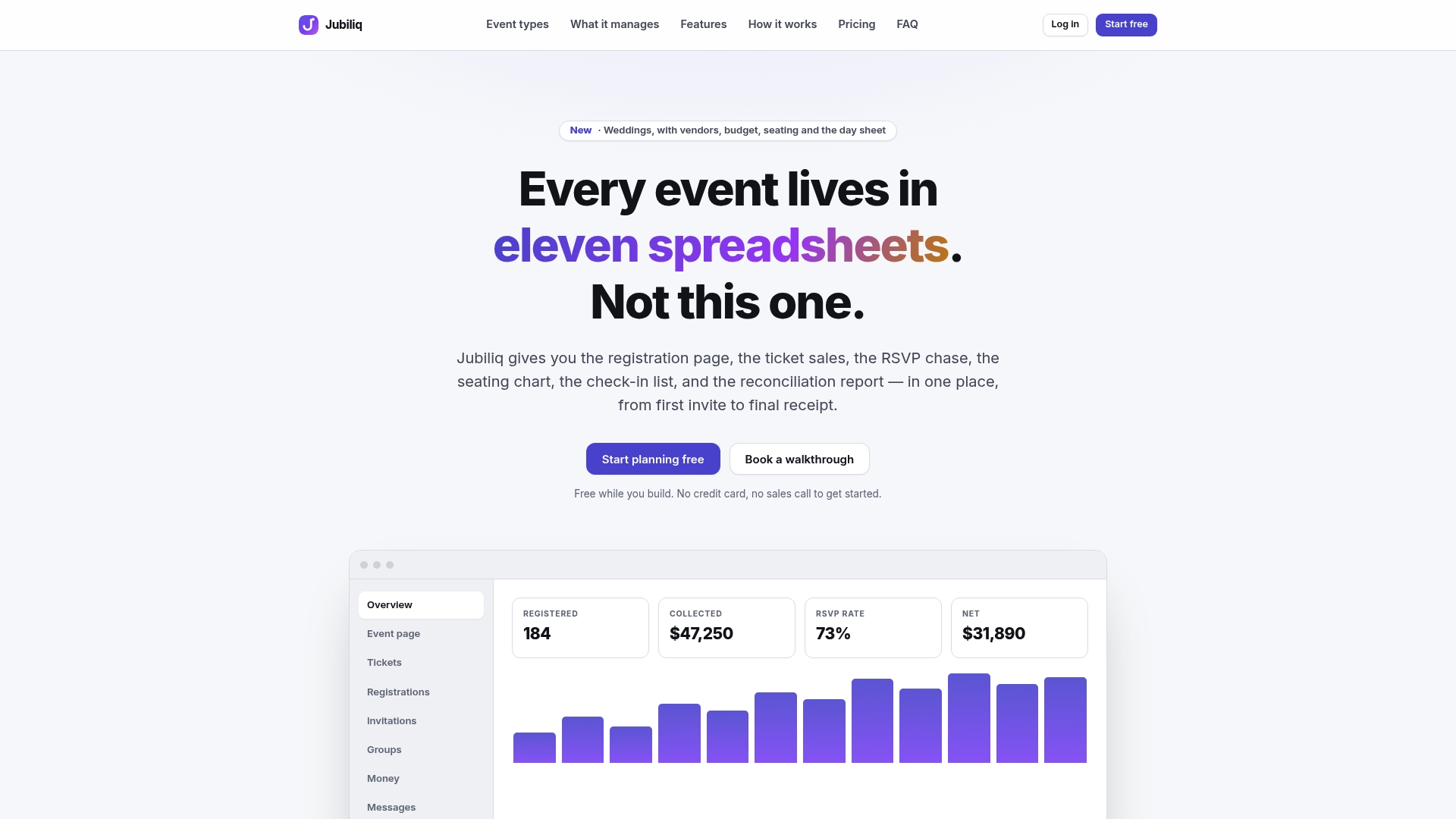
Pricing follows the money you raise. The Starter plan is $0 one-off per event, and events without paid tickets (planning-only mode) are free. The Organizer plan charges 2% per paid registration, plus Stripe fees. Enterprise pricing for multi-event organizations is not published, so see the plans or ask us for a quote. You can also export to CSV for your accountant, which makes the post-event reconciliation below much shorter.
Reconciling after the event
Reconciliation is where your tracking either pays off or falls apart. The goal is to prove that what your records say you received matches what actually reached the bank.
- Total by category. Add up cash, card, online, checks, ticket sales, sponsorships and raffle separately. Reconciling each category on its own makes any gap easier to locate.
- Match to statements. Compare your totals to the bank deposit and the payment processor report. Some organizations reconcile monthly, but after an event it is wise to do it within days while everyone remembers what happened.
- Separate fees. Record the gross amount, then the card or platform fees as an expense or a documented variance.
- Document variances. The Stanislaus Foundation’s fundraising manual requires post-event reconciliation of actual revenue and expenses against the general ledger, with variances such as sales tax, postage, card fees and accruals documented. Borrow that habit: every difference gets a written explanation.
- Review the pledge list. Mark what has been paid, and schedule reminders for the rest.
If your event included an auction, the handoff from the last bid to payment is a major source of discrepancies. Our silent auction checkout process walks through it step by step.
Receipts and acknowledgments
In the United States, a donor needs a written acknowledgment from the charity for any single contribution of $250 or more, and it has to state whether any goods or services were given in return. At an event, that second part matters, because a gala dinner ticket usually includes a meal. Only the portion above the value of what the guest received is generally treated as a gift, so your system should hold the ticket price and the value of the benefit for each ticket type.
For gifts of stocks or securities, the AFP’s receipt guidance says the receipt should specify the ticker symbol, the quantity and the date of transfer, which helps the donor with their tax documentation.
Requirements differ by country. In the UK, for example, Gift Aid claims bring their own record-keeping rules, and Canada and other countries have their own receipt formats. If you serve donors in more than one country, confirm the rules with a local accountant or your national tax authority.
Speed matters as much as format. The gap between receiving a gift and thanking the donor is one of the strongest signals of whether that donor gives again, so send thank-yous within days, not weeks. A status column for “thanked” turns that goal into a list you can work through.

A tracking plan you can set up in a week
Here is a simple sequence that works for most galas, golf outings and benefit dinners. Our fundraiser planning checklist places these steps in a longer timeline.
Several weeks out
- Decide who owns donation records, and who backs them up.
- List every way a guest can give: ticket, table, sponsorship, online donation, paddle raise, raffle, cash, check, pledge, in-kind.
- Build one record format with the fields above and use it for all of them.
- Set the value of any benefit that comes with each ticket or sponsorship level. Our sponsorship package guide covers how to word these.
The week of the event
- Print the day sheet with station owners, cash handoff times and who counts.
- Prepare pledge cards and cash count sheets in advance.
- Brief volunteers: every gift gets written down at once, no exceptions.
Event night
- Count cash in pairs, sign the sheet, lock it up.
- Enter pledges as they are made.
- Pull a quick gift report before people leave, so you catch obvious gaps while the donors are still in the room.
Within a week
- Reconcile by category, match to bank and processor records, and document variances.
- Send acknowledgments, with the $250 wording where it applies.
- Report results to your board by source, so next year’s plan learns from this one.
If you are running a golf tournament, the same plan applies with a few extras, such as hole sponsorships and on-course contests. See our golf tournament planning playbook.
Our perspective
We build event software, and the pattern we see is consistent: events do not lose donation records because organizers are careless. They lose them because the information lives in too many places. The guest list is in one tool, tickets in another, the auction in a spreadsheet, and the budget in someone’s inbox.
That is why we designed Jubiliq around the event type. A gala organizer sees ticketing, sponsorships, donations and seating. A bride on a budget sees guests, vendors and a budget, with no fundraising tools in the way. The goal is that whatever you are running, the tools you need are in front of you and the rest is hidden.
Our advice on donation tracking is simple. Use one record per gift and one place for every channel. Write it down when it happens, not at the end of the night. Reconcile within days. And keep the system lighter than the event: a plan that volunteers can follow at 9 p.m. beats an elegant one that only the treasurer understands.
— HCRF
Frequently asked questions
How do I track donations at a fundraising event?
Give every gift a record with the donor, amount, date, payment method, source and intended use, and enter it at the time you receive it. Keep cash, online gifts, checks, pledges and in-kind gifts in separate categories. After the event, reconcile each category against your bank and processor statements.
Do I need software, or is a spreadsheet enough?
A spreadsheet is fine for a small event with one person entering data. Once you have several payment channels, multiple volunteers or a need to send many acknowledgments quickly, software that links registration, payments and donor records reduces mistakes and saves time.
Do I have to send a receipt for every donation?
In the U.S., a written acknowledgment is required for any single donation of $250 or more, and it must say whether goods or services were provided in return. Many organizations thank every donor regardless of the amount. For tax questions about a specific gift, ask your accountant or the IRS.
How should I record in-kind donations?
Record a description, quantity, fair market value, donor details and intended use, and flag the gift as in-kind so it does not count toward cash revenue. The receipt describes the item without assigning it a dollar value.
How do I keep cash safe at an event?
Have two people count it together, keep it secured and never unattended, and deposit it the same day if you can. Record the count by category before the money leaves the building.
Sources
- Developing Fundraising Policies and Procedures, Association of Fundraising Professionals
- Code of Fundraising Practice, Fundraising Regulator (UK)
- Standards for Gift Solicitation and Fundraising Manual, Stanislaus Foundation
- Cash Contributions, Pledges and Donated Goods and Services
- How to Issue Donation Receipts for Different Types of Gifts, AFP