$250 Rule: Donation Receipts for U.S. Nonprofits & Donors

$250 Rule: Donation Receipts for U.S. Nonprofits & Donors
A donation receipt, also called a written acknowledgment, is the document a donor needs to substantiate a tax-deductible contribution. U.S. donors generally need a contemporaneous written acknowledgment from the charity for any single gift of $250 or more, while smaller cash gifts can often be substantiated with a bank record alone. Charities must also include specific fields on that acknowledgment and disclose the value of any goods or services provided in exchange.
TL;DR:
- Donations of $250 or more require a contemporaneous written acknowledgment from the charity, including the donation date, amount, and goods or services provided.
- Bank records, canceled checks, or credit card statements can substitute for receipts only for donations under $250.
- For noncash gifts over $500 or property valued above $5,000, additional documentation like appraisals or Form 8283 is necessary for the deduction.
- Receipts must clearly state whether the donor received goods or services and estimate their value if applicable, to avoid invalidating deductions.
- State-specific rules may impose additional requirements, especially for high-value or cross-border donations, demanding customized recordkeeping and compliance.
Table of Contents
- What a donation receipt actually confirms and who needs one
- The $250 and $75 rules that trigger paperwork
- What belongs on the receipt, and a template to start from
- Noncash gifts, high-value property, and event tickets
- State-specific rules or variations in donation receipt requirements
- Common mistakes that can invalidate a deduction
- How donors should use their receipts at tax time
- What to do if a donor loses their donation receipt
- Why event organizers should treat receipting as core operations
- An adjacent way to keep donation records organized
- Where to check the official rules and templates
- Sources
- FAQ
What a donation receipt actually confirms and who needs one
A donation receipt is a nonprofit’s written confirmation that it received a gift, paired with any statement about what, if anything, the donor got in return. It is not the same as a bank statement or canceled check, though for smaller cash gifts those records can substitute.
The line between “donor keeps a bank record” and “donor needs a written acknowledgment” comes down to size. A donor giving $50 by check can usually rely on that canceled check or a credit card statement. A donor giving $300 cannot claim the deduction without a written acknowledgment from the charity, no matter how clear the bank record is.
Timing matters too. The acknowledgment has to be “contemporaneous,” meaning the donor needs it in hand by the earlier of the date they file their tax return or the return’s due date, including extensions.
The $250 and $75 rules that trigger paperwork
Two dollar thresholds drive most of the substantiation work in U.S. charitable giving, and missing either one can cost a donor their deduction or put a nonprofit out of compliance.
Any single contribution of $250 or more requires a contemporaneous written acknowledgment from the charity, according to IRS guidance on substantiating contributions. This applies per gift, not per year: federal recordkeeping regulations confirm that separate gifts under $250 are not added together to trigger the rule, even if the same donor gives multiple times.
The second threshold governs quid pro quo contributions, where a donor receives something of value in exchange for a payment. When the payment exceeds the federal threshold, the IRS requires charities to disclose (https://www.irs.gov/charities-non-profits/charitable-organizations/charitable-contributions-quid-pro-quo-contributions) the value of goods or services provided and state the deductible portion. A donor who pays more for an event ticket than its fair market value has made a deductible charitable contribution equal to the excess amount, and the charity must state that amount in writing.
Donors relying on smaller gifts can generally point to:
- A bank record showing the transaction, such as a statement line or canceled check image.
- A credit card statement showing the charge to the organization.
- Written communication from the charity that includes its name, the date, and the amount.
These substitute for a formal acknowledgment only below the $250 line.
What belongs on the receipt, and a template to start from
A compliant acknowledgment does not need to be fancy, but it does need specific fields. IRS Publication 1771 lays out what a contemporaneous written acknowledgment must contain:
- The name of the organization.
- The date the gift was received.
- The amount of cash, or a description (not the value) of any property donated.
- A statement about whether goods or services were provided in exchange, and if so, a good-faith estimate of their value.
- If no goods or services were provided, a statement saying so.
Beyond those required items, most nonprofits add the donor’s name and address, a receipt or serial number for tracking, the payment method, and a line noting where the donor should keep the document for tax records. A short acknowledgment might read: “Thank you for your gift of [amount] received on [date]. No goods or services were provided in exchange for this contribution.” Publication 1771 also accepts letters, postcards, computer-generated forms, or emails as valid formats, so nonprofits have flexibility in how they deliver the message.
Pro Tip: Build the required fields into a fixed template so no receipt goes out missing the goods-or-services statement, since that single line is what most often gets left off.
Noncash gifts, high-value property, and event tickets
Cash gifts are the simplest case. Noncash gifts and event-related payments carry extra rules that trip up a lot of organizers.
- Noncash gifts over $500 generally require the donor to file Form 8283 with their return, and the charity’s receipt should describe the property without assigning it a value, since that judgment belongs to the donor.
- Gifts of property valued over $5,000 typically require a qualified written appraisal before the donor can claim the deduction, and the nonprofit should keep a record that the item was received, not what it is worth.
- Auction items and gala tickets require calculating the eligible amount by subtracting the fair market value of what the donor received. A gala ticket with a meal and entertainment value requires subtracting the fair market value of the benefits from the total payment to determine the deductible portion, and the quid pro quo disclosure rule applies once the payment exceeds $75.
- Vehicle donations follow their own substantiation path, often requiring the charity to issue a specific contemporaneous written acknowledgment within 30 days of the sale or donation.
State-specific rules or variations in donation receipt requirements
Federal rules set the floor for donation receipts in the United States, but state law can add requirements on top. Several states require charities to register before soliciting donations, and some tie receipt or disclosure language to that registration status. A nonprofit operating in multiple states may need to track separate rules for each one where it actively fundraises, particularly around required disclosures for professional fundraisers or paid solicitors.
Sales tax treatment of donated goods, appraisal requirements for vehicle donations, and rules around raffle or gaming proceeds also vary by state and can affect how a nonprofit structures its receipts for those specific activities. A charity auction, for example, might need to account for state consumer protection rules on top of the federal quid pro quo disclosure.
Outside the United States, receipt rules differ entirely. Canada’s official donation receipts follow a distinct framework: only registered charities or qualified donees can issue official receipts, and the Canada Revenue Agency prescribes specific content, numbering, and format rules, including for electronic receipts. A donor or nonprofit operating across borders should not assume U.S. thresholds like $250 or $75 apply anywhere else.
The practical takeaway is that a receipt template built for one jurisdiction rarely transfers cleanly to another. Nonprofits that fundraise nationally or internationally benefit from checking state charity regulators and, where relevant, the tax authority of each country where donors are based, rather than relying on a single federal or national rule of thumb.

Common mistakes that can invalidate a deduction
The mistakes that cost donors their deductions are usually small omissions, not big errors.
Leaving off the goods-or-services statement is the most frequent one. A receipt that lists only the amount and date, without saying whether the donor received anything in return, does not meet the contemporaneous acknowledgment standard even if every other detail is correct.
Valuing donated property on the receipt is another common error. The charity’s job is to describe what it received, not assign it a dollar value, since that determination belongs to the donor and, for higher-value items, an independent appraiser.
Sending the acknowledgment too late causes problems too. If a donor files their return before receiving the written acknowledgment, the gift may not qualify for the deduction even if the charity eventually sends one.
Other frequent issues include combining multiple small gifts into one receipt in a way that obscures individual contribution dates, failing to separate the deductible portion of a quid pro quo payment, and issuing a receipt to the wrong party, such as a company check written on behalf of an individual donor rather than the business itself. CRA guidance on issuing receipts makes a similar point: identifying the true donor matters as much as the dollar amount.
How donors should use their receipts at tax time
A donor claiming a charitable deduction needs to itemize rather than take the standard deduction, and the receipt is the evidence that backs up the number entered on the return. For any single gift of $250 or more, the donor should hold onto the contemporaneous written acknowledgment itself, not just a bank record, since the IRS can disallow the deduction without it even if the payment clearly went through.
For smaller cash gifts, a bank record, canceled check, or credit card statement is generally enough on its own. Donors giving property should keep the charity’s description of the item along with any appraisal documentation for higher-value gifts, since that supports the value claimed on the return rather than anything the charity states.
The practical habit is to keep receipts filed by tax year, matched to the return where each was used, rather than scattered across email inboxes. Donors do not attach every receipt to a paper return, but they need to produce them if the IRS asks, so accessible storage matters as much as having the document in the first place.
What to do if a donor loses their donation receipt
A lost receipt is not necessarily a lost deduction, but the fix depends on the size of the gift. For contributions under $250, a donor can usually fall back on a bank record, canceled check image, or credit card statement showing the payment to the organization, since those substitute for a written acknowledgment at that level.
For gifts of $250 or more, the donor should contact the charity directly and request a duplicate acknowledgment. Most nonprofits can reissue a copy from their records, particularly if they use sequentially numbered or electronic receipts that are easy to search and reprint. A donor should ask for the reissued copy to carry the original donation date, not the date it was reprinted, since that date is part of what makes the acknowledgment valid.

If the charity no longer exists or cannot locate the original transaction, the donor’s best option is to gather whatever bank or card records exist and be prepared to explain the gap if the IRS questions the deduction. Waiting until tax filing time to discover a receipt is missing is the most common version of this problem, so requesting a duplicate as soon as the loss is noticed avoids a scramble in April.
Why event organizers should treat receipting as core operations
Donation receipting is not paperwork layered on top of an event. It is part of running one. Capture donor identity and payment details at the point of sale, and separate ticket revenue and sponsorships from pure donations immediately, since mixing them makes the eligible deductible amount impossible to calculate cleanly later. A simple donor capture, receipt, retention workflow protects the organization if a gift is ever questioned.
— HCRF
An adjacent way to keep donation records organized
Manual receipting works until an event has multiple ticket tiers, a live auction, and a sponsorship table running at once, and then it becomes easy to lose track of which payment was a donation and which was a purchase. Jubiliq is designed to adjust its interface to the event type, so donation and ticketing workflows appear distinct from sponsorship tracking, without extra tools bolted on. 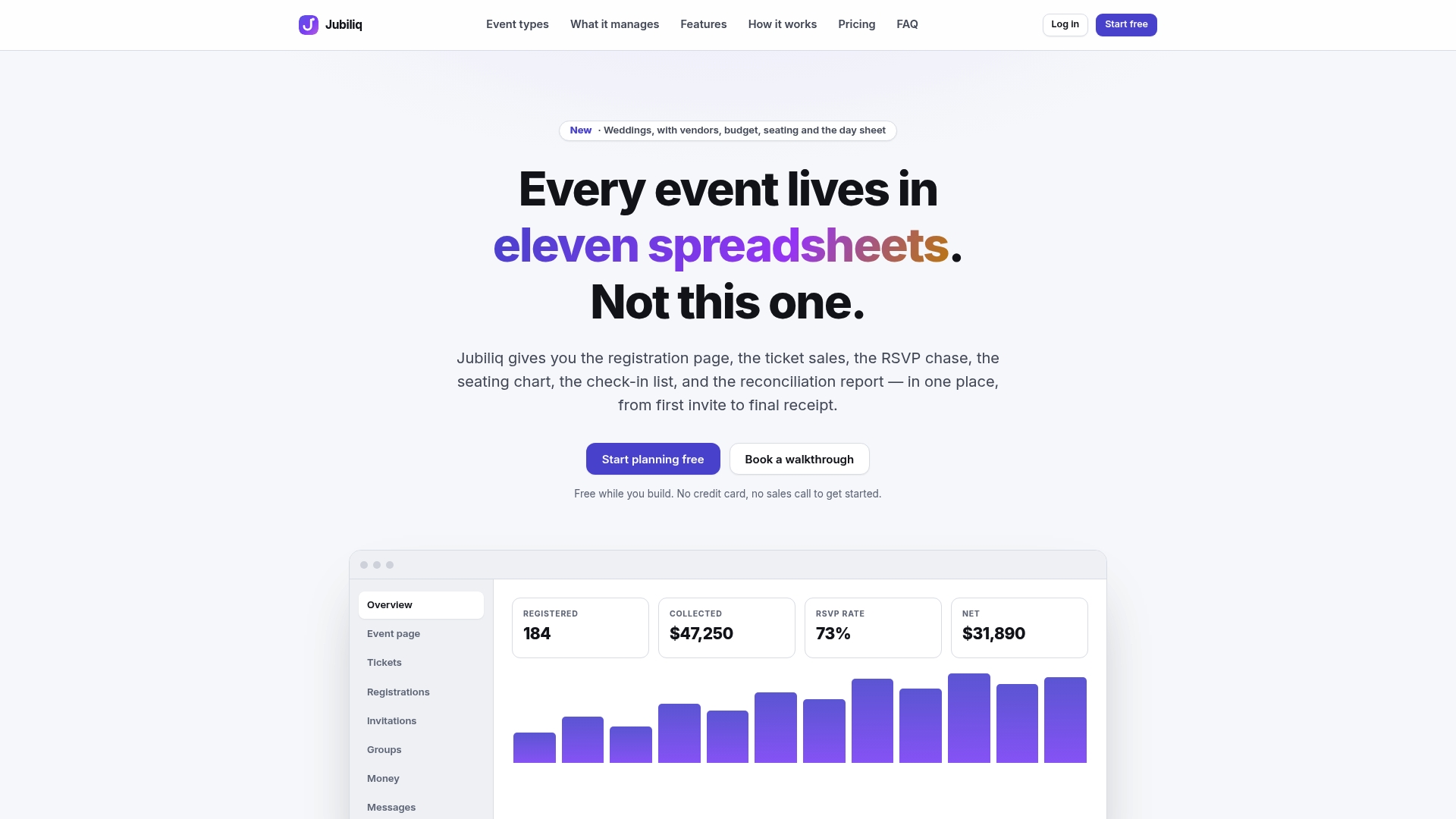
- Donation handling and financial tracking can be managed in the same dashboard as guest lists and ticket sales, helping to minimize manual reconciliation afterward.
- Day sheets and financial records that are printable and exportable provide organizers with documentation that supports receipting requirements.
- Real-time updates help keep sponsorship, ticket, and donation totals separated as money comes in, rather than sorting them after the event closes.
Jubiliq is not a substitute for tax advice, but for organizers running ticketed fundraisers, auctions, or sponsorship-driven events, centralizing that data reduces the manual errors that lead to receipting headaches. Review the plans on Jubiliq’s site to see which fits your next event.
Where to check the official rules and templates
- The IRS substantiation page and Publication 1771 cover U.S. rules and sample acknowledgment language.
- CRA’s sample official receipts show Canadian format and content requirements.
- For high-value or cross-border gifts, consult a tax professional familiar with your jurisdiction.
Sources
- Substantiating charitable contributions | Internal Revenue Service
- Publication 1771, Charitable Contributions - Substantiation and Disclosure Requirements (PDF)
- Canada
- 26 CFR § 1.170A-13 - Recordkeeping and return requirements for deductions for charitable contributions | e-CFR / LII
FAQ
What are the IRS rules on donation receipts?
The IRS requires a contemporaneous written acknowledgment for any single contribution of $250 or more, stating the organization’s name, the date, the amount or property description, and whether goods or services were given in exchange. Smaller cash gifts can usually be substantiated with a bank record instead.
How do I make a donation receipt?
Include the charity’s name, the date the gift was received, the amount or a description of donated property, and a statement about goods or services provided, or a statement that none were given. Publication 1771 accepts letters, emails, or computer-generated forms as valid formats.
Does Goodwill still give receipts for donations?
Donation centers that accept noncash goods typically provide a receipt describing the items donated, though the donor is responsible for determining the value for tax purposes. Keep the receipt with any records needed to support that valuation, especially for gifts over $500.
How much can you claim for donations with receipts?
The deductible amount depends on what was given and whether anything was received in return. For quid pro quo gifts, the deductible portion excludes the value of goods or services provided, and that disclosure is required once a payment exceeds $75.