Corporate Event Logistics: A Planner's Working Guide
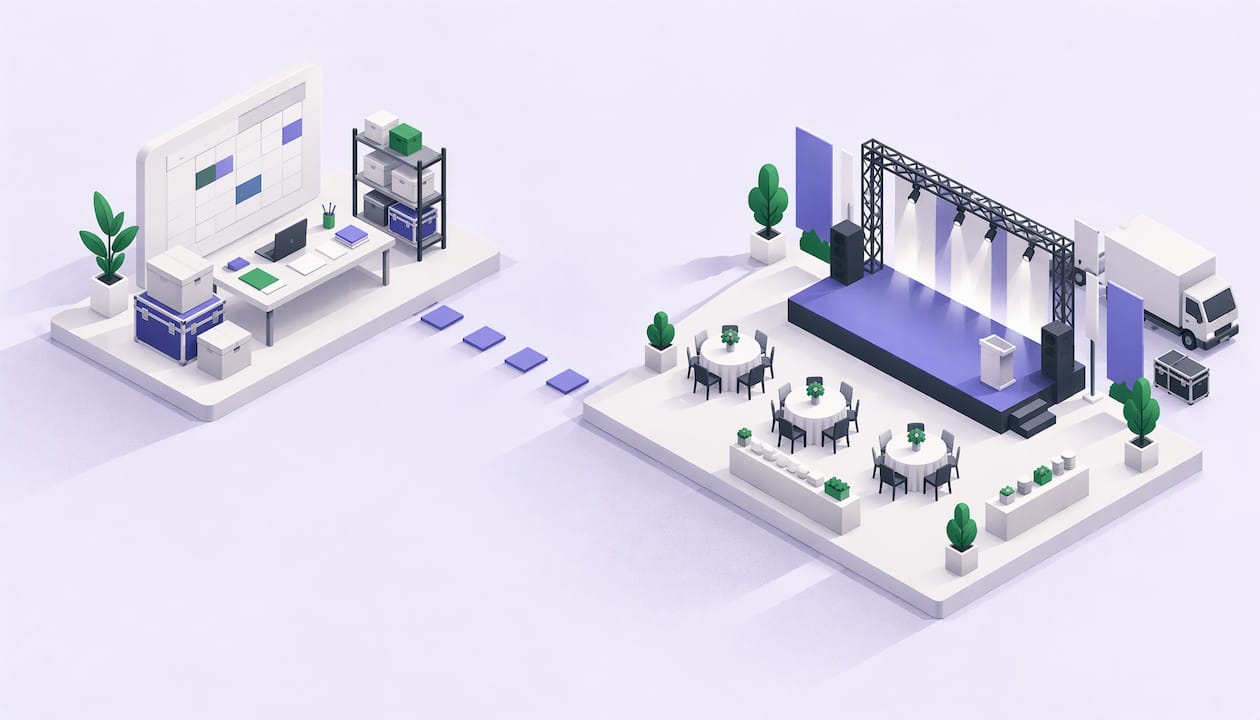
Corporate event logistics is the work of turning decisions into working arrangements: who arrives where, when, with what, and who answers when something slips. The teams that do it well keep the venue, vendors, guests, budget and schedule in one place with one owner per task. That is how we built Jubiliq: the guest list, vendor contracts, budget, tasks and a printable day sheet live together, and the interface adapts to the event type, so a client dinner does not carry wedding tools.
This guide walks through what logistics covers, how to sequence it, how to brief vendors, how to write a run of show and what to prepare for when things go wrong. It suits corporate teams hosting client events, and the same routine scales to galas, golf outings and large parties.
TL;DR
- Logistics covers nine areas, from venue and transport to staffing and teardown. Give each one a single named owner.
- Build the schedule backward from doors opening, and pad on-site tasks by 20% to 30%.
- Send every vendor the same written brief once contracts are signed, and resend it two weeks out.
- Keep a budget with a 10% to 15% contingency, tracked line by line against actuals.
- Plan for failure early: backup vendors, backup Wi-Fi and a crew that has read the plan.
Table of Contents
- What corporate event logistics includes
- Start from the brief, not the venue
- Build the timeline backward
- Coordinate vendors without chasing them
- Write a run of show the crew can use
- Handle venue, registration, food, transport and staffing
- Prepare for what goes wrong
- Perspective: logistics is a visibility problem
- Run it in one place with Jubiliq
- FAQ
- Sources
What corporate event logistics includes
Planning decides what the event should be. Logistics makes it physically happen. A practical guide to event logistics splits most events into nine areas:
- Venue and space
- Transportation and accommodation
- Equipment and AV
- Suppliers and vendors
- Registration and attendee movement
- Staffing and communication
- Speaker and session logistics
- Safety, accessibility and contingency
- Setup and breakdown
Not every event uses all nine. A 40-person client dinner may skip transportation and speaker logistics. A conference with out-of-town guests needs every one. The first job is to mark which areas apply, so you plan the event you actually have to produce. Teams lose time when they plan the event they want without mapping the event they have to deliver, and the gap shows up later as rushed decisions and vendor compromises.
This is also why our planning interface hides tools that do not fit your event type. A corporate client event surfaces guest lists, vendors, budget and tasks, not registry or toast-order features.
Start from the brief, not the venue
Before you tour a single room, write down what success looks like and what cannot change: date, guest count, audience, budget range, location, accessibility needs, brand requirements and what stakeholders expect. Keep a separate decision log for any change that affects cost, timing or guest experience, so nobody argues later about who approved what.
The brief sets the budget, and the budget needs a cushion. The Meeting Professionals International (MPI) planning guide advises a 10% to 15% contingency and tracking actual costs against budgeted costs for every line item. Doing that in a standalone spreadsheet means re-keying every invoice. In Jubiliq, the budget sits next to your vendors and contracts, so a signed quote and its payment status show up where you track spend, and you can export the figures to CSV for your accounting team.
Build the timeline backward
The master schedule works from the moment doors open and runs backward through guest entry, rehearsal, speaker arrival, AV checks, catering milestones, staff call times and load-in. Every line gets one owner. A task with two owners has none.
For lead times, a six-month corporate timeline is a sound default:
| Time before event | Milestone |
|---|---|
| 6 months | Approve scope and budget |
| 5 months | Secure venue and core vendors |
| 4 months | Launch registration |
| 3 months | Confirm program and speakers |
| 6 weeks | Approve production and floor plans |
| 2 weeks | Review readiness and the run of show |
| 1 day | Setup checks and briefings |
| 1 week after | Collect feedback |
These milestones follow a published six-month event timeline; each task there carries a phase, one owner, a due date, a dependency and a status. Larger or more complex events need more runway: one 2026 logistics guide suggests starting detailed planning 6 to 9 months out for mid-size and large events.
Pad the moments that always run long
On-site tasks like load-in and setup almost always take longer than planned, and the same guide recommends a 20% to 30% time buffer for them. A worked example: if rental delivery is booked for 7:30 a.m. and guests arrive at 8:00, you have no buffer at all. Move delivery to 6:30 or move guest arrival. A room flip that takes 15 minutes on paper can take 35 with real furniture and real staff, so pad every key transition.
The weekly rhythm matters too. Check in monthly early on, weekly as the date approaches, and daily in the final stretch.
Coordinate vendors without chasing them
Vendor coordination is where most logistics fail, because every vendor holds a piece of the schedule. The fix is boring and effective: one owner, one schedule and one communication channel for each supplier.
What goes in the vendor brief
Send each vendor the same core brief once contracts are signed, and resend an updated copy two weeks out. It should include:
- Event name, date, venue and main contact
- Load-in and load-out windows and access details
- Power requirements
- Setup and teardown responsibilities
- Payment terms
- Check-in procedure on arrival
Add parking, insurance documentation, meal arrangements for crews, waste removal and who can authorize changes on site. Raise overtime, power distribution and late-night loading before you sign, since those are the costs that otherwise appear after the contract.
When you request proposals from venues, be specific about dates, start and end times, attendee and room counts, food and beverage needs, AV requirements, accessibility requirements such as shuttles, ramps and parking, proposal and deposit deadlines, and a budget estimate. MPI’s guide also recommends checking references, confirming backup plans for last-minute cancellations and finalizing everything in writing.
If you are still finding suppliers, our guide to finding, vetting and booking suppliers covers the sourcing side, and vendor management for organizers covers the ongoing relationship. For the paperwork, see what to put in a catering contract and how payment terms depend on a trigger date.
Sequence arrivals and map dependencies
Who comes in first changes everything. A sensible order: AV enters first because power, sound, screens and stage lines affect the whole room; registration tools are tested before guest signage is finalized; décor installs after technical placement; catering arrives into a protected service lane. When vendors stack up in the same hour, every later task starts late.
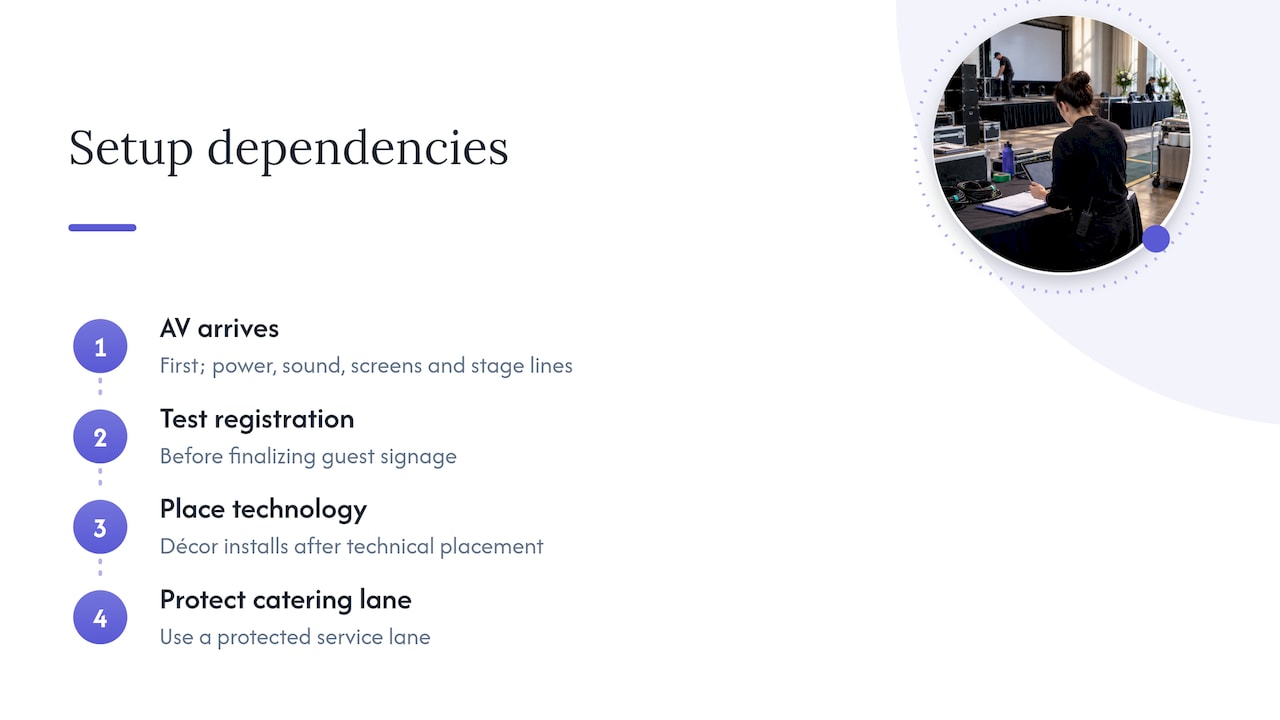
Map which tasks are hard dependencies (the stage cannot be dressed until it is built) and which are soft. When you fall behind, protect the hard ones first.
Teardown deserves its own chain. Gear strike, cable pull, floor check, venue walkthrough and deposit return each need an owner and a time, or you lose your out-by window and risk the deposit. Vendors who know they are on the critical path tend to arrive early rather than on time, so tell them.
Write a run of show the crew can use
Three documents matter most on site: the load-in schedule, a live contact sheet and a minute-by-minute run of show. An agenda tells guests what is happening. A run of show tells your team how. “Welcome remarks at 9:30” is not a cue until it says when the speaker arrives, when they are mic’d and when the walk-in music fades.
A workable run of show uses seven columns: time, duration, segment, location, owner, cues and notes. Durations should add up to the next start time, every line has one named owner, every page carries a version number, and the document is frozen at staff call so only the person calling the show changes it on the day.
Jubiliq produces a printable day sheet from the plan you already built, so the version your crew holds on the day is drawn from the same tasks, vendors and guest data your team has been updating.
Handle venue, registration, food, transport and staffing
Venue. Confirm capacity for your layout, not just a headcount, plus load-in access, power, Wi-Fi and accessibility. Ask for the room’s out-by time in writing.
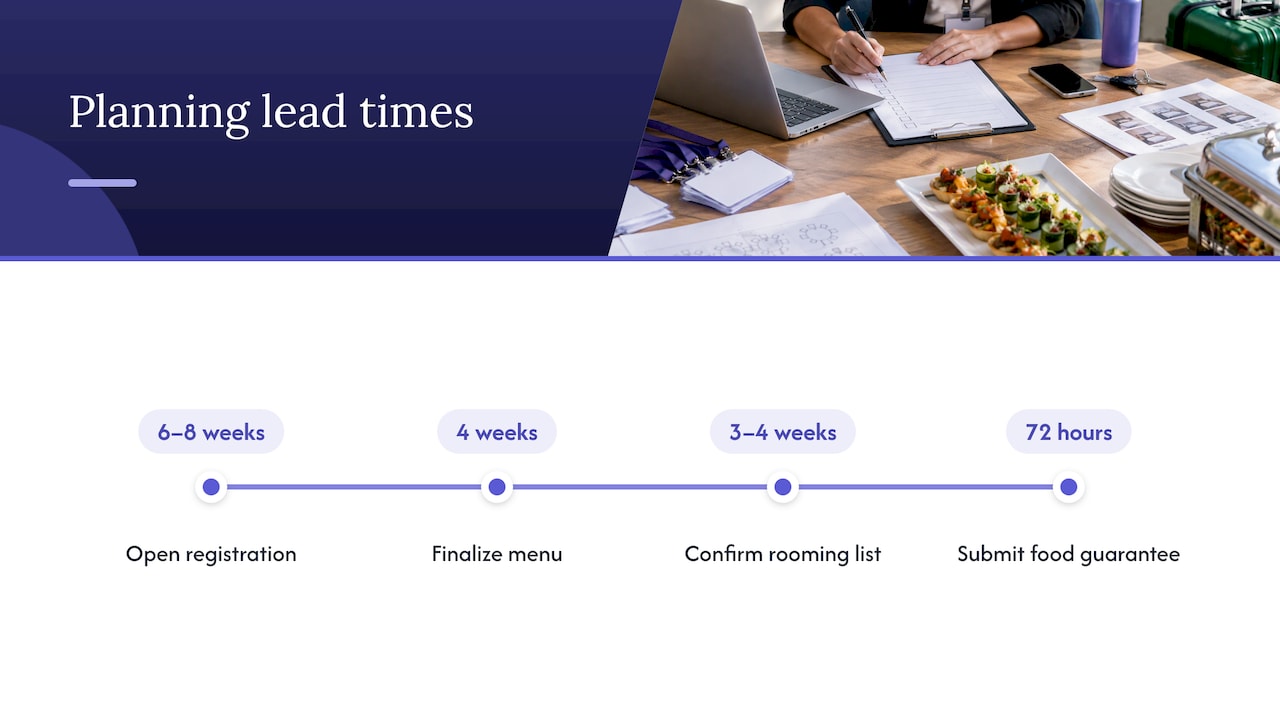
Registration. Open invitations and registration 6 to 8 weeks out for most events, earlier for travelers. Registration data drives everything downstream: catering counts, seating, badges and transport. Our guest communication plan shows how to keep RSVPs and messages in sync, and Jubiliq supports RSVP tracking and segmented email blasts so a reminder to the unconfirmed group does not reach everyone else. If senior guests need special handling, see our VIP guest playbook.
Food and beverage. MPI’s guide says to give guaranteed attendance numbers at least 72 hours ahead for food and beverage events. Finalize the menu about four weeks out, collect dietary needs at registration, and sample the food when you can.
Transportation and lodging. Decide whether guests need flights managed, airport shuttles or ride credits, and whether the shuttle company offers consistent communication or vehicle tracking. Plan the guest journey as one chain: invitation, registration, travel, arrival, transfer, accommodation, event, departure. Flights set arrival patterns, arrivals set transfers, and transfers must line up with hotel check-in. Send the group rooming list to the hotel and confirm three to four weeks out, and read our notes on hotel room block clauses before you sign.
Staffing. Set call times, assign a central production lead who consolidates vendor requirements and confirms handoffs, and name who can authorize changes on site.
Prepare for what goes wrong
Contingency planning is common among professionals. An industry study by the Incentive Research Foundation found that 54% of planning companies required contingency plans for all events and 37% for some. The examples included backup plans for no-shows, transportation, suppliers, speakers and Wi-Fi. The same study found that 49% of planners actively told attendees about potential disruptions and suggested actions.
Turn that into a one-page plan:
- A backup for each single point of failure: AV tech, caterer, shuttle, speaker, internet
- Emergency access points and a venue contact reachable during the event
- A message template for attendees, ready to send in minutes
- A walk-through with the people who will actually be in the building
Finalize operating assumptions early, such as power, access and headcount. The show itself can change, but the infrastructure cannot. A plan written by one person and unread by the crew helps nobody.
Perspective: logistics is a visibility problem
Most logistics failures we hear about are not failures of effort. They are failures of visibility: the caterer has last month’s headcount, the AV crew has an old load-in time and nobody knows which version is current.
That is why we built Jubiliq as one place for the whole event. The guest list and RSVPs, the vendors and contracts, the budget, the task schedule and the day sheet are connected, so a change made once is the change everyone sees. Real-time progress dashboards show what is done and what is stuck, and the interface adapts to the event type so a corporate team is not wading through options built for a wedding.
Our advice is to pick one source of truth early, give every task one owner and keep the day sheet drawn from the same data as the plan. Logistics gets easier when the plan, the money and the people live together.
HCRF
Run it in one place with Jubiliq
If your event has no paid tickets, such as a client dinner, an internal offsite or a planning-only project, the Starter plan costs $0 one-off per event. If you sell tickets, sponsorships or registrations, the Organizer plan charges 2% per paid registration, plus Stripe’s processing fees. Enterprise is for organizations running multiple events, and it has no published price. Plans are on the Jubiliq site.
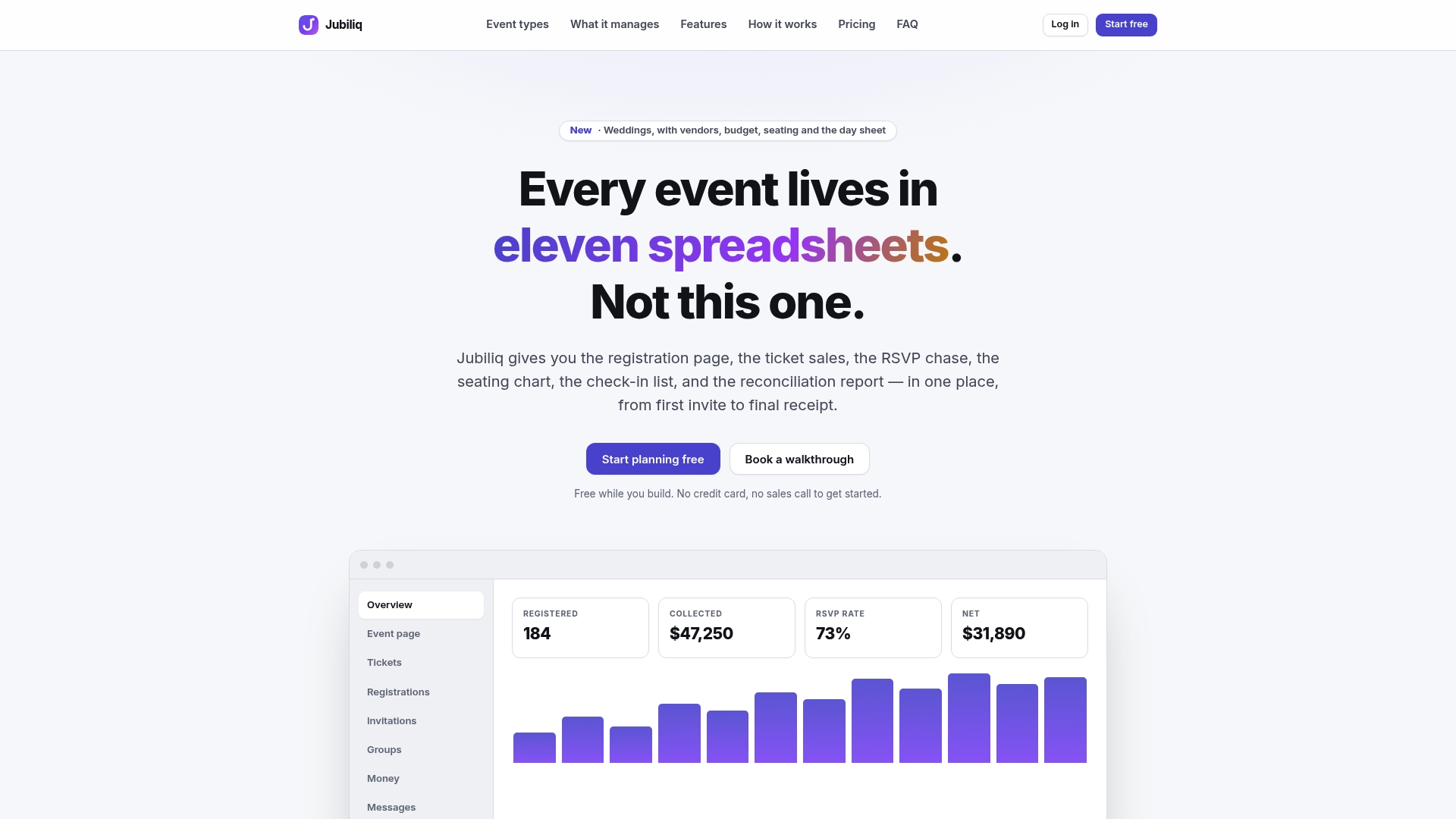
For corporate teams, that means guest management, vendor and contract tracking, budgets, task scheduling and a printable day sheet without stitching together add-ons. Fundraising galas and golf outings can add ticket and sponsorship sales and donation handling to the same plan. For a phase-by-phase checklist, see our corporate event checklist, and for the guest side, our guide to event experience design.
FAQ
What is the difference between event logistics and event planning?
Planning covers the broad decisions: goals, audience, budget, concept. Logistics turns those decisions into working arrangements for people, equipment, schedules and suppliers. Event management is the umbrella over both.
How far ahead should I start corporate event logistics?
A six-month timeline works for most corporate events: scope and budget at 6 months, venue and core vendors at 5, registration at 4. Large or complex events may need detailed planning to start 6 to 9 months out. Smaller dinners can compress this, but book the venue first.
What belongs in a vendor brief?
Event name, date, venue, main contact, load-in and load-out windows, access, power, setup and teardown duties, payment terms and the check-in procedure. Send it once contracts are signed and resend an updated copy two weeks before the event.
How do I track vendors, budget and tasks together?
Keep them in one shared system so a change to a contract, a payment or a headcount is visible to everyone at once. In Jubiliq, vendors, contracts, the budget, tasks and the day sheet sit in the same event plan.
Sources
- What Is Event Logistics? A Practical Guide for Organizers
- MPI Practical Meeting Planning Guide
- Event planning timelines guide
- Event Logistics Management: A Complete 2026 Guide
- How Do You Coordinate Multiple Event Vendors?
- Run of show template and example
- 2016 Event Disruption Study