Prevent Surprise Hotel Bills: Contract Clauses Hotel Room Blocks Need

Prevent Surprise Hotel Bills: Contract Clauses Hotel Room Blocks Need
A hotel room block reserves a set number of rooms at a negotiated rate for your wedding guests, and yes, it’s usually worth setting one up once you have 10 or more out-of-town guests. The tradeoff: courtesy blocks carry no financial risk, but contracted blocks obligate you to fill a percentage of rooms or pay attrition fees on the ones that go unbooked. Choose the block type based on your guest count and your appetite for that liability.
TL;DR:
- Booking a contracted room block is advisable only if you expect more than 20 out-of-town guests, as smaller groups typically qualify for courtesy or no-risk blocks.
- It is crucial to scrutinize contract terms, especially cutoff dates and attrition clauses, to avoid surprise fees or billing after the wedding.
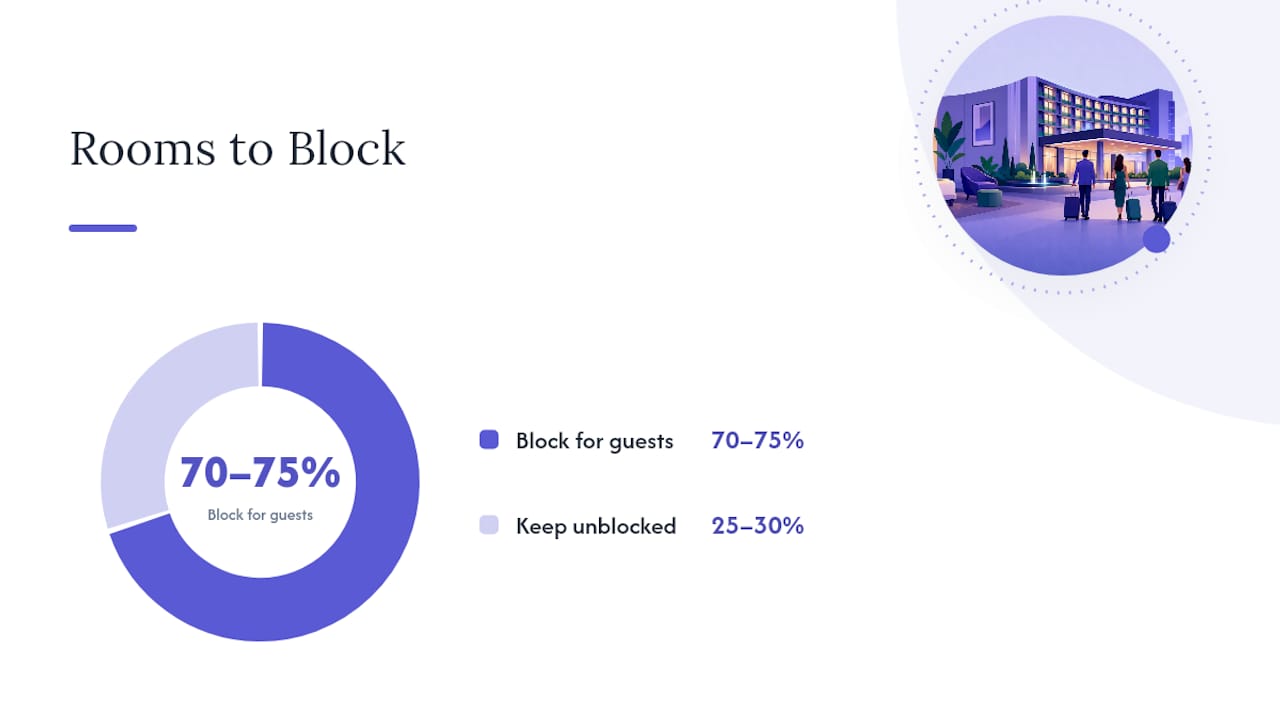
- Aim to block about 70 to 75 percent of your total expected guests to minimize attrition risk and set the cutoff date for 30 to 60 days before the event.
- Negotiating concessions like free breakfast or suite upgrades is often more feasible than reducing the rate, and getting multiple proposals improves your bargaining leverage.
- Using a centralized planning platform simplifies tracking booking, guest RSVPs, deposits, and room assignments, reducing administrative errors during the busy wedding weekend.
Table of Contents
- What Is a Hotel Room Block, Exactly?
- Courtesy vs. Contracted Blocks: Who Actually Carries the Risk
- Contract Terms That Determine Whether You Get Burned
- How Many Rooms to Block and When to Set Your Cutoff
- What to Ask For at the Negotiating Table
- How a Planning Platform Like Jubiliq Fits Into Room-Block Management
- A Checklist and Sample Language for Your Hotel Proposals
- Working With Your Venue and Other Vendors on the Block
- Handling Cancellations and No-Shows Without Losing Money
- Individual vs. Master Billing: Who Pays for What
- Planner Perspective: Common Mistakes and Field-Tested Shortcuts
- Let Jubiliq Handle the Admin Side of Your Room Block
- Sources
What Is a Hotel Room Block, Exactly?
A room block is a set of rooms a hotel holds under one agreement for your wedding, tied to a specific date range and a group rate. The process moves through four stages: quote, contract, pickup window, and the stay itself, and the contract terms govern everything that happens in between. This is according to Engine’s breakdown of the block lifecycle.
You’ll see specific terminology on every proposal a hotel sends. Knowing it upfront saves you from emailing the sales manager five times asking what a term means.
- Group rate: the discounted nightly rate reserved for your block, usually locked at signing.
- Group code or booking link: the unique code or URL guests use to book within your block instead of the general public rate.
- Master bill: the single invoice the wedding host (or whoever signs the contract) is responsible for, separate from what guests pay individually for their rooms.
- Rooming list: the roster of guest names and room assignments submitted to the hotel, often required close to the cutoff date.
- Pickup: the running count of how many rooms in your block have actually been booked, measured against your original block size.
Some hotels call this a “group block,” others just say “block,” and a few large chains fold it into their general “group booking” language. The terms are interchangeable. What matters more is whether the hotel classifies your booking as courtesy or contracted, because that decision changes your financial exposure entirely.
Courtesy vs. Contracted Blocks: Who Actually Carries the Risk
A courtesy block costs you nothing upfront. The hotel holds rooms at your group rate with no signed guarantee, and on the cutoff date, any unbooked rooms simply release back into general inventory. No penalty, no invoice, no drama. Hotels typically offer courtesy terms for smaller blocks, often under 9 rooms per night, where the sales math doesn’t justify a contract.
A guaranteed or contracted block is a different animal. You sign an agreement promising a minimum number of room nights will be booked, and if pickup falls short, you owe attrition fees on the shortfall. In exchange, you usually get better perks: locked rates, comp rooms, sometimes a suite upgrade for the couple.
Once your group needs 9 or more rooms on a peak night, most properties route the request to group sales rather than the front desk, according to both Engine and group booking pages from major chains like Hilton and Choice Hotels. That’s the threshold where courtesy terms tend to disappear and contracts enter the conversation.
The general rule for choosing between the two:
- Under 15 to 20 expected room nights, push for courtesy terms. The hotel has less incentive to lock you into a contract, and your downside risk stays at zero.
- Above that, especially at 30+ rooms, hotels will often only offer a group rate through a signed contract, because the discount they’re extending justifies wanting a guarantee.
- If your wedding falls during a high-demand weekend (peak season, a local event, graduation weekend), expect hotels to push contracted terms even for smaller blocks, since they have less reason to hold rooms on spec.
Ask directly whether a proposal is courtesy or contracted before you get excited about a rate. Sales managers don’t always volunteer which one they’re offering.
Contract Terms That Determine Whether You Get Burned
This is the section that actually protects your bank account. Every contracted block includes language on cutoff dates, attrition, deposits, and billing, and each one deserves scrutiny before you sign anything.
- Cutoff (release) date. Most hotels set this 30 to 60 days before your wedding, per Room Price Genie’s glossary. After this date, unbooked rooms in your block release to the public, and guests booking after cutoff may pay the standard rate instead of your group rate, if rooms are even still available.
- Attrition liability. This is the penalty for under-filling your block. Hotels calculate the shortfall between your contracted minimum and actual pickup, then charge you a percentage of the lost room revenue on those unfilled rooms.
- Mitigation or resell clause. Ask for language stating you only owe attrition fees on rooms the hotel couldn’t resell to other guests. Without this clause, you pay the full shortfall penalty even if the hotel filled those rooms with walk-in traffic.
- Deposit and cancellation terms. Expect a deposit request at signing, refundable or applied against the master bill depending on the property. Cancellation windows and penalties vary widely, so get the exact numbers in writing.
- Master bill scope. Clarify what’s actually on the master invoice: just room attrition, or also incidentals like parking, resort fees, and minibar charges guests failed to settle individually.
- Room-type guarantees and overflow language. If your block includes a mix of king and double rooms, the contract should specify how substitutions work if one room type sells out, and what happens if the hotel needs to relocate your group due to overbooking.
| Contract Term | Typical Range or Practice | Why It Matters |
|---|---|---|
| Cutoff date | 30 to 60 days before event | Determines when unbooked rooms release and guests lose group pricing |
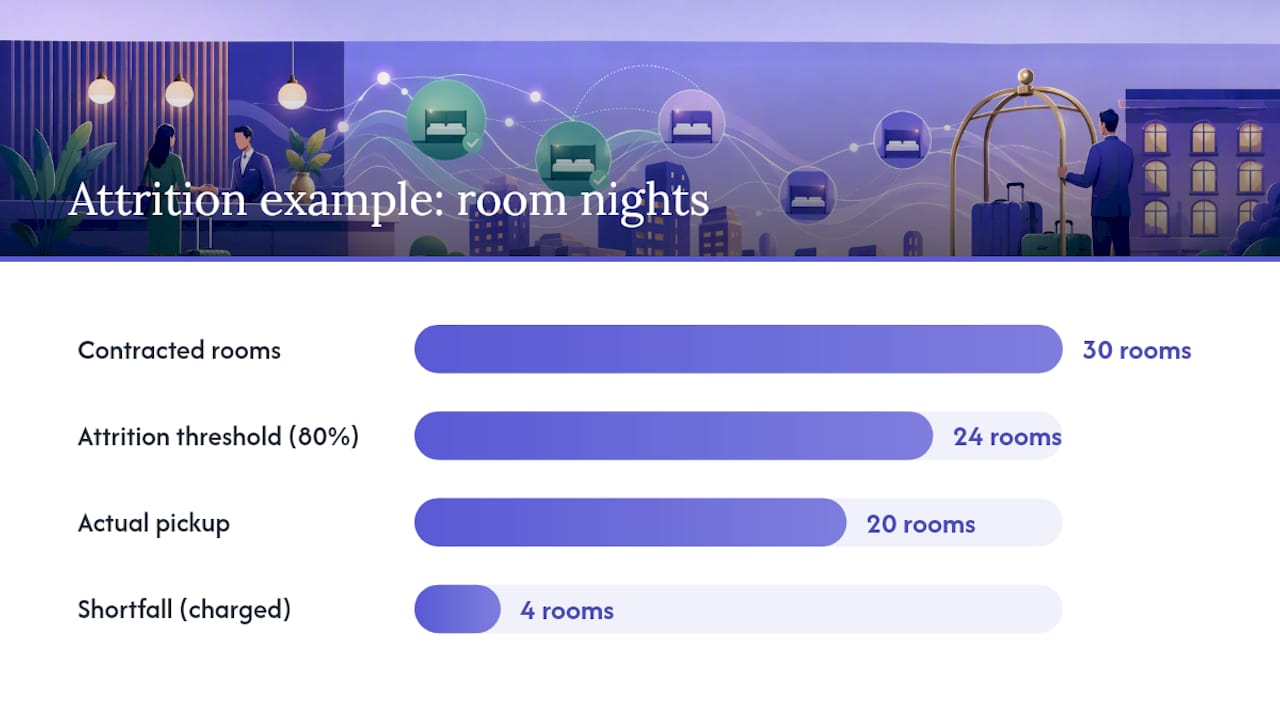
| Attrition threshold | Often 80 percent of blocked rooms | Sets the pickup level you must hit to avoid penalty fees |
| Deposit | Requested at signing, property-dependent | Affects upfront cash commitment before guests book anything |
| Comp room ratio | Scales with total room nights booked | Standard incentive hotels use to reward larger blocks |
Read the attrition clause twice. This is where couples get surprise bills months after the wedding, usually because nobody calculated the shortfall math before signing.
How Many Rooms to Block and When to Set Your Cutoff
Block roughly 70% to 75% of your total expected out-of-town guest count, not 100%. Industry guidance consistently points to this range because guests overestimate their own attendance on RSVPs, and a smaller block is easier to fill (which protects you from attrition) than a large one you can expand later, according to TakeTravelInfo’s group reservation guide.
Here’s how the timeline typically plays out:
- 6 to 9 months out: Request proposals from 2 to 3 hotels near your venue, giving each an accurate projected peak room count.
- 4 to 6 months out: Sign your contract and distribute the booking link to guests through save-the-dates or your wedding website.
- 60 days before the wedding: This is when most cutoff dates land. Confirm your pickup numbers against your contracted minimum.
- 30 days before the wedding: If pickup is lagging, this is your last real window to request a block reduction or negotiate mitigation terms before the cutoff locks in.
If your guest list is large enough to strain one property’s inventory, consider splitting the block across two nearby hotels, or negotiating an overflow block at a second property that only activates once your primary block fills. This spreads your risk instead of concentrating it in one contract.
Ask for pickup reports at least monthly once booking opens, and weekly in the final 30 days. Hotels won’t always send these unprompted. You have to ask.
Pro Tip: Put your booking deadline on the invitation itself, not just the wedding website. Guests who only see the group code buried on page three of your site are the ones who forget to book until it’s too late, and their late bookings are what push you toward attrition penalties.
What to Ask For at the Negotiating Table
Rate is not the only lever you can pull, and it’s often not the easiest one to move. Concessions beyond the base price tend to be far more negotiable than a deeper discount, because they cost the hotel less in hard revenue while still feeling valuable to you.
Reasonable asks to bring to any proposal conversation:
- A complimentary suite for the couple, often standard once your block hits a moderate size.
- Waived resort or parking fees for guests booking within the block.
- Complimentary breakfast included in the group rate.
- Comp rooms scaled to your total room nights (some chains formalize this, per Choice Hotels’ group program).
- A meeting-room credit if you need space for a rehearsal dinner or day-after brunch.
- Lowered food and beverage minimums if you’re also booking a hotel restaurant or bar for a group event.
Comp room ratios generally scale with the total number of room nights booked, with incentives increasing as the block size grows, such as one complimentary room per several dozen room nights and occasional suite upgrades. Get multiple proposals before you negotiate anything. Two competing offers from nearby properties give you real leverage that a single quote never will.
What hotels rarely budge on: the cutoff date itself and the base attrition percentage. Spend your negotiating energy on mitigation language and concessions instead of trying to move those two numbers, since Corporateevents notes these tend to be closer to fixed policy than a couple’s rate is.
How a Planning Platform Like Jubiliq Fits Into Room-Block Management
Running a room block by email and spreadsheet works until it doesn’t, usually right around the point where three guests book outside the group link and nobody notices for six weeks. A centralized system closes that gap.
Here’s what that actually looks like in practice:
- Storing your signed contract PDF and group booking link in one place your whole planning team can access, instead of buried in an inbox thread from four months ago.
- Connecting your RSVP list directly to your rooming list, so you can see at a glance which confirmed guests haven’t booked a room yet.
- Tracking pickup in real time and sending automated reminders to guests who RSVP’d yes but haven’t used the group code, rather than manually cross-referencing lists before every deadline.
- Reconciling deposits and master-bill charges against your event budget, so attrition exposure shows up as a line item, not a surprise.
- Generating a printable day sheet for whoever is coordinating check-ins on the wedding weekend, so room assignments and special requests travel with the paper, not just your memory.
Jubiliq’s adaptive event planning interface adjusts to a wedding’s actual workflow, which means the fields relevant to managing a hotel room block surface automatically, while irrelevant options for other event types stay hidden. That matters when you’re already juggling a caterer, a florist, and a seating chart, and the last thing you need is a piece of software adding its own complexity on top.
A Checklist and Sample Language for Your Hotel Proposals
Before you email a single hotel, gather these details so every proposal request produces comparable numbers.
- Your wedding dates and the specific nights you need rooms held (rehearsal dinner night through checkout).
- Expected room type mix (kings, doubles, suites) based on your guest list breakdown.
- Your projected peak room count, calculated at 70% to 75% of total expected out-of-town guests.
- Your preferred cutoff date and whether you need flexibility to extend it.
- A specific request for mitigation or resale credit language in the contract.
- A request for a reduction option, letting you lower the block size by a set percentage without penalty if you notify the hotel by a certain date.
Sample language worth requesting almost verbatim in your proposal email:
Here’s the attrition math worth running before you sign anything: say you contract 30 rooms at a group rate and your agreement sets an 80% attrition threshold, meaning you’re on the hook for at least 24 room nights. If actual pickup lands at 20 rooms, you’re short by 4 room nights. The hotel then bills you the difference between the group rate and what those 4 rooms would have earned at a higher rate, or a flat penalty per unfilled room, depending on how the clause is written. That’s exactly why the mitigation language above matters. It caps your exposure to rooms the hotel genuinely couldn’t resell.
Working With Your Venue and Other Vendors on the Block
Your venue coordinator often has existing relationships with nearby hotels, sometimes with preferred vendor rates already in place. Ask early whether your venue has any hotel partnerships, because a preexisting relationship can shortcut your negotiation and sometimes unlocks better terms than a first-time inquiry would.
Share your wedding timeline with the hotel sales manager the same way you would with your caterer or photographer. If your reception ends late and buses are shuttling guests back to the hotel at midnight, the front desk needs to know that in advance, not discover it when forty guests arrive at once.
Coordinate transportation logistics between your venue and hotel directly. If you’re arranging a shuttle, the hotel’s group sales contact can often tell you the best pickup and drop off point on their property, which saves your day-of coordinator from guessing.
If you’re using a wedding planner or coordinator, make sure they have direct contact information for your hotel’s sales manager, not just your own notes. Emergencies on the wedding weekend, like a guest needing a late checkout or a room mix-up, get resolved faster when your coordinator can call the hotel directly instead of routing everything through you.
Finally, loop your caterer in if your welcome bags or any deliveries are being dropped at the hotel for guest pickup. Hotels have specific policies on accepting and storing packages, and those policies vary enough that assuming it’ll just work out is a mistake.
Handling Cancellations and No-Shows Without Losing Money
Guests cancel. It happens for reasons that have nothing to do with your wedding and everything to do with their own lives, and your block needs a plan for it regardless of the cause.
Build a buffer into your catering headcount separate from your room block numbers. A guest canceling their hotel room days before the wedding doesn’t necessarily mean they’re skipping the reception, so don’t let hotel cancellations automatically adjust your catering counts without confirming with the guest directly.
Ask your hotel contact what their internal cancellation window is for individual reservations within your block. Some hotels allow guests to cancel up to 24 or 48 hours before arrival without penalty to your master pickup numbers; others count a booked-then-canceled room differently depending on timing. Get this in writing rather than assuming it works the same way as a standalone hotel reservation.
For no-shows, the room typically still counts against your pickup total since it was booked, which is actually good news for your attrition math even though it stings when a guest doesn’t show. Track no-shows separately from true cancellations so your final pickup report reflects reality accurately.
If you notice a wave of cancellations in the final weeks before your cutoff, contact your hotel sales manager immediately rather than waiting. Some properties allow late-stage block reductions if you ask before the cutoff date locks the numbers in, but almost none will retroactively adjust after the fact.
Individual vs. Master Billing: Who Pays for What
Most wedding room blocks use individual billing by default: each guest provides their own credit card at booking and pays for their own room, taxes, and incidentals directly to the hotel. Only your specific commitments, like a comp suite for the couple or a welcome reception charged to the block, land on the master bill you’re responsible for.
Master billing means the couple (or whoever signed the contract) covers all charges for the block, which is far less common for wedding guest rooms and used mainly when a couple is deliberately gifting hotel stays to guests, such as covering rooms for the wedding party or immediate family.
Clarify this distinction with your hotel contact before guests start booking, because the default setup varies by property and you don’t want a guest assuming their room is comped when it isn’t. Put explicit language on your wedding website and booking instructions: state plainly whether guests pay individually at check-in or whether specific rooms are prepaid.
If you are covering select rooms, ask the hotel to itemize exactly which room numbers or guest names are billed to the master account, so you’re not stuck disputing charges after checkout. And if a guest’s incidental charges, like room service or minibar use, accidentally get routed to your master bill instead of their individual folio, catch this at checkout, not weeks later when the final invoice arrives.
Planner Perspective: Common Mistakes and Field-Tested Shortcuts
The single most common mistake couples make is over-blocking out of anxiety, reserving far more rooms than their actual guest count justifies because it feels safer. It isn’t. A block sized to 70% of expected attendance, with a clear plan to add rooms if pickup runs hot, protects you far better than a padded block that quietly accrues attrition risk for months.
The second mistake is vague booking instructions. “Book your room by using our special rate” tells guests nothing useful. State the group code, the exact cutoff date, and the direct booking link in the same sentence, repeated across every communication.
Escalate to a group-booking specialist or a professional planner once your guest list crosses roughly 75 rooms across multiple room types, or if you’re splitting a block across two properties. Below that threshold, most couples handle negotiation and pickup tracking fine on their own with a clear checklist and consistent follow-up.
— HCRF
Let Jubiliq Handle the Admin Side of Your Room Block
Jubiliq gives you one place to manage everything the room block touches, instead of a booking link in one inbox, a contract PDF in another, and your RSVP list in a spreadsheet nobody’s updated since March.
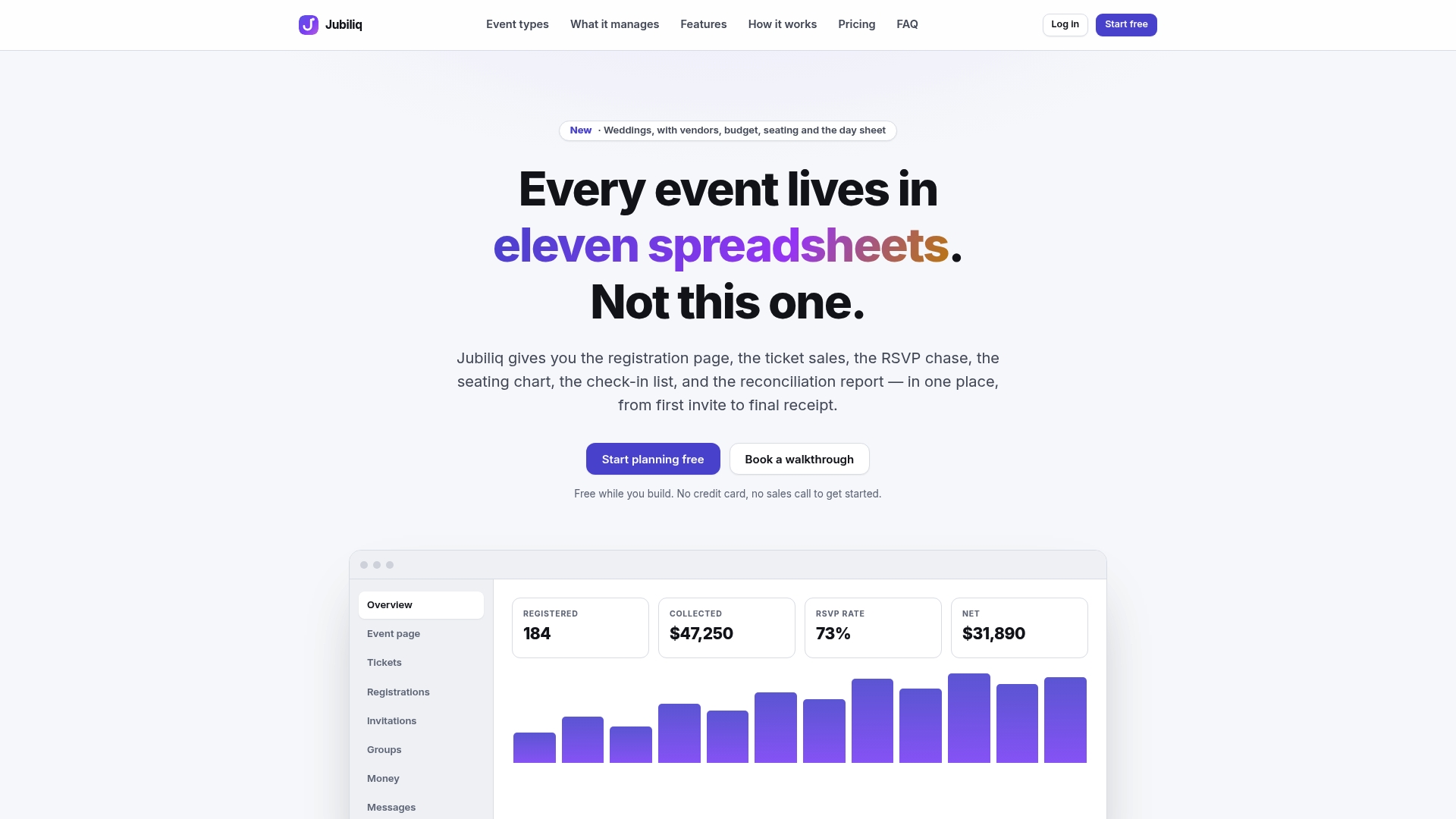
The platform centralizes your group booking link alongside your guest list, so RSVP status and room pickup live in the same view. Reminders go out automatically to guests who haven’t booked yet, contracts stay stored where your whole planning team can find them, and your financial tracking keeps deposits and master-bill charges tied to your actual event budget instead of a separate mental math problem. When the wedding weekend arrives, a printable day sheet puts room assignments and check-in notes in the hands of whoever is coordinating on-site, without anyone needing to dig through email.
Because some planning platforms adapt to weddings specifically, the tools relevant to managing a room block surface automatically while features built for other event types stay out of your way. If your guest list, RSVP tracking, and hotel block feel like they’re living in three disconnected systems right now, set up your wedding on Jubiliq and bring them into one.