Vendor Payment Schedule for Events: Build One That Works

Vendor Payment Schedule for Events: Build One That Works
A vendor payment schedule is a single list of every deposit, installment and final balance you owe your event suppliers, each with an amount, a due date (or the trigger that sets it), a payment method and a status. Build it from the signed contracts, sort it by the date money leaves your account, and update it whenever a headcount or scope changes. This guide shows how to set one up, what split to expect, and how to keep it honest as the event gets closer.
TL;DR
- List every payment as its own row: vendor, amount, due date or trigger, method, fees and status. Pull the figures from signed contracts, not from emails.
- A common structure is reservation, progress and balance. Wedding vendors often ask for 25 to 50 percent at signing, with the rest due 14 to 30 days before the event.
- Net terms count calendar days from the invoice date. Sort your schedule by due date, never by invoice date.
- Get late-fee rules, cancellation terms and guest-count deadlines in writing before you sign.
- Check the schedule against your income dates. An event can be profitable and still miss a payment if deposits fall due before ticket revenue arrives.
Table of Contents
- What a vendor payment schedule contains
- How to split deposits, milestones and balances
- When vendors expect to be paid
- Net 7, Net 15, Net 30: how payment terms change your dates
- Match payments to your income
- Questions to settle before you sign
- Late, disputed or changed payments
- Our perspective
- Keep your payment dates next to your budget
- FAQ
- Sources
What a vendor payment schedule contains
Think of it as a register of upcoming payments. One published wedding template gives each deposit, installment and final balance its own row, with the amount, due date or trigger, payment method, fees and a link back to the source document. A more detailed event version adds the contract it belongs to, the stage it pays for, the internal deadline (usually a few days before the contractual one), who owns the payment and its status.
Here is a practical layout:
| Vendor | Stage | Amount | Due date or trigger | Method | Fees | Owner | Status |
|---|---|---|---|---|---|---|---|
| Venue | Deposit | Per contract | On signing | Check | None | You | Paid |
| Caterer | Progress | Per contract | Menu approval | Card | Card surcharge, if any | You | Scheduled |
| Caterer | Balance | Per contract | 14 days before, after final count | ACH | None | Treasurer | Open |
One rule keeps the table useful: every payment needs a contractual basis, a clear deliverable and a named person responsible. A payment calendar guide points out that an invoice alone does not show the terms or the acceptance criteria. If a row has no contract behind it, it is a guess, not a schedule.
How to split deposits, milestones and balances
The usual shape has three parts: a reservation payment that holds the date, one or more progress payments, and a balance near the event. One supplier-contract guide describes the typical split as reservation 10 to 30 percent, progress 30 to 50 percent, and balance in event week or on the day. Treat these as ranges to negotiate within, not rules.
A few published reference points show how much it varies:
- A festival and event production guide suggests, when possible, a 50% deposit with the remaining 50% at Net 30 for vendors. It says artist deposits normally run 10% to 50%, with the balance on the day of the show.
- An event planning agency’s checklist gives illustrative terms of 25% to 30% on signing, 40% to 50% around the midpoint, and 25% to 30% seven to 14 days before the event. The agency itself calls these examples, not universal rules.
- A sample 9 to 12 month runway uses 20% at booking, 30% at 90 days out and 50% at 14 days out, after the final headcount.
Why a deposit plus a later balance is the norm
The logic is shared risk. The vendor recovers upfront costs, and you keep some flexibility if scope changes before the balance. Milestone payments push this further. They tie each payment to a deliverable, such as menu approval or a final proof, instead of just a calendar date. That gives you leverage if a vendor slips between stages, and gives the vendor steady cash flow.
A worked example
Say you are planning a 150-guest fundraising gala and the caterer’s contract totals $12,000. A schedule using a 25/40/35 split could look like this:
- $3,000 (25%) on signing, to hold the date.
- $4,800 (40%) at menu approval, roughly halfway to the event.
- $4,200 (35%) 14 days before, once the guaranteed count is locked.
The last figure may move. If the contract prices per head and your count drops, the balance shrinks. If it rises, the balance grows. That is why the guaranteed-count date belongs on the schedule as its own line, not buried in the contract.
When vendors expect to be paid
Timing differs by vendor type. Based on one wedding vendor guide, final payments usually fall 14 to 30 days before the event. Venues typically want the balance 30 to 60 days before. Caterers ask for it 14 to 21 days before, once the final headcount is in. Photographers usually fall in the 7 to 30 day window.

The same logic applies to corporate and nonprofit events, even if the vendors differ. Venues and large production suppliers tend to be paid earliest. Day-of vendors such as rentals, music and staffing tend to be paid last, sometimes on the day.
How far back should your schedule reach? A cash-flow guide suggests starting on the first date money is owed, often the venue commitment, and running 60 days past the event. That window catches late invoices, refunds and final payouts that arrive after the party is over.
Net 7, Net 15, Net 30: how payment terms change your dates

If a vendor invoices you instead of using fixed milestones, the invoice terms set your due date. Net 15, 30 or 60 mean payment is due 15, 30 or 60 days from the invoice date, while “due on receipt” means pay immediately. Net terms count calendar days, not business days, and a term like 2/10 net 30 gives a 2% discount if you pay within 10 days.
Two habits prevent most timing mistakes:
- Use the due date, not the invoice date. An event cash-flow guide advises listing outflows by the date the money must leave the account.
- Check what starts the clock. A Net 30 invoice issued a week before the event does not leave you 30 days of breathing room if the contract says the balance is due before the event. Our own piece on vendor contract terms and trigger dates goes deeper on this.
For typical event vendors, one guide describes Net 30 for most suppliers, with larger vendors accepting Net 45 or Net 60. Treat that as a starting point for negotiation.
Match payments to your income
This is where many fundraisers and ticketed events get caught. The venue deposit, the caterer’s reservation and the deposit for the band all fall due months before most tickets sell. An event can be profitable overall and still miss a payment because the money arrives after the bill.
The fix is a running balance:
- Add your income dates (ticket sale waves, sponsor pledges, donor commitments) on the day the money reaches the bank.
- Add each vendor payment on its due date.
- Keep a running balance down the page and find the lowest point.
- If that low point goes negative, you have three levers: negotiate a later milestone, move a sponsor invoice earlier, or open an early-bird ticket window.
If your event includes a private event menu from a restaurant or caterer, ask early whether the deposit can be tied to menu approval rather than to the signing date. That one change can push a large payment closer to your first ticket revenue.
Questions to settle before you sign
A schedule is only as good as the contract behind it. Before signing, confirm these items, drawn from a deposit and payment checklist:
- The deposit amount and what exactly it reserves.
- Interim payment amounts and dates.
- The final guest-count date and the rules for adjustments.
- Accepted payment methods and any surcharges.
- Additional charges, such as service fees, gratuities and overtime.
- Late-payment consequences.
- Date-transfer and force majeure terms.
- Whether the price is locked.
Changes should be in writing too. One contract guide says the agreement should require written change orders signed by both parties. If your attorney or an experienced planner reviews contracts for you, have them look at the payment and cancellation clauses first. Our guide to cancellation clauses that protect event budgets and our notes on catering contract duties show what to look for.
Late, disputed or changed payments
Plan for the unexpected before it happens. One vendor-terms guide says late fees are typically 1.5 percent per month past the net window, and that a first late payment usually draws a written notice before any penalty. It also advises getting the full schedule in writing, including every remaining due date and what happens if a payment is late.
A contract should define the late-payment remedy: any grace period, fee or interest, and whether work can stop. A legal template guide cautions that disproportionate late fees may be unenforceable penalties. If a fee looks out of proportion, raise it before you sign, not after.
When a vendor cancels or you must, the paper trail decides the outcome. A supplier-contract checklist says postponement terms should cover transferability, rebooking fees and price changes, and that supplier cancellation should at least trigger a refund, ideally replacement help. For a sense of how a real vendor writes this down, read a bar cancellation policy before you draft your own questions. If you need to notify guests, our cancellation email templates and refund policy clauses help.
Keeping the schedule current
A schedule goes stale in three predictable places: the guest count, the scope and the date. Review it at each of these points:
- When the final count locks. Recalculate every per-head balance.
- After any change order. Update the amount and the due date together.
- After each payment. Mark it paid, attach the receipt and note the confirmation number.
At the end, the final invoice should show the full approved price, credit the payments actually received, and leave one exact balance. If your records can produce that number in a minute, your schedule did its job.
Our perspective
Most payment problems we see are not about money. They are about information scattered across email threads, spreadsheets and memory. A deposit gets paid twice, a balance is missed because the guest count changed, or a treasurer finds out about a due date from the vendor.
We built Jubiliq around the idea that one event should live in one place. Vendors and contracts, the budget, tasks and the guest list sit side by side, so when the headcount changes, the people responsible can see what it does to the budget. Real-time progress dashboards and a printable day sheet mean the same facts reach the planner, the committee and the person on site.
The interface adapts to the event type. A bride managing a wedding budget sees what she needs. A nonprofit running a gala sees ticketing, sponsorship and donations. Irrelevant tools stay out of the way. That makes a payment schedule easier to keep, because you only maintain what your event actually involves.
Our advice: write the schedule when you sign the first contract, not when the first reminder arrives.
HCRF
Keep your payment dates next to your budget
If you are juggling vendor contracts, budget lines and tasks across several files, Jubiliq brings them into one event workspace. You can track budgets and vendor contracts, schedule tasks, manage guest lists and RSVPs, and print a day sheet for the event.
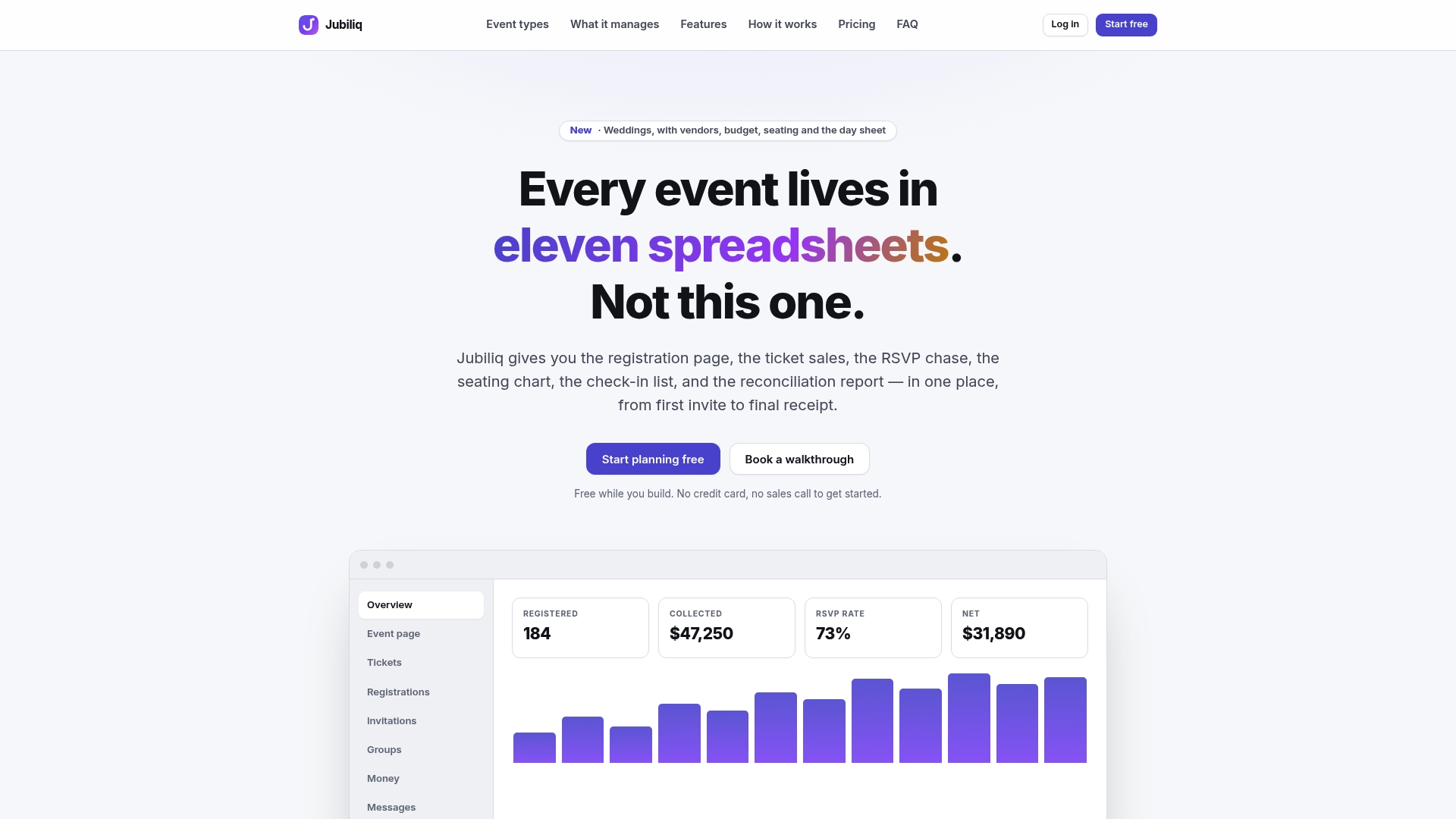
Planning-only events, such as weddings and parties without paid tickets, start on the Starter plan at $0 per event. The Organizer plan charges 2% per paid registration for events that sell tickets, and Enterprise is for organizations running multiple events. See the plans on the Jubiliq site. If you are still choosing suppliers, our guide to finding, vetting and booking vendors is a good first step.
FAQ
What should a vendor payment schedule include?
Each payment needs its own row with the vendor, stage, amount, due date or trigger, payment method, fees, owner and status. Add the contract it comes from and an internal deadline a few days before the contractual one. Include the guaranteed-count date, since it often changes the final amount.
How much deposit do event vendors usually ask for?
It varies by vendor and event. One wedding guide reports 25 to 50 percent of the total at signing, often nonrefundable. A festival production guide cites 10% to 50% for artists. Always confirm what the deposit reserves and whether it can transfer to a new date.
What does Net 30 mean on a vendor invoice?
It means payment is due 30 calendar days from the invoice date, not business days. Other terms such as Net 7, 15, 60 and 90 follow the same convention, according to an invoice terms guide. If the contract sets an earlier balance date for the event, that date wins.
When should the final vendor payment be made?
Most wedding vendors want the balance 14 to 30 days before the event, though venues often ask for it 30 to 60 days out. Caterers usually want it 14 to 21 days before, after the final headcount. Check each contract, because the due date is the one in writing.
Sources
- Wedding payment schedule: a template and how to build it
- Event Payment Schedule: Advances and Points of No Return
- How to Read Supplier Contracts: Payment Schedules
- Accounting / Contracting Guide for Festival and Event Production
- What to Include in Your Event Planning Contract (Checklist)
- Event Vendor Payment Terms That Protect You
- Wedding Vendor Deposits and Payment Schedules Explained
- Event cash flow: deposits before ticket revenue
- Invoice Payment Terms Explained
- Invoice payment terms: definitions, examples, and tips
- Event Deposit and Payment Schedule: What to Ask
- Event Vendor Contract Template: Key Clauses to Include
- Event Supplier Contracts: 12 Clauses To Check
- Event Vendor Deposits, Payments & Receipts
- Bar Cancellation Policy
- Private Event Menus