Event Ticket Tiers: Types, Pricing and How to Set Them Up

Event Ticket Tiers: Types, Pricing and How to Set Them Up
Event ticket tiers are different price levels for the same event. A tier can mean a different experience (general admission versus VIP), a different moment (early bird versus regular), or simply a different batch of the same ticket that costs more as the earlier batch sells out. The label alone tells you very little, so the job for an organizer is to define each tier clearly, price it for a reason, and say plainly what the buyer gets.
This guide covers the tier models organizers use, how to price and cap them, how to explain them without confusing buyers, and which structures suit a wedding, a corporate event, a fundraising gala, a large party and a golf outing.
TL;DR
- A tier is either an access tier (what you get) or a release tier (when you buy). Many events use both, and mixing them up is the most common cause of buyer confusion.
- Tier names like GA1, GA2 or Tier 3 have no universal meaning. You define them, so you have to explain them.
- Keep it to two to four tiers, make every price step explainable by a visible benefit or a clear deadline, and cap quantities before you open sales.
- Match the structure to the event: free or planning-only for weddings and parties, sponsor levels for galas, packages for corporate events, player and hole options for golf.
- Regulators have acted against unexplained premium labels. Plain descriptions protect your guests and your reputation.
Table of Contents
- What ticket tiers actually mean
- The main types of ticket tiers
- VIP versus general admission
- How to set ticket tier prices
- Explain every tier so buyers can choose with confidence
- Ticket tier structures by event type
- Common mistakes with ticket tiers
- Perspective
- Plan and sell your tiers with Jubiliq
- FAQ
- Sources
What ticket tiers actually mean
People search “tier 1, 2, 3 and 4 tickets” expecting a standard scale. There isn’t one. The number only means something inside the event that uses it, and organizers use it in at least two different ways.
Tiers as seating or viewing categories. Large ticketed events often sort seats into lettered or numbered categories. LA28, for example, explains that Categories A through J are pricing tiers tied to different viewing points, with A the highest priced and J the lowest, and not every venue has every category. Here the tier describes where you sit and what you pay for it.
Tiers as release stages. Sometimes a higher number just means a later batch. The official ticket page for Boots in the Park lists general admission tiers at $104, $124 and $149, with no difference in benefits between them: the price rises as each quantity sells out. VIP is a separate product on that page, with express entry, a dedicated viewing area, stage access, VIP vendors and private restrooms.
So when you set up your own tiers, decide first which kind you are building. If Tier 2 costs more only because Tier 1 sold out, say so in the description. If Tier 2 includes something extra, name the extra.

The main types of ticket tiers
Most events draw from the same short menu. Pick the ones that fit your audience, not all of them.
| Tier type | What differs | Best for |
|---|---|---|
| General admission | Basic entry, no reserved spot | Parties, open houses, community events |
| VIP or premium | Better access, space or perks | Galas, festivals, client events |
| Early bird | Lower price for a limited time or quantity | Any event that needs early cash |
| Release stages (Tier 1, 2, 3) | Same ticket, price rises as batches sell | Events with a hard capacity |
| Reserved or table seating | Assigned seat or table | Dinners, galas, banquets |
| Group or bundle | Discount at a set quantity | Corporate teams, golf foursomes, families |
| Multi-day or single-day pass | Length of access | Conferences, tournaments with several sessions |
| Sponsor packages | Ticket plus visibility and benefits | Fundraisers, charity golf outings |
Pricing tiers versus ticket types
A ticket type describes what the ticket is: general admission, a table of ten, a dinner-only seat, a child pass. A pricing tier describes the price level at which a given type is sold, usually tied to time or quantity. One event can have three ticket types, each with its own early bird and regular price. Keeping the two ideas separate in your planning makes the setup far easier to read, both for you and for your guests.
VIP versus general admission
The VIP versus general admission question comes down to three things: access, comfort and extras. Price follows from how much of each you add.
The official 2022 pass page for Firefly Music Festival gives a clear illustration. General admission covered festival and performance access. VIP added main-stage viewing, shaded areas, private air-conditioned restrooms, hospitality lounges, private bars and complimentary bottled water. Super VIP went further, with concierge service, side-stage access, an open bar and snacks, food vouchers and golf-cart service.
Pricing from the same category of event shows the spread. The Charlotte Observer reported that for Lovin’ Life Music Fest in 2024, three-day GA was $319, Main Stage VIP $669 and Super VIP $1,299. VIP added front-row access, dedicated entrances, private bars, food and restrooms, while Super VIP added complimentary drinks and food plus indoor air-conditioned seating.

You don’t need a festival budget to use the same logic. A fundraising dinner can offer general seating at one price and a front-table seat with a reception pass at a higher price. A corporate client event can offer a standard pass and an executive pass with a private lunch. The principle holds at every scale: the premium tier should give the buyer something they can name.
How to set ticket tier prices
Pricing tiers is mostly a matter of working backward from your costs and your capacity, then deciding how much of the room to put in each tier.
Step 1: Know your break-even
Add up your fixed costs (venue, catering minimums, entertainment, insurance) and your per-guest costs (meal, favor, transport). Divide the fixed costs by the number of paid guests you realistically expect, then add the per-guest cost. That gives you the lowest price at which the event pays for itself before fees. A budget tracker that sits next to your guest list makes this a quick calculation rather than a spreadsheet project.
Step 2: Choose the number of tiers
Two to four is plenty. Every extra tier adds explanation, and buyers who face too many near-identical choices tend to stall. A simple structure is a base ticket, a premium ticket and, if the event warrants it, an early price on the base ticket.
Step 3: Decide what each step up is worth
Cost out the extras you are adding to the premium tier: the better seating area, the extra drink tickets, the private entrance, the meet-and-greet. The premium price should cover those costs and leave margin, while still reading as fair next to the base ticket. Here is a worked example with illustrative numbers for a 200-guest charity dinner:
- Base seat: $75, includes dinner and entertainment.
- Premium seat: $125, adds a front-section table, a welcome reception and a reserved parking spot. The extras cost you roughly $25 per guest, so the step up carries margin.
- Table of ten: sold at a modest group rate for companies that want to host clients.
These figures are examples, not recommendations. Your costs and your community decide the real numbers.
Step 4: Set quantities before you open sales
A tier needs a cap. Decide how many premium seats the room can genuinely support (front tables, VIP area capacity, reserved parking) and how many tickets each release stage will hold. If you run release stages, set the quantity at which Tier 1 closes and Tier 2 opens, and write that rule down so the changeover doesn’t feel arbitrary to buyers.
Step 5: Add time-based pricing carefully
An early price rewards people who commit sooner and brings cash in while your deposits are due. If you want to see how the numbers work, our guide to early bird pricing for organizers walks through a discount-and-cap approach. Pricing that moves with demand in other industries, such as peak and off-peak dynamic pricing, shows how far buyers will accept price changes when the rules are clear. For events, keep it simpler: a fixed early deadline and a fixed regular price are easier to explain than a price that drifts.
For teams and families, a quantity discount is often better than a deadline. Our piece on group ticket discounts covers how to set the minimum and prepare for the inquiries that follow.
Explain every tier so buyers can choose with confidence
Unexplained tiers create refund requests, awkward emails and, at scale, regulatory attention. In the UK, the Competition and Markets Authority said Ticketmaster had sold some platinum tickets at almost 2.5 times standard prices without sufficiently explaining that they offered no extra benefits over some standard tickets in the same areas. In September 2025 the CMA announced that Ticketmaster must disclose tiered pricing 24 hours in advance, show price ranges in online queues, update the ranges as cheaper tickets sell out, and avoid misleading labels. That is a UK action against one large seller, not a rule for every organizer in every country, but it is a useful standard for anyone selling tiered tickets.
A practical checklist for your ticket page:
- Name each tier for what it gives. “Front Table and Reception” beats “Platinum.”
- List the differences in plain bullets. Access, seating, food and drink, parking, extras.
- State the quantity and the rule. “100 seats at this price, then the price rises to $X.”
- Show all tiers side by side so no one learns about the cheaper option after paying.
- State what is the same. If every tier gets the same dinner, say so.
- Tell buyers what happens if they change their mind. Our guide on cutting ticket refunds covers the operations side.
If you publish an event website, put the tier comparison on the tickets page and link to it in every invitation and reminder email. Our guide to event website essentials lists the pages worth building. For more on the selling mechanics, read how to sell event tickets online.
Managing a tier change
When Tier 1 sells out, tell people. Update the page the same day, show the new price and note how many seats remain at it. If you promised a deadline, honor it to the minute. Buyers remember whether you kept your own rules, and they talk.
Ticket tier structures by event type
The right tier structure depends on who is buying and why. These are starting points you can adapt.
Weddings
Most weddings don’t sell tickets at all, so tiers are about guest management rather than price. Think in groups: ceremony only, ceremony and reception, rehearsal dinner, welcome party. Each group gets its own RSVP and meal choice. If you do sell something, such as a charity raffle or a cash-bar pass at a destination wedding weekend, keep it to a single option. On a budget, the useful tiering is internal: A-list and B-list guests, so you can send invitations in waves as replies come in.
Corporate client events
Corporate events benefit from packages. A standard pass covers sessions and lunch. An executive pass adds a private roundtable or a reserved front row. A team package covers five or ten attendees at a combined price. Keep the tiers simple enough that an assistant booking for a manager can choose in one pass.
Fundraising galas
Galas usually combine ticket tiers with sponsorship levels. Individual seats can be general or premium, tables can be sold whole, and sponsors can buy a table plus recognition. Because sponsor benefits need careful wording, see our gala sponsorship levels templates. Remember that donors often care more about the cause than the perk, so describe what each tier funds as well as what it includes. If part of a ticket is a donation, check with your tax adviser how to describe the deductible portion to attendees.
Large parties and private events
For a milestone birthday or a community party, one or two tiers is plenty: general entry, and perhaps a food-and-drink package. Our private event planning guide covers the rest of the planning. If the party is free, you can skip ticketing and use RSVP tracking alone.
Golf outings
Golf tournaments have a natural tier structure. Options include an individual player, a foursome at a combined price, a dinner-only guest, and hole or cart sponsorships. Early registration helps you secure the course count and the food order. Cap the player slots at what the course can host, and sell sponsorships separately from player tickets so the sponsor benefits are clear.
Common mistakes with ticket tiers
- Too many tiers. Four near-identical options make buyers hesitate and make your support inbox busier.
- A premium tier with no visible premium. If buyers can’t say what the extra money buys, you lose trust.
- No cap. An uncapped VIP tier quickly dilutes the experience you promised.
- Changing the rules midstream. Moving a deadline or adding a cheaper tier after selling premium seats annoys the people who paid first.
- Hiding the final price. Show what the buyer pays, fees included in the way your local rules require, before the final click.
- Forgetting the day-of. Each tier needs a line on your day sheet: who checks them in, which entrance, which wristband, which seat.
Perspective
At Jubiliq we see the same pattern: organizers think tiers are a pricing question, then discover they are really an operations question. Every tier you create is a promise that someone has to keep on the day, at the door, at the table, in the seating chart and in the catering count.
That is why we built Jubiliq around the idea that an event platform should adapt to the event rather than make the organizer adapt to the software. A wedding doesn’t need ticket tiers cluttering the screen. A golf outing needs player slots and sponsorships. Our adaptive interface is designed to hide the tools an event doesn’t need and surface the ones it does, so tier decisions sit next to your guest list, budget, tasks and day sheet instead of in a separate tool.
Our advice is to start with the day-of experience and work backward. Write down what each tier receives, who delivers it and what it costs you. If you can’t answer all three in one sentence, the tier isn’t ready to sell.
HCRF
Plan and sell your tiers with Jubiliq
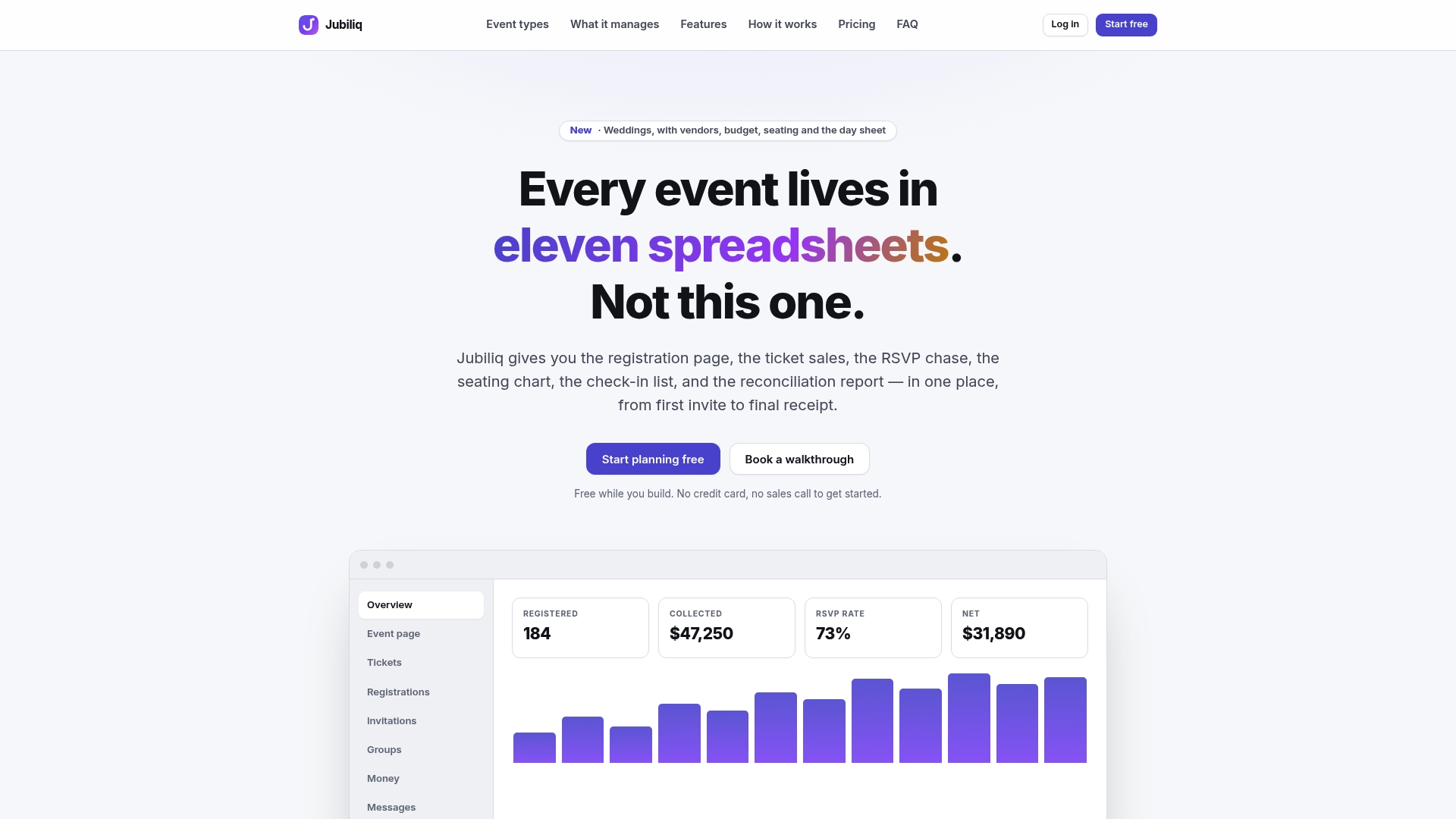
Jubiliq is an event planning platform that handles guest lists with RSVP tracking, budgeting, vendors and contracts, task scheduling, seating and catering workflows, and a printable day sheet. When your event sells tickets, sponsorships or donations, you can run those sales through the same account and follow progress on a real-time dashboard.
The Starter plan is $0 per event, and events without paid tickets, such as weddings, parties and planning-only events, are free. The Organizer plan charges 2% per paid registration, plus Stripe processing fees. Enterprise is for organizations running multiple events, with custom pricing. See the plans on Jubiliq and set up your event.
FAQ
What is the difference between VIP and general admission?
General admission gives basic entry to the event, usually without a reserved spot. VIP adds access or comfort, such as a dedicated entrance, a better viewing or seating area, private restrooms, food or drink. The exact list is set by the organizer, so always read the ticket description.
What do Tier 1, Tier 2 and Tier 3 tickets mean?
There is no universal definition. Sometimes they are seating or viewing categories, and sometimes they are release stages of the same ticket, with the price rising as each batch sells out. Organizers define them, so the event’s official ticket page is the only reliable guide.
How many ticket tiers should an event have?
Two to four is enough for most events. A base ticket, a premium ticket and an early price on the base ticket cover the needs of many weddings-adjacent gatherings, galas and corporate events. Add more only if each one offers something clearly different.
Should I use early bird pricing or release stages?
Use early bird pricing when you want a fixed deadline and need cash sooner. Use release stages when your capacity is firm and you want the price to rise as seats sell. Either way, publish the rule so buyers know how the price will change.
Do ticket tiers need to be disclosed?
Yes, as a matter of good practice everywhere, and in some markets as a matter of consumer protection. The UK’s CMA required Ticketmaster to disclose tiered pricing in advance and avoid misleading labels. Check the consumer rules where you sell, and describe every tier clearly.
Sources
- What does Category A, B, C, D, etc., mean? (LA28)
- OC Tickets, Boots in the Park
- What Does GA1, GA2, GA3 Mean in Concert?
- 2022 Firefly Music Festival passes
- Lovin’ Life Music Fest: How do GA and VIP tickets compare? (Charlotte Observer)
- CMA secures changes from Ticketmaster following Oasis tickets investigation (GOV.UK)
- Dynamic pricing, peak and off-peak