20% Off, 20% Cap: Early Bird Pricing to Lock Early Cash for Organizers

20% Off, 20% Cap: Early Bird Pricing to Lock Early Cash for Organizers
Set your early bird discount at 20% off the full price, cap it at 20% of sellable inventory, and let it run for six weeks (or shorten to two to three weeks for smaller, single-day events). That configuration works for most first-time organizers because it balances urgency against margin loss. Larger, recurring events can tighten the discount to 15% once demand history exists. Everything below explains why this works, how to adjust the numbers to your event, and how to enforce the rules once tickets go live.
TL;DR:
- Early bird discounts should be set at 15% to 25% below full price, representing 15% to 25% of total inventory, to create credible urgency without eroding margin.
- The ideal duration for early bird periods varies by event type, from two to three weeks for single-day events to six weeks for festivals, based on planning complexity.
- Automated tier transitions and strict caps are essential to enforce deadlines and caps, preventing extensions that weaken the scarcity effect.
- Active email campaigns, multiple reminders, and clear next-price messaging significantly boost early bird ticket sales within the set timeframe.
- Excessive discounting, extending deadlines, or removing caps threaten the strategy’s effectiveness and can lead to lower revenue or lost margin.
Table of Contents
- What Early Bird Pricing Actually Does
- Why Organizers Rely on Early Bird Tickets
- How to Set Your Discount and Timing
- Structuring Tiers and Allocating Inventory
- The Email Cadence That Actually Sells Early Bird Tickets
- Setting Up Ticket Tiers Without Breaking Your Checkout
- Where Early Bird Pricing Goes Wrong
- Tracking Whether Your Early Bird Strategy Is Working
- Worked Examples You Can Copy Directly
- How Jubiliq Enforces Your Early Bird Rules Automatically
- When to Push Hard vs. Play It Safe
- Start Building Your Early Bird Tiers in Jubiliq
- Where These Benchmarks Come From
- Sources
- FAQ
What Early Bird Pricing Actually Does
Early bird pricing is a time or quantity limited discount on the first block of tickets sold, priced below the tier that follows it. The mechanic works because it converts patience into a cost. A buyer who waits doesn’t just risk paying more. They risk losing a specific, limited option, and that loss looms larger in a buyer’s mind than an equivalent gain.
Behavioral pricing research backs this up. Advance-selling models show that offering a discount to buyers who commit early raises overall profits by unlocking a segment of lower-valuation buyers who wouldn’t pay full price later, while still capturing full value from buyers who wait. The advance-purchase discount research shows this only works when capacity or marginal costs justify the tradeoff, which is why blanket discounting without a cap or deadline erodes the strategy instead of strengthening it.
The tactic also compresses decision time. A ticket buyer facing an open-ended registration window has no reason to act today. A buyer facing a countdown does. That’s the entire engine behind early bird pricing strategy, and it’s why the mechanic shows up everywhere from conferences to golf tournaments to gala fundraisers.
Why Organizers Rely on Early Bird Tickets
The most immediate benefit is cash flow. Venue deposits, catering minimums, printing, and staff booking fees all land before your event happens, and early bird tickets generate the revenue to cover them without dipping into a line of credit or personal savings.
Beyond cash, early sales act as public proof that people want to attend. A registration page showing 340 tickets sold reads very differently than one showing zero, and that momentum makes the next wave of buyers more comfortable purchasing at full price. Early commitment also reduces churn. Someone who paid weeks in advance has more psychological investment in showing up than someone who bought a ticket the night before.
That said, early bird pricing can backfire when organizers treat it as a permanent discount instead of a limited window:
- Extending the deadline more than once trains your audience to ignore future deadlines entirely.
- Running the discount for the entire sales cycle strips out the urgency that made it valuable in the first place.
- Discounting too aggressively on a low-margin event can turn a full house into a financial loss.
- Skipping a hard cap removes the scarcity signal that drives the psychology in the first place.
Early bird sell-through commonly runs 15% to 30% below full price, according to organizer benchmark data from TickPick’s pricing guide, with 20% to 25% being the most common range across events of varying size. That range exists because it’s steep enough to feel like a real deal, but not so steep that it signals desperation or undercuts the perceived value of your event.
How to Set Your Discount and Timing

Academic pricing models point to a specific number that matters more than most organizers realize: the gap between your early bird price and your next tier. A Wharton study on advance ticket pricing found that price gaps in the 15% to 25% range are what create credible urgency. Anything smaller and buyers don’t feel the “sting” of waiting. Anything larger and the discount starts to look like a gimmick rather than a genuine reward for early commitment.
Duration depends heavily on event type. A single evening gala doesn’t need a six-week early bird window. A multi-day conference or festival, where buyers plan travel and time off work, benefits from a longer runway.
| Event type | Suggested window | Typical discount |
|---|---|---|
| Single-day local event | 2 to 3 weeks | 15% to 20% |
| Weekend conference | 4 to 2 to 3 weeks | 20% to 25% |
| Multi-day festival | 6 weeks | 20% to 30% |
| Annual gala or fundraiser | 6 weeks | 15% to 25% |
Deciding between a quantity cap and a date cap comes down to what you need more urgently:
- Choose a quantity cap when cash flow is the priority. You need deposits covered by a specific dollar figure, not a specific calendar date.
- Choose a date cap when marketing timing matters more. You want a hard deadline to build a promotional push around.
- Use both together as the strongest default. The date closes the tier no later than a set point, but the tier can also sell out early if demand is strong. Eventist’s organizer guide recommends this combined approach specifically because it protects margin without sacrificing the marketing beat a deadline creates.
Structuring Tiers and Allocating Inventory
Two tiers, early bird and general admission, cover most events fine. Add a third tier (often labeled “last chance” or “regular”) when your sales window is long enough to need a middle price point between the early discount and full price. A fourth tier is rarely worth the complexity unless you’re running a large conference with distinct pricing seasons.
Inventory allocation follows a simple rule: early bird should represent 15% to 25% of your total sellable capacity. Set it lower than that and the tier sells out too fast to generate meaningful cash flow. Set it higher and you’re giving away margin on tickets that would have sold at full price anyway.
Here’s how that plays out at different capacities:
- A 300-seat gala at $150 per ticket: early bird cap of 60 tickets (20%) at $120, saving buyers $30 each.
- A 1,200-person conference at $400 per ticket: early bird cap of 240 tickets (20%) at $320, saving buyers $80 each.
- A 5,000-capacity festival at $85 per ticket: early bird cap of 1,000 tickets (20%) at $68, saving buyers $17 each.
Notice the pattern: the percentage stays consistent, but the dollar savings scale with your base price. That consistency is what makes 15% to 25% a reliable starting point rather than a number you have to reinvent for every event.
The Email Cadence That Actually Sells Early Bird Tickets
Early bird tickets don’t sell themselves just because they’re cheaper. They sell because buyers are told, repeatedly and specifically, that the discount is disappearing. A quiet launch with no follow-up almost always underperforms, according to organizer case data from VenueSight’s early bird strategy breakdown, which found that active email sequences and visible next-price messaging are what actually convert interest into purchases.
Run four emails minimum:
- Launch email, sent the day the tier opens. Subject line should name the discount and the deadline in the same breath, something like “Early Bird Tickets Are Live, Save 20% Until [Date].” Lead with the price difference in dollars, not just percent.
- Midpoint update, sent roughly halfway through the window. Report progress honestly: “60% of Early Bird Tickets Are Gone.” This is where social proof does its heaviest lifting.
- Seven-day reminder, sent exactly one week before the cutoff. Subject line should create a countdown feel: “One Week Left at This Price.”
- Final-day email, sent the morning the tier closes. Keep it short. State the exact time it closes and what the price becomes afterward.
Pair the email cadence with a lightweight amplification checklist:
- Post a live ticket counter on your event page if your platform supports it.
- Ask sponsors or partner organizations to share the early bird announcement to their own lists.
- Run a small paid boost behind the launch and seven-day reminder emails specifically, since those two dates carry the most urgency.
- Include a testimonial or attendee quote from a past event if you have one, since social proof compounds the scarcity message.
Pro Tip: Never bury the next price in fine print. Put it right next to the current price in every email and on the checkout page itself, “Early Bird: $320 (General: $400 starting March 15).” Buyers respond to visible contrast, not implied urgency.
Setting Up Ticket Tiers Without Breaking Your Checkout
Strategy only matters if your registration platform executes it correctly. Most ticketing errors happen at setup, not at launch.
Configure each ticket type as a separate inventory pool with its own cap, rather than a single ticket type with a manually applied discount code. Manual discount codes are easy to leak, hard to track, and don’t automatically shut off when inventory runs out. A dedicated tier with a hard cap does that work for you.

Automatic tier transitions matter more than most organizers expect. Platform guidance from Zoho Backstage’s dynamic pricing documentation points out that automating the switch from one tier to the next removes the manual error risk entirely, someone forgetting to disable a code at midnight, or a staff member accidentally extending access. Automation also keeps sales moving without a person watching a dashboard around the clock.
Before launch, run a short quality assurance pass:
- Complete a full test checkout as a buyer, not an admin, to confirm the price and cap display correctly.
- Simulate hitting the cap to verify the tier actually closes and the next tier activates.
- Check how promo codes interact with the early bird tier. The safest rule is non-stacking: a buyer gets either the early bird price or a group discount, whichever is larger, never both.
- Confirm your export or accounting feed reflects the correct tier revenue split, since finance teams need that breakdown for reconciliation.
Where Early Bird Pricing Goes Wrong
The single most damaging mistake is extending the deadline. Organizer guidance is consistent on this point: extending an early bird deadline once trains your audience to ignore every deadline you set afterward, for this event and for future ones. If sales are lagging near the cutoff, the fix is more marketing pressure on the existing deadline, not a longer deadline.
A few other patterns cause real damage:
- Too-small tier gaps. A discount under 15% doesn’t create enough contrast to motivate action, so buyers see no reason to skip waiting.
- An invisible ladder. If buyers can’t see what the next tier costs, the fear of missing the deal disappears along with it.
- Discounting every event the same way regardless of demand. A sold-out annual event doesn’t need the same discount depth as a brand-new one.
If you genuinely must release more early bird inventory, because demand outpaced your forecast, communicate it as a capacity increase, not a deadline extension: “We’ve added 50 more Early Bird tickets due to demand” reads very differently than quietly moving the cutoff date.
Pro Tip: If your early bird tier undersells by the midpoint of the window, don’t panic and discount further. Increase targeted promotion first. A pricing problem and a visibility problem look identical from the outside but require opposite fixes.
Tracking Whether Your Early Bird Strategy Is Working
Three numbers tell you almost everything you need to know: early bird sell-through percentage, revenue advanced (how much cash you’ve collected before the event relative to your total budget), and pacing versus your plan or prior comparable events.
VenueSight’s operational guidance suggests using pacing as an early-warning system: by the midpoint of your early bird window, sales should track within 10% to 15% of a comparable prior event. Fall outside that band and you have a clear signal to act, before the deadline arrives, not after.
Secondary metrics round out the picture:
- Email open and click rates on your cadence, especially the seven-day reminder, since a drop there often predicts a weak final push.
- Refund and no-show rates among early bird buyers compared to full-price buyers.
- Social shares or mentions tied to your launch and midpoint announcements.
Use two decision rules once you have this data: if pacing is ahead of plan and inventory is thin, consider a small capacity release rather than letting the tier sell out too early. If pacing is behind, increase marketing spend on your existing deadline before you touch the price or the date.
Worked Examples You Can Copy Directly
Numbers make this concrete faster than explanation.
That early bird revenue lands in your account before the event happens in every case, which is the entire point of the tactic. Note also that tiered pricing typically nets somewhat less total revenue than a hypothetical flat-price sellout, a tradeoff most organizers accept willingly in exchange for early certainty and reduced financial risk, according to TickPick’s organizer data.
Adapt the four-email cadence with this timing:
- Launch email, day one of the window, subject line names the discount and deadline together.
- Midpoint update, roughly at the window’s halfway point, reports percentage sold.
- Seven-day reminder, exactly one week before close, frames it as a countdown.
- Final-day email, morning of close, states the exact closing time.
Adjust the discount depth and window length based on your own fixed costs and how far in advance your audience typically plans.
How Jubiliq Enforces Your Early Bird Rules Automatically
The rules above only work if they’re enforced consistently, and that’s the part most organizers get wrong manually. An adaptive planning interface can set up ticket types with hard quantity caps and automated tier transitions, so a sold-out early bird tier closes itself the instant inventory hits zero, avoiding the need for manual intervention.
That automation removes the two biggest risks covered above:
- No accidental deadline extensions, since the cap and date rules run on the platform, not on a calendar reminder someone forgot to set.
- Real-time financial tracking shows exactly how much revenue has advanced against your total goal, mapped directly to the pacing metrics that matter.
- Printable day sheets and CSV exports hand your finance team a clean tier-by-tier revenue breakdown without manual reconciliation.
- Segmented email tools let you send the launch, midpoint, and reminder cadence to your registered list without juggling a separate email platform.
The operational discipline that makes early bird pricing work, caps that hold, deadlines that don’t move, numbers that reconcile cleanly, is exactly what a platform is built to enforce.
When to Push Hard vs. Play It Safe
First-time events with heavy upfront deposits should lean aggressive: a fuller discount and a generous cap, because cash flow risk outweighs the cost of leaving some margin on the table. Established events with proven demand should tighten both numbers, since the crowd will show up regardless and every discounted ticket is margin you didn’t need to give away.
The rule of thumb worth remembering: price for the risk you’re actually carrying, not the discount your competitor used last year. Your fixed costs and your audience’s buying patterns should set the number, nothing else.
— HCRF
Start Building Your Early Bird Tiers in Jubiliq
Jubiliq is the alternative to juggling spreadsheets, a separate email tool, and a ticketing platform that doesn’t talk to any of them. Every early bird rule covered in this guide, quantity caps, automated tier transitions, deadline enforcement, lives inside one adaptive interface that reconfigures itself based on your event type, whether that’s a wedding, a gala, or a golf tournament fundraiser.
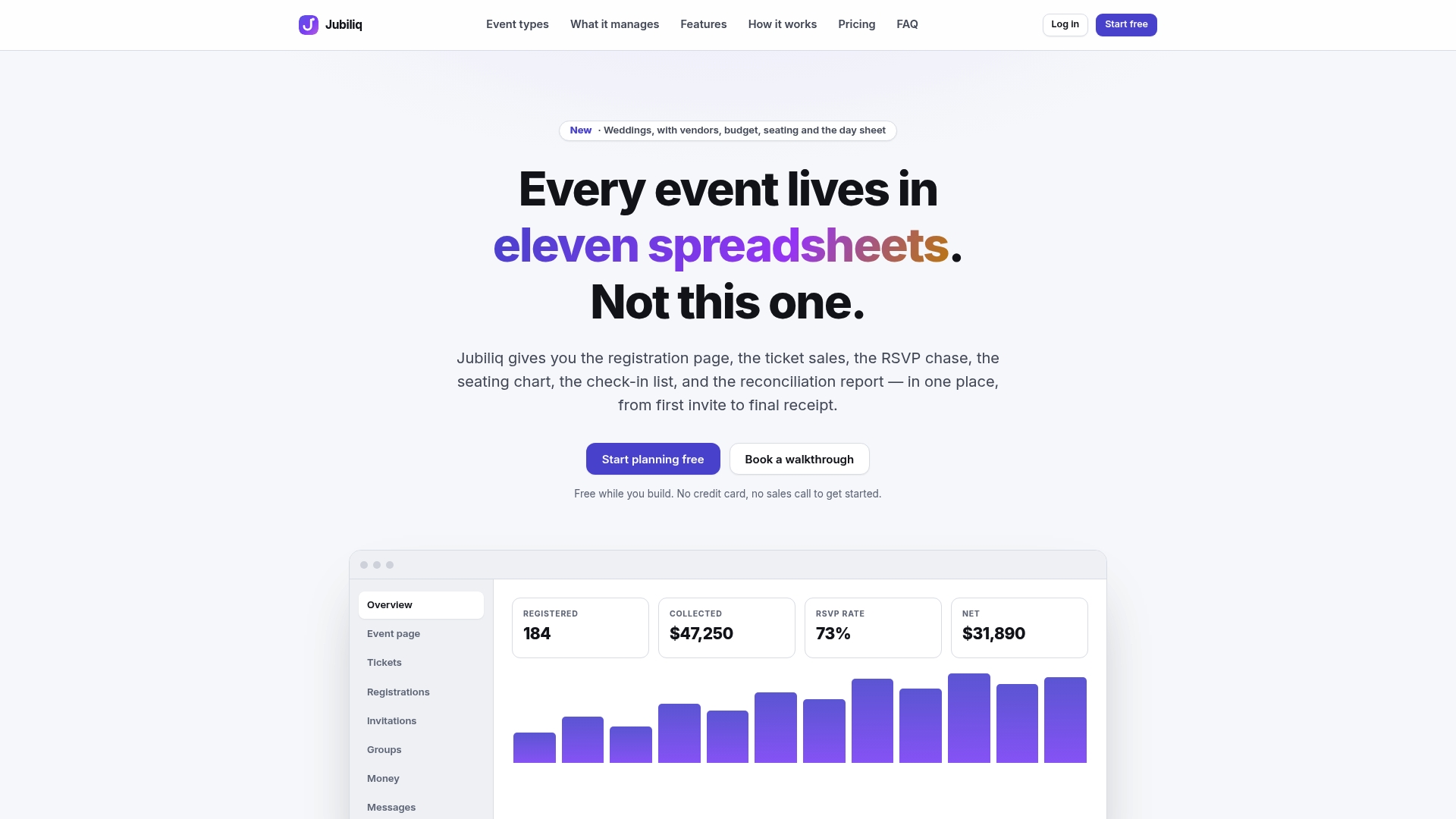
You get real-time financial tracking that shows exactly how much revenue has advanced against your goal, plus printable day sheets and CSV exports your finance team can use without manual reconciliation. Jubiliq’s Starter plan costs $0 per event upfront, and the Organizer plan runs a 2% fee per paid registration, so you’re only paying once tickets actually sell. Set up your first early bird tier and quantity cap on Jubiliq’s event platform today and see your sell-through pacing update in real time from the moment tickets go live.
Where These Benchmarks Come From
The discount ranges, tier gaps, and inventory caps referenced throughout this guide come from a mix of academic pricing research and organizer-facing industry guides. The Wharton study on price tiers grounds the 15% to 25% tier gap recommendation in pricing theory. TickPick’s organizer guide and Eventist’s strategy guide supply the practical discount and inventory benchmarks, while Zoho Backstage’s documentation covers the automation side of tier enforcement.
Sources
- Wharton marketing paper on price tiers and advance purchasing
- Early Bird Pricing: Discounts, Tiers, and Cutoffs | TickPick Organizer
- Early-Bird Ticket Pricing: The Complete Strategy Guide for Organizers
- Dynamic ticket pricing and staged tiers (Zoho Backstage)
FAQ
How Much Cheaper Is Early Bird Pricing?
Early bird tickets typically run 15% to 30% below the full ticket price, with 20% to 25% being the most common discount depth according to organizer benchmark data. The exact number should reflect your event’s margin and how far in advance your audience typically buys.
What Is Early Bird Ticket Pricing?
Early bird ticket pricing is a discounted rate offered to the first buyers who purchase before a set date or before a limited quantity of tickets sells out. It’s designed to reward early commitment while creating urgency for buyers who might otherwise wait.
What Does Early Bird Pricing Mean for Organizers?
For organizers, early bird pricing means trading some margin on the first batch of tickets in exchange for earlier cash flow, visible social proof, and validated demand before the event happens. Platforms like Jubiliq automate the caps and deadlines so that tradeoff enforces itself without manual tracking.
What Is an Example of Early Bird Pricing?
Once either the deadline passes or the 240 tickets sell out, the price moves to the next tier automatically.