8 Week Event Marketing Plan to Turn Attendees into Pipeline

8 Week Event Marketing Plan to Turn Attendees into Pipeline
An event marketing plan is a timeline-driven playbook that maps goals to channels, assets, responsibilities, and KPIs. It needs SMART goals, defined audience segments, a channel mix, a week-by-week timeline, a content calendar, and clear metrics tied back to revenue. The fastest path to a working plan is a template: open one now, pick your promotion timeline, and start filling in owners.
TL;DR:
- Set measurable targets with deadlines and owners, segment audiences into two to four groups, and tailor each message and call to action.
- Schedule save the date, early bird, launch, and reminder phases against milestones at 12, 8, 6, 4, 2, and 1 weeks before the event.
- Track registrations by source, attendance, qualified leads, pipeline, and closed revenue, assigning each measure a data source and an owner.
- Send thank you notes and surveys within 24–48 hours, then route sales ready leads immediately and place other attendees in tailored nurture sequences.
Table of Contents
- Build your event marketing plan step by step
- Which channels to use and when to launch them
- What content to create before, during, and after the event
- Budget allocation and the KPIs that prove ROI
- Day-of tactics that capture leads and create shareable moments
- Turning attendees into pipeline after the event ends
- A copyable event marketing plan template and 8-week checklist
- Operationalizing the plan with event technology
- Why competitive analysis shapes your event’s positioning
- Legal and compliance basics every event marketer should check
- Planning for what goes wrong: crisis communication basics
- Connecting event marketing to brand and corporate strategy
- Events work best as a measurable channel, not a one-off bet
- How Jubiliq fits into the plan you just built
- FAQ
- Sources
Build your event marketing plan step by step
A plan only works when it moves in order: goals first, tactics last. Skipping steps is why so many event teams end up boosting social posts a week before doors open with no idea whether it’s working.
- Set SMART goals and tie them to business outcomes. Decide whether this event needs to produce 500 registrations, 50 qualified leads, or $20,000 in sponsorship revenue, and assign one owner accountable for each number.
- Define and prioritize your audience segments. Split your list into past attendees, warm prospects, and cold outreach targets, then rank which segment gets the earliest and most personal outreach.
- Write segment-specific messaging and a single clear call to action per channel. A sponsor email and a past-attendee email should never share the same subject line.
- Choose your event format and registration model, and set pricing tiers. A virtual webinar, a hybrid conference, and an in-person gala each demand different promotion cadences and different ticketing logic.
- Work backward from the event date to build your promotion timeline. Mark milestones at 12, 8, 6, 4, 2, and 1 week out, and treat each as a checkpoint, not a suggestion.
- Assign tasks, approvals, and tools, then test the registration flow end to end. A broken registration form on launch day erases every dollar spent on the plan.
- Run launch phases in sequence: save-the-date, early bird, main launch, reminders. Each phase has its own offer and its own urgency, and skipping a phase usually costs you the attendees who needed extra nudges.
- Plan on-site content capture and finalize the follow-up sequence before the event starts. Decide now who records testimonials, who posts live updates, and who owns the thank-you email, so nobody improvises on the day.
Treat this sequence as the backbone of your plan the way an event marketing plan template does: a reusable structure that keeps cross-functional teams aligned on timelines and approvals instead of relying on memory. Teams that reuse a template report lower coordination overhead because the handoffs between marketing, sales, and operations are defined before the clock starts running.
The components to lock in before you touch a single channel:
- A goal statement with a number, a deadline, and an owner.
- Two to four audience segments with distinct messaging.
- A promotion timeline with dated milestones, not just a vague “start promoting early.”
- A content calendar covering pre-event, day-of, and post-event assets.
- A KPI list that includes attendance, leads, and revenue, not just registrations.
- A named person responsible for each task, including registration QA.
Once these six pieces exist on paper, the channel and content work in the next sections becomes an execution exercise rather than a guessing game.
Which channels to use and when to launch them
Channel choice should follow your audience, not habit. A B2B conference audience responds to email and partner co-promotion; a consumer gala audience responds more to social proof and paid retargeting. According to the AMA’s trade show guidance, programs that integrate event technology with CRM and marketing automation platforms can track appointments, booth traffic, and pipeline in one view, which makes channel decisions easier to justify after the fact.
- Email works best for warm lists and past attendees; segment by job title, past attendance, or purchase history and personalize the subject line.
- Social media builds awareness and FOMO through countdowns, speaker spotlights, and behind-the-scenes content.
- Content marketing (blog posts, guest content, SEO landing pages) captures people who aren’t on your list yet.
- Paid ads fill registration gaps fast, especially retargeting people who visited the landing page but didn’t convert.
- Partners and co-marketers extend reach into audiences you don’t already own.
- PR and media outreach matters most for larger public events with a newsworthy angle.
Research from HubSpot points to a multi-touch approach across email, social, content, paid, and partnerships as the most reliable structure for driving registrations, with segmented and well-timed email remaining one of the strongest single channels.
Cadence matters as much as channel choice. Early weeks build awareness; mid-campaign weeks drive volume; final weeks convert fence-sitters with urgency.
| Weeks out | Primary focus | Channel actions |
|---|---|---|
| 12 weeks | Awareness | Announce save-the-date, launch landing page, open early-bird pricing |
| 8 weeks | List building | Partner co-promotion, content marketing push, paid awareness ads |
| 6 weeks | Segmentation | Personalized email sequences by segment, speaker/agenda reveal |
| 4 weeks | Conversion | Retargeting ads, urgency messaging, social proof posts |
| 2 weeks | Final push | Reminder emails, influencer or partner shoutouts, last-chance pricing |
| 1 week | Logistics | Confirmation emails, app download prompts, day-of logistics reminders |
Personalize within each channel: a paid ad targeting past attendees should reference last year’s event by name, while an ad targeting a cold audience should lead with the core value proposition instead.
What content to create before, during, and after the event
Content needs differ by phase, but the raw material should be reused, not recreated each time. Build a landing page, an email series, social tiles, and a short video teaser before promotion starts, since these four assets cover most early-funnel needs.
- Pre-event: registration landing page, 4 to 6 email touches, social countdown graphics, a 30-second teaser video.
- During the event: live session clips, attendee-generated content prompts, a branded hashtag, and candid speaker or moment photos.
- Post-event: a highlight reel, a recap blog post, a thank-you email, and a survey link.
The repurposing framework that saves the most time: turn one long-form recording into short clips, turn those clips into social cards with pull quotes, and turn the strongest quotes into email snippets for your nurture sequence. One keynote session can realistically fuel two weeks of post-event content.
During the event itself, assign someone to capture live Q&A moments, collect short attendee testimonials on camera, and post in real time using the event hashtag; according to ClickUp’s event promotion guide, live content during the event can meaningfully lift both registration momentum for future events and in-the-moment engagement.
For conversion copy, keep it specific: “Reserve your seat before early-bird pricing ends Friday” outperforms “Register now” because it states the deadline and the stakes. A sponsor-facing CTA should reference the audience size or segment the sponsor is buying access to, not just “learn more.”
Pro Tip: Draft your post-event recap blog post before the event even starts, leaving blanks for quotes and photos. You will have no time to write from scratch once the event ends.
Budget allocation and the KPIs that prove ROI
Budget splits should scale with event size and channel mix: a small webinar might run almost entirely on email and organic social, while a multi-day conference often allocates a meaningful share to paid media and partner co-promotion.
- Reserve the largest share of budget for channels with proven past conversion, typically email and retargeting.
- Set aside a smaller test budget for one new channel per event cycle.
- Keep a contingency line, roughly 10% of the total, for last-minute promotion needs.
Registrations are a vanity metric unless tied to pipeline. According to AMA’s event marketing research, events should be treated as an integrated, data-driven channel where attendee behavior feeds directly into CRM data, so sales can see exactly how an event accelerated a deal.
Essential KPIs to track: registrations by source, attendance rate, MQLs and SQLs generated, pipeline value, closed revenue, and engagement metrics like session attendance or app interactions, as detailed in our guide to measuring ROI for timed bookings. Map each KPI to a specific data source and owner, registrations to your registration platform, MQLs to marketing automation scoring, so nobody has to reconcile spreadsheets after the fact. Report weekly during the promotion window and shift to a single post-event ROI summary once the event closes.
Day-of tactics that capture leads and create shareable moments
The day of the event is where plans either convert or quietly fail. Build in micro-CTAs at every touchpoint: a booth scan-to-win, a session poll with a follow-up offer, or an appointment-setting prompt for sales reps on the floor.
- Use live polls and Q&A tools to keep both in-person and virtual attendees engaged in real time.
- Push app notifications ahead of key sessions so attendees don’t miss the moments that matter most to them.
- Capture leads digitally at every interaction point and route hot leads to sales within hours, not days.
- Assign one person to photo and video capture and another to live social posting, so neither job gets dropped.
- Brief booth or session staff on a single, consistent ask: book a demo, grab a resource, or join a mailing list.
Routing speed matters more than most teams assume. A lead captured at a booth and forgotten in a spreadsheet for a week has already cooled by the time anyone follows up.
Turning attendees into pipeline after the event ends
Follow-up speed determines whether an event turns into revenue or just a nice memory. The days right after the event are the highest-leverage window you’ll get.
- Send thank-you notes and a feedback survey within 24 to 48 hours, while the event is still fresh in attendees’ minds.
- Score leads into A, B, and C tiers based on engagement level and sales readiness, then route A-tier leads to sales immediately.
- Launch tier-specific nurture flows: A-tier leads get a direct outreach call, B-tier leads get a targeted email sequence, and C-tier leads go into a longer-term nurture campaign.
- Repurpose recordings, highlight reels, and recap blogs into ongoing content that keeps the event’s value compounding for months.
- Run a post-event retrospective with marketing, sales, and operations to capture what worked, what didn’t, and what changes before the next event cycle.
The ClickUp promotion guide recommends assigning sales development reps to hot leads within 48 hours of contact capture, paired with urgency tactics like last-chance pricing or VIP add-ons during the final promotional sprint, a pattern worth carrying into your post-event nurture cadence too.
A copyable event marketing plan template and 8-week checklist
Copy this table into a project tool or shared doc and fill in each field for your event.
| Field | What to fill in |
|---|---|
| Event name | The exact name attendees will see everywhere |
| Primary goal | A number, a deadline, and an owner |
| Audience segments | 2 to 4 named segments with distinct messaging |
| Key messages | One core message per segment |
| Timeline | Dated milestones at 12, 8, 6, 4, 2, 1 weeks out |
| Core assets | Landing page, email series, social tiles, video |
| Budget | Total and per-channel split |
| KPIs | Registrations, attendance, leads, revenue, engagement |
| Owners | One named person per task |
An 8-week sprint checklist to run alongside the template:
- Weeks 8-7: finalize goals, audience segments, and the landing page draft.
- Weeks 6-5: launch early-bird pricing, begin email sequence, open paid ad campaigns.
- Weeks 4-3: push retargeting, confirm speaker or sponsor content, test registration flow again.
- Weeks 2-1: send reminder emails, confirm day-of staffing, finalize follow-up templates.
- Approvals: get legal, brand, and sponsor sign-off on the landing page and email series before each send, not after.
Operationalizing the plan with event technology
A plan on paper still needs somewhere to live, and that’s usually where manual coordination breaks down. Mapping each checklist task to a system that tracks it in one place removes a lot of the spreadsheet juggling that slows teams down during the final sprint.
- RSVP and guest list tracking replaces manually updated spreadsheets with a live, shared list.
- Vendor management keeps contracts, deadlines, and contact details in one record instead of scattered emails.
- Budget tracking tools show spend against plan in real time, so overages surface before the invoice does.
- A printable day sheet consolidates the day-of schedule into one document the whole team can reference on-site.
An adaptive interface that adjusts to the type of event, hiding irrelevant tools for a wedding versus a corporate gala, means organizers spend less setup time configuring software and more time running the actual promotion plan. Real-time updates keep every stakeholder, from vendors to volunteers, looking at the same current information instead of outdated exports.
Why competitive analysis shapes your event’s positioning
Before writing a single email, look at what similar events in your space are doing. Who else is running a conference, webinar, or fundraiser in the same window, targeting the same audience? If three competing webinars are scheduled the same week you planned yours, that’s a scheduling problem worth solving before launch, not after low registrations roll in.
Market research here means checking competitor event pages for pricing, agenda structure, and promotional angles, then identifying the gap your event fills that theirs doesn’t. Maybe competitors focus on broad industry trends while your event offers hands-on workshops; that distinction becomes your positioning statement and shows up in every piece of messaging from the landing page headline to the first email subject line.
Positioning also affects pricing tiers and sponsorship packages. If comparable events in your category charge a premium for VIP access, undercutting that price without a clear reason can signal lower quality rather than better value. Research three to five comparable events, note their format, pricing, and apparent audience size, and use that as a baseline for your own goal-setting rather than guessing at what “good” registration numbers look like.

Legal and compliance basics every event marketer should check
Event marketing touches several legal areas that are easy to overlook until something goes wrong. Venue permits, especially for public spaces or events involving alcohol, food service, or amplified sound, typically require local approval well before the event date, and requirements vary significantly by jurisdiction and event type.
Privacy law matters the moment you collect registration data. Anyone operating in or marketing to residents of the EU/EEA needs to collect consent properly under data protection rules in that region, and similar state-level privacy laws apply in parts of the United States. Build consent checkboxes into your registration form rather than assuming implied consent from a sign-up.
Advertising claims in promotional copy, particularly around sponsor benefits, attendance numbers, or speaker credentials, need to be accurate and verifiable; overstating expected attendance to sponsors can create contractual exposure if the numbers don’t materialize. When an event involves alcohol service, raffles, or ticketed gambling-adjacent activities like golf tournament prize pools, check local licensing rules specifically, since these vary by region and are often enforced separately from general event permits.
None of this replaces legal counsel for your specific event and location, but building a simple compliance checklist, permits, data consent, advertising claims, and licensing, into your planning timeline catches most issues before they become expensive.

Planning for what goes wrong: crisis communication basics
Every event plan needs a contingency branch, because weather, venue issues, speaker cancellations, and technical failures happen regardless of how well you’ve planned. Decide in advance who has authority to make a call, like postponing, moving to a backup venue, or shifting to virtual, so no one is scrambling to find a decision-maker during an actual disruption.
Draft template messaging for the most likely scenarios before you need it: a postponement email, a venue-change social post, a refund policy statement. Having these pre-written means your team adjusts details rather than composing a message from scratch while stressed and short on time.
Identify your communication channels for a crisis separately from your promotional channels. Email and SMS reach registered attendees directly, while social media handles public-facing updates for anyone who hasn’t registered yet but is watching the event’s status. For large public events, consider pre-arranging a point of contact with local authorities and a backup venue option, especially for outdoor events dependent on weather.
Connecting event marketing to brand and corporate strategy
An event marketing plan that operates in isolation from the rest of the business wastes most of its potential. The goals set in step one should trace back to a company-level objective, whether that’s pipeline growth, brand awareness in a new market, or customer retention through a user conference.
Messaging consistency matters here too. If your brand voice elsewhere is direct and no-nonsense, an event landing page full of generic enthusiasm undercuts brand recognition rather than reinforcing it. Sales and customer success teams should know the event is happening and what message it’s sending, since they’re often the ones fielding questions from prospects and customers before and after.
Treating the event as one input into a longer customer journey, rather than a standalone campaign, also changes what you measure. A single event rarely closes a deal on its own, but it can meaningfully shorten a sales cycle when the data from attendance and engagement feeds into the broader CRM record a sales rep is already working from.
Events work best as a measurable channel, not a one-off bet
The biggest mistake in event marketing isn’t poor promotion. It’s treating each event as an isolated project instead of a data source that should feed the rest of the marketing engine. According to AMA’s research on event marketing strategy, the strongest programs map attendee behavior directly into CRM systems so sales teams can see exactly how an event moved a deal forward, not just whether someone showed up.
That requires marketing and sales to agree on lead scoring and handoff timing before the event, not after. Cross-functional alignment, not better graphics or a bigger budget, is usually what separates an event that produces pipeline from one that produces a nice photo gallery and nothing else.
— HCRF
How Jubiliq fits into the plan you just built
Running the plan above by hand across spreadsheets, email threads, and shared docs works, but it takes constant manual upkeep. We built Jubiliq to hold the operational side of that plan in one place: guest lists and RSVP tracking replace manual updates, budget tracking shows spend against your plan as it happens, and a printable day sheet keeps the final schedule in one document for the whole team.
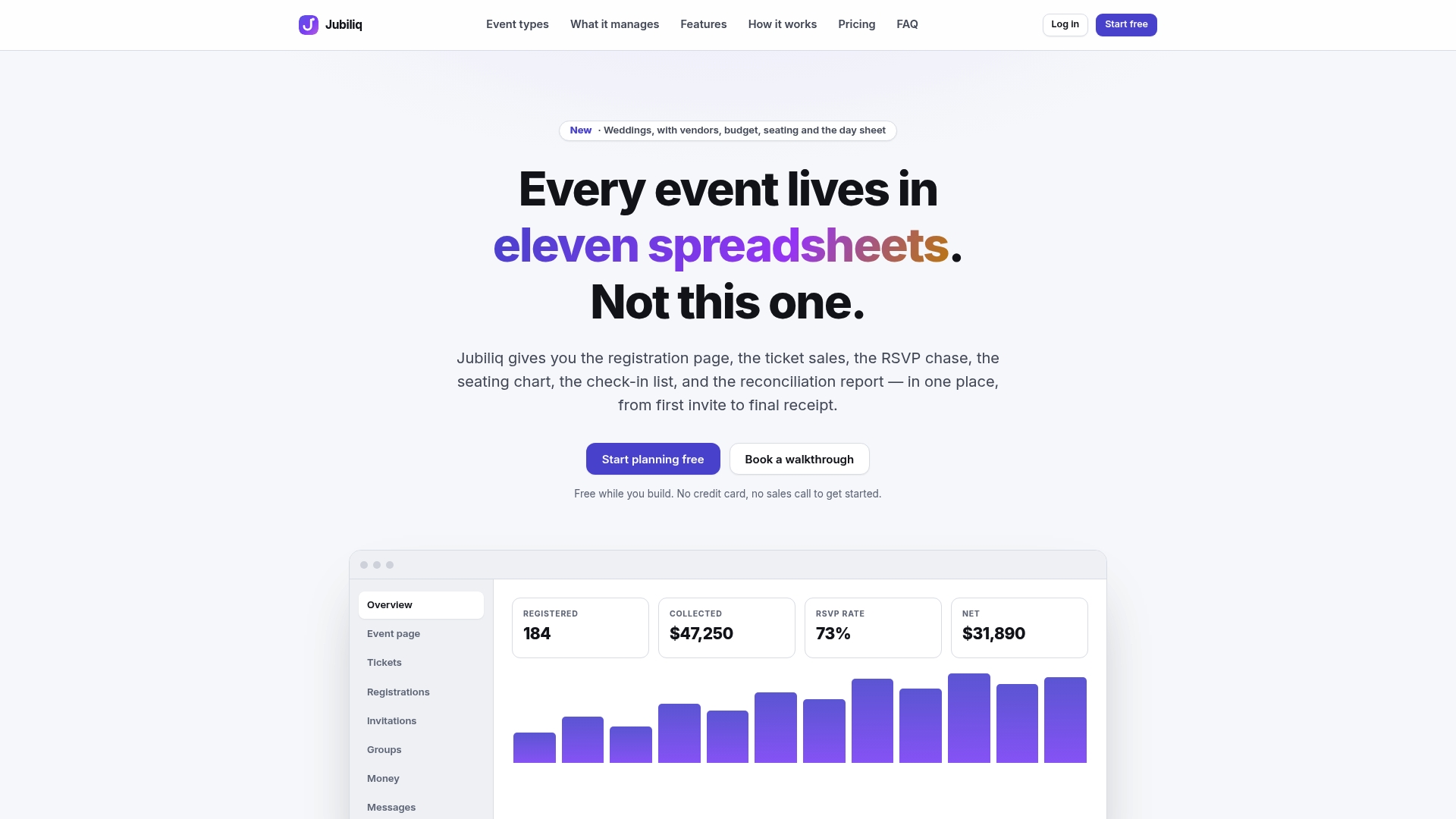
- An adaptive interface shows only the tools relevant to your event type, whether that’s a conference, a gala, or a fundraiser.
- Vendor and contract management keeps every commitment in one record instead of scattered across email.
- Ticket and sponsorship sales flow through the same platform used for guest lists and budgeting.
Starter is free for events without paid tickets, and Organizer charges 2% per paid registration. Visit our plans page to see which fits your next event.
FAQ
What is a marketing plan for an event?
An event marketing plan is a structured document that sets goals, defines audience segments, chooses promotional channels, and maps a timeline of tasks leading up to the event. It typically includes a budget, a content calendar, and KPIs used to measure whether the event met its goals.
What are the 5 C’s of event marketing?
Common frameworks describe the 5 C’s as company, customers, competitors, collaborators, and climate, used to analyze the market context before planning an event. Definitions vary by source, so treat this as a planning lens rather than a fixed checklist.
What are the 4 C’s of event marketing?
The 4 C’s are often described as concept, coordination, control, and culmination, representing the phases of planning and executing an event from idea to wrap-up. Some versions swap in cost or communication depending on the framework being used, so the exact terms aren’t universally standardized.
What are the 5 C’s of a marketing plan?
In general marketing strategy, the 5 C’s usually refer to company, customers, competitors, collaborators, and climate, used to assess internal capability and external market conditions. This framework overlaps closely with the event-specific version and serves a similar diagnostic purpose before setting goals.
Sources
- Next Gen Trade Shows: Maximize Your Opportunities
- Event marketing plan template
- Event Marketing: How to Build Your Strategy & Connect With Customers in Real Life