Stop Weddings Running Late: 3 Wedding Day Timeline Templates

Stop Weddings Running Late: 3 Wedding Day Timeline Templates
A wedding day timeline is a minute-by-minute schedule built around one fixed point: your ceremony start time. Everything else, hair and makeup, photographer arrival, cocktail hour, dinner, gets scheduled backward or forward from that anchor. The real decisions are whether you do a first look, how many people need hair and makeup, and whether you’re moving between venues, because those three choices shift every other block on the page.
TL;DR:
- Incorporate at least 30 to 45 minutes of buffer time between major blocks to handle delays like traffic, dress delays, or vendor setbacks.
- Decide on a first look early, as it significantly reduces portrait and buffer times, freeing up more of the ceremony day for guests and spontaneity.
- Schedule vendor arrivals, photo sessions, and family formals based on the ceremony start time, giving ample time for each activity while accounting for location transitions.
- Use a real-time planning platform to update and share the schedule easily, avoiding miscommunications and last-minute improvisations.
- Build each tradition or cultural ritual into the timeline with accurate durations, sequencing them clearly to prevent overlaps and ensure smooth flow.
Table of Contents
- Why You Need a Wedding Day Timeline (and When to Build One)
- How to Build Your Wedding Day Timeline Step by Step
- Three Hour-by-Hour Wedding Day Timeline Examples
- Photography Timing: First Looks, Formals, and Sunset Portraits
- Reception Timeline: From Grand Entrance to Send-Off
- What to Include on Each Timeline Version You Share
- Managing Delays: Build in Contingency Before You Need It
- Fitting Family and Cultural Traditions Into the Schedule
- Adjusting Your Timeline for Wedding Size
- Timing Meals and Breaks for Guests and the Wedding Party
- What Planning Software Gets Right About Timeline Creation
- Build, Print, and Share Your Timeline With Jubiliq
- The Templates Are a Starting Point, Not a Straitjacket
- Sources
- FAQ
Why You Need a Wedding Day Timeline (and When to Build One)
Weddings run late for one reason more than any other: nobody built in room for the small stuff. Hair and makeup takes ten minutes longer than planned. The shuttle hits traffic. Uncle Ray can’t find his boutonniere. None of that sinks a wedding by itself. What sinks a wedding is a schedule with zero slack, where a ten-minute hiccup at 1 PM turns into a 45-minute delay by 6 PM because every vendor was booked back to back with no cushion.
A written timeline is what keeps that from cascading. It also gives every vendor, from the florist to the DJ, the same shared reference point, so nobody is guessing when the room needs to be set or when the bouquet needs to arrive.
Timing matters as much as the document itself. Start drafting your timeline months before the wedding, as soon as your vendor list is locked. Share a working draft 4 to 6 weeks before the wedding so vendors can flag conflicts, then lock and distribute the final version 2 to 4 weeks out. Resist the urge to keep tweaking it the week of the wedding.
Not everyone needs the same version:
- Vendor day sheet: contact numbers, arrival windows, setup and load-in details, and cues for key moments like the grand entrance.
- Wedding-party one-pager: call times, where to be and when, hair/makeup order, and photo groupings.
- Guest-facing summary: just the big milestones, ceremony time, reception start, and end time, nothing granular.
Handing your photographer the same sparse sheet you send Grandma is how photo blocks get missed. Build once, then trim.
How to Build Your Wedding Day Timeline Step by Step
Building a timeline isn’t guesswork if you work it in the right order. Anchor everything to the ceremony start time, then calculate backward for the morning and forward for the reception.
- Lock the ceremony time first. Every other block on your schedule depends on this single number.
- Decide on a first look. This single choice reshapes your entire afternoon, more on that trade-off below.
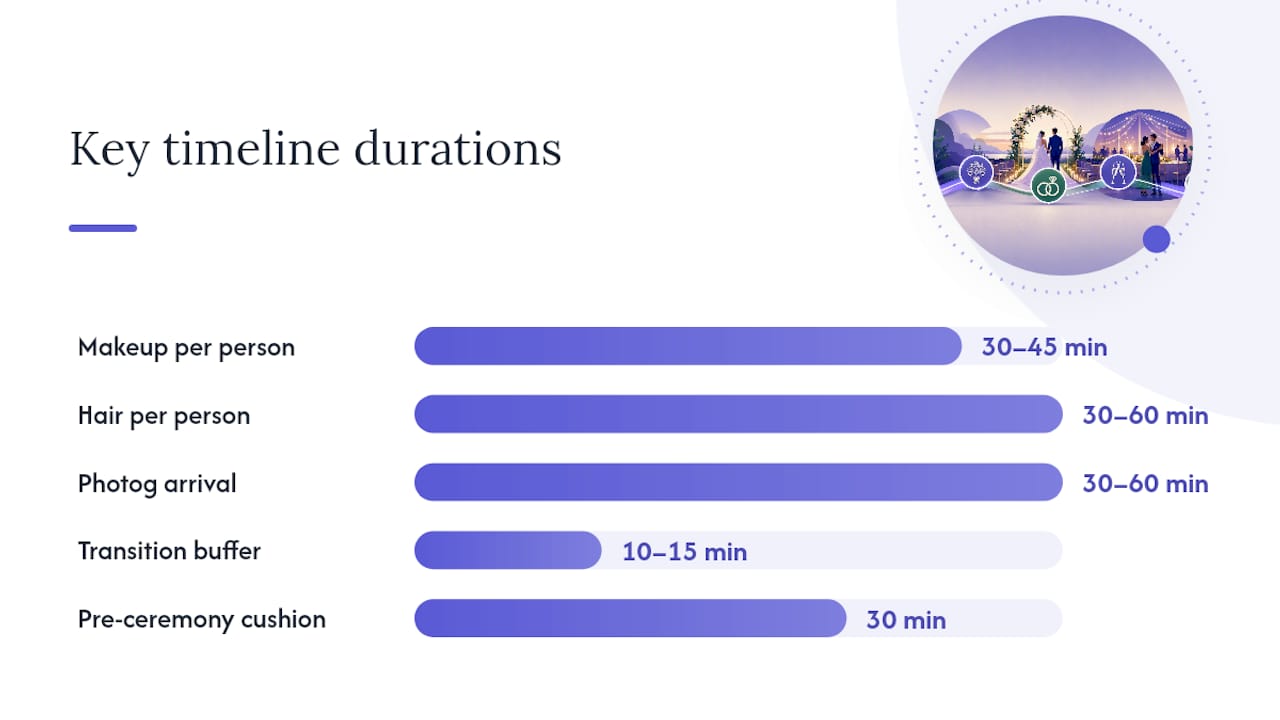
- Work out hair and makeup math. Budget 30 to 45 minutes for makeup and 30 to 60 minutes for hair per person, depending on style complexity. A simple rule of thumb: 30 to 40 minutes per person per artist. If your party is four or more, add a second hair or makeup artist, or you’re waking up at 5 AM for a 4 PM ceremony.
- Schedule the photographer’s arrival. Have them arrive 30 to 60 minutes before you’re dressed and ready so they can shoot details, dresses, and rings before the chaos starts.
- Block portrait time realistically. Family formals, wedding party shots, and couple portraits each need their own slot, not a shared 15 minutes.
- Insert buffers everywhere. Add 10 to 15 minutes between most transitions and a full 30-minute cushion before the ceremony itself.
- Account for travel if you’re using multiple venues. Add drive time plus 15 to 20 minutes on either end for loading, unloading, and vendors resetting for the next location.
Pro Tip: Build your buffers into the schedule you actually hand out, not just the version in your head. A hidden mental cushion doesn’t help your photographer, who will plan around whatever time is printed on the sheet.
If your ceremony and reception happen at different addresses, don’t just add drive time. Confirm each vendor’s setup window at the second location; caterers and florists often need 60 to 90 minutes of uninterrupted access before guests arrive, and that window has to exist somewhere on your printed schedule.
Three Hour-by-Hour Wedding Day Timeline Examples
These three templates cover the ceremony times most couples actually pick. Adjust the clock times and keep the logic.
3 PM ceremony: the relaxed template
An early ceremony gives you the most breathing room and usually pairs well with a first look.
- 9:00 AM: Wake up, breakfast, start hair
- 9:30 AM: Makeup begins (staggered if more than one artist)
- 11:30 AM: Getting dressed, detail photos begin
- 12:00 PM: Photographer arrives for finishing touches and detail shots
- 12:30 PM: First look and couple portraits
- 1:15 PM: Wedding party portraits
- 1:45 PM: Family formals
- 2:15 PM: 30-minute buffer, guests arrive, hide from view
- 2:45 PM: Wedding party lines up
- 3:00 PM: Ceremony begins
- 3:30 PM: Cocktail hour starts (guests only, since portraits are done)
- 4:30 PM: Reception entrance and first dance
- 5:00 PM: Dinner service begins
- 6:15 PM: Toasts
- 6:45 PM: Cake cutting
- 7:00 PM: Open dancing
- 9:30 PM: Send-off
4 to 5 PM ceremony: the common template, two ways
This is the timeline most couples land on, and the first-look decision splits it into two clearly different shapes.
With a first look:
- 10:00 AM: Hair and makeup begins
- 12:30 PM: Photographer arrives
- 1:00 PM: First look and couple portraits
- 1:45 PM: Wedding party and family portraits
- 2:45 PM: Buffer and hiding before guests arrive
- 3:00 PM: Guests arrive
- 3:30 PM: Buffer, final touch-ups
- 4:00 PM: Ceremony
- 4:30 PM: Cocktail hour (guests only)
- 5:30 PM: Reception entrance
- 6:00 PM: Dinner
- 7:15 PM: Toasts and cake
- 7:45 PM: Open dancing
- 10:00 PM: Send-off
Without a first look:
- 10:30 AM: Hair and makeup begins
- 1:00 PM: Photographer arrives, detail shots
- 1:30 PM: Wedding party gets dressed
- 2:30 PM: Buffer before ceremony
- 3:00 PM: Guests arrive
- 4:00 PM: Ceremony (couple sees each other for the first time at the aisle)
- 4:30 PM: Cocktail hour begins, extended to allow post-ceremony portraits
- 4:30 to 5:45 PM: Couple, family, and wedding party portraits happen during a longer cocktail hour
- 5:45 PM: Reception entrance
- 6:15 PM: Dinner
- 7:30 PM: Toasts and cake
- 8:00 PM: Open dancing
- 10:00 PM: Send-off
6 to 7 PM ceremony: the compressed evening template
Late ceremonies mean less flexibility, more back-to-back blocks, and portraits scheduled around the sun rather than the clock.
- 12:00 PM: Hair and makeup begins
- 3:30 PM: Photographer arrives
- 4:00 PM: First look, if doing one
- 4:15 PM: Portraits (couple, party, family, batched tightly)
- 5:30 PM: Buffer, dress, final details
- 6:00 PM: Ceremony
- 6:30 PM: Cocktail hour
- 7:30 PM: Reception entrance and first dance
- 7:45 PM: Dinner (often served faster to protect dancing time)
- 8:45 PM: Toasts and cake
- 9:00 PM: Sunset portraits, if the sky cooperates and the schedule allows a 20-minute slip-out
- 9:15 PM: Open dancing resumes
- 11:00 PM: Send-off
Photography Timing: First Looks, Formals, and Sunset Portraits
The single decision that reshapes your whole day is whether you do a first look. A first look completes most portraits before the ceremony, which usually frees up the couple to actually attend their own cocktail hour instead of missing it for photos. Skip the first look and you preserve the aisle reveal, but you’re pushing couple, family, and party portraits into the window right after the ceremony, which means cocktail hour has to stretch to cover it.
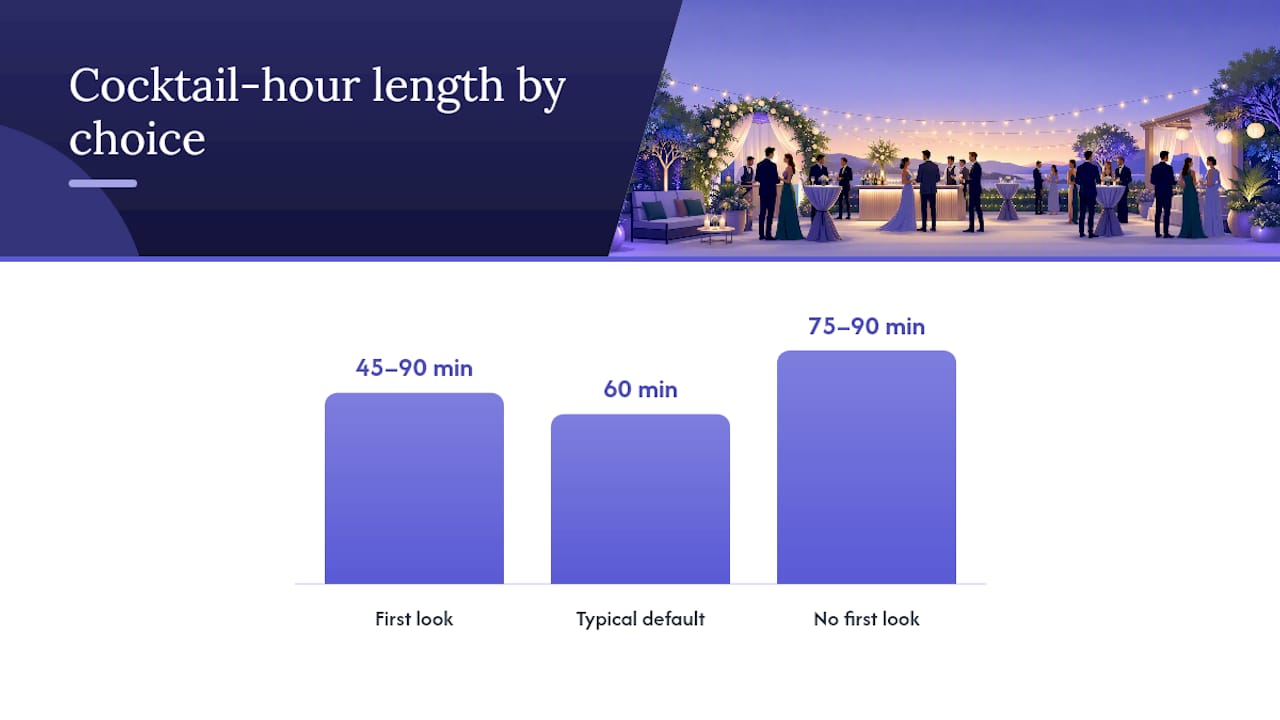
That trade-off shows up directly in cocktail hour length. A standard cocktail hour runs 45 to 90 minutes, with 60 minutes as the common default. Skip the first look and plan for 75 to 90 minutes instead, especially with a large family formal list.
A few scheduling rules that keep photography from eating the whole afternoon:
- Have your photographer arrive 30 to 60 minutes before you’re dressed and ready to capture rings, dress, and invitation suite details without rushing.
- Batch family formals by side (bride’s family, groom’s family, both together) rather than calling names one at a time; a well-run formal list of 10 to 15 groupings still takes 30 to 45 minutes.
- Assign a family member or planner to physically round up relatives for formals, since this single step is what most often blows up a photo schedule.
- If sunset portraits matter to you, check the local sunset time for your date and reserve about 30 minutes beforehand to step away from the reception for a quick outdoor session.
Family formals are the block couples underestimate most. Ten groupings at three minutes each sounds fast on paper; add walking time, a missing cousin, and someone who wandered off for a drink, and it easily runs 40 minutes instead of 30.
Reception Timeline: From Grand Entrance to Send-Off
Receptions typically run four to five hours total, and within that window there’s a sequence most guests expect, even if they couldn’t name it. Breaking from it too much tends to confuse the room and slow everything down.
A standard order looks like this:
- Grand entrance (5 to 10 minutes)
- First dance (3 to 5 minutes)
- Welcome toast or blessing before dinner (2 to 3 minutes)
- Dinner service (45 minutes to 1 hour, depending on plated vs. buffet)
- Parent dances and toasts, often slotted between courses or right after dinner (15 to 20 minutes total)
- Cake cutting (10 minutes, including photos)
- Open dancing (remainder of the night)
- Send-off (5 to 10 minutes)
Service style changes your pacing more than most couples expect. Buffet service can move faster once the line gets going, but it delays the moment everyone actually sits down to eat, since guests trickle back to tables at different times. Plated service starts on a fixed clock, salads out at 6:00, entrées at 6:30, but needs enough serving staff to avoid a long gap between courses.
Toasts are the most common reception derailment. Group them so speeches happen back to back rather than scattered between courses; jumping up for a toast every ten minutes stalls the meal and the DJ’s momentum along with it. If you have more than three or four speakers, split them across dinner (one or two) and right before cake (the rest), rather than stacking six speeches in a row.
What to Include on Each Timeline Version You Share
Not every person on your wedding day needs the same document. Sending your caterer a sheet meant for your bridesmaids, or vice versa, is how details fall through the cracks.
- Vendor day sheet: full contact list with cell numbers, specific arrival and setup windows for each vendor, load-in and load-out instructions, and cues for key moments (when to cut music for toasts, when the DJ should announce the grand entrance).
- Wedding-party one-pager: individual call times, where to physically be at each hour, hair and makeup order, and a single point of contact for last-minute questions.
- Guest summary: ceremony time, reception start, and end time only. Guests don’t need to know your first-look schedule.
| Timeline version | Who receives it | Core contents |
|---|---|---|
| Vendor day sheet | Photographer, caterer, florist, DJ, planner | Contacts, arrival windows, setup notes, key cues |
| Wedding-party one-pager | Bridal party, family in the wedding | Call times, locations, photo order, contact person |
| Guest summary | Invited guests | Ceremony time, reception start, end time |
Share the draft with vendors 4 to 6 weeks out so they can flag issues while there’s still time to adjust, then lock the final version 2 to 4 weeks before the wedding. If something changes after that, one person, usually your planner or your most organized bridesmaid, should own communicating the update to everyone affected, rather than relying on a group text nobody reads twice.
Managing Delays: Build in Contingency Before You Need It
Every wedding day has at least one surprise. The goal of a good timeline isn’t to prevent every delay, it’s to make sure a 15-minute hiccup stays a 15-minute hiccup instead of snowballing into a missed sunset or a rushed ceremony.
The buffers already built into your schedule, 10 to 15 minutes between blocks and a 30-minute cushion before the ceremony, are your first line of defense. They exist specifically to absorb the ordinary stuff: hair running long, a delayed shuttle, a missing groomsman.
Beyond buffers, a few habits reduce the odds of a real problem:
- Assign one person, not the couple, as the point of contact for the day. Your planner, a detail-oriented friend, or a family member who isn’t in the wedding party should field vendor calls and troubleshoot so you never see the texts.
- Build a rain plan into your timeline itself, not as a separate document. If you’re moving photos indoors or shifting the ceremony location, write out the adjusted times in advance so nobody is improvising at 2 PM in a downpour.
- Protect the ceremony start time above everything else. If something runs behind, trim time from cocktail hour or portrait blocks first, since those flex more easily than a room full of seated guests.
- Tell your officiant and DJ they have permission to make small real-time calls, like starting music a few minutes late, without needing your sign-off.
None of this eliminates delays. It just keeps them small, contained, and mostly invisible to your guests.
Fitting Family and Cultural Traditions Into the Schedule
Traditions add meaning, and they also add time that generic templates don’t account for. A tea ceremony, a hora, a unity candle, a Sikh Anand Karaj, or a receiving line each need their own named block, not a vague “extra time” buffer stuffed in somewhere.
The fix is simple: treat each tradition as its own line item with a realistic duration, sourced from people who’ve actually run one, not a guess. A first look template built for a 20-minute Western ceremony doesn’t stretch cleanly to accommodate an hour-long religious ceremony or a multi-part reception ritual.
Two practical habits help:
- Ask family members who’ve planned similar events how long each ritual actually took, not how long it was supposed to take.
- Give your officiant, DJ, or planner a written cue sheet with tradition names, timing, and any specific instructions (music cues, who processes when, props needed).
If you’re blending multiple traditions, for example a ceremony that includes both a Western processional and a separate cultural ritual, sequence them clearly and give each its own buffer rather than assuming they’ll flow into each other smoothly. The couples who feel most at ease on the day are usually the ones who wrote out these moments explicitly instead of trusting they’d remember to mention them to the DJ that morning.
Adjusting Your Timeline for Wedding Size
An intimate wedding of 30 guests and a 200-person production don’t run on the same clock, even with an identical ceremony time.
Smaller weddings compress beautifully. Family formals take less time because there are fewer combinations to shoot. Dinner service moves faster with fewer tables. You can often shave 30 to 45 minutes off a standard reception timeline just from lower headcount alone, and a first look becomes less critical since cocktail hour photo needs are smaller too.
Larger weddings need the opposite adjustment: more buffer, not less. Formals for two large families plus an oversized wedding party can easily run 45 minutes to an hour. Buffet lines take meaningfully longer past 150 guests. Restrooms, coat checks, and parking logistics all slow down at scale, and your timeline should account for that with wider buffers between blocks rather than the standard 10 to 15 minutes.
The core method stays the same regardless of size: anchor to ceremony time, work backward and forward, insert buffers. What changes is the size of those buffers and how many photo groupings and reception moments you’re stacking into the day.
Timing Meals and Breaks for Guests and the Wedding Party
Guests notice hunger faster than almost anything else on your timeline. A cocktail hour that runs past 90 minutes without real food, more than passed appetizers, starts to sour the mood no matter how good the open bar is.
A few timing rules keep both guests and your wedding party fed and functional:
- Serve substantial appetizers during cocktail hour, not just cheese cubes, especially if it’s running on the longer end (75 to 90 minutes).
- Get the wedding party a real meal before the reception if the ceremony to dinner gap runs long; a granola bar at 10 AM does not carry someone through a 7 PM dinner service.
- Start dinner within 30 minutes of the reception entrance whenever possible, since a longer gap between arrival and food is when guests start drifting or getting restless.
- Build a short break into the timeline for the couple, even 10 minutes, to eat, sit down, and drink water before speeches start.
It’s easy to forget that the two people getting married are often the last ones fed and the most exhausted by 9 PM. A timeline that protects a few quiet minutes for the couple to actually eat pays off in how present they feel for the rest of the night.
What Planning Software Gets Right About Timeline Creation
Most timeline friction comes from juggling versions: one document for the caterer, another for the photographer, a text thread for last-minute changes. An adaptive planning interface that only shows fields relevant to a wedding, rather than a generic event template, cuts out a lot of that clutter before you even start typing.
The bigger win is real-time updates. When a vendor arrival time shifts, everyone with access sees the change instantly instead of hunting through old email threads for the latest version. Some event planning platforms offer printable day sheets, centralized vendor contacts, and RSVP tracking that consolidate information in one place instead of multiple spreadsheets. For a day with this many moving parts, having one source of truth matters more than any single feature.
Build, Print, and Share Your Timeline With Jubiliq
Every template in this guide works on paper, but paper doesn’t update itself when your florist texts to say they’re running 20 minutes behind. That’s the gap Jubiliq is built to close.
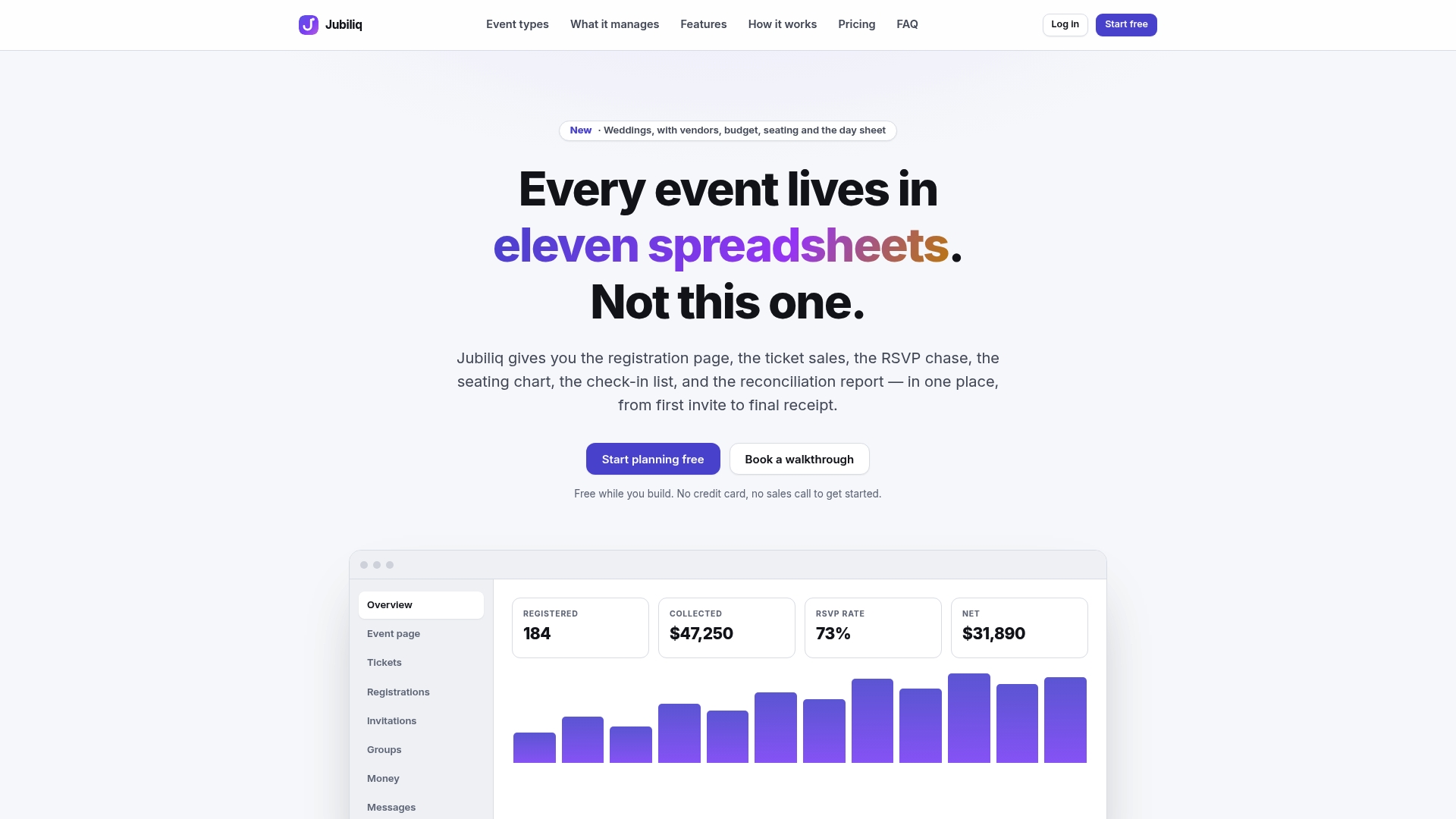
Some event planning platforms have adaptive interfaces tailored for weddings that hide irrelevant fields to simplify planning. Such platforms can generate printable day sheets for vendors and update changes in real time across different views, keeping all stakeholders aligned. Adding vendor contacts, guest RSVPs, and seating charts to a single workspace can help organize event details efficiently.
If you’re ready to stop juggling spreadsheets and text threads, start building your wedding day timeline with Jubiliq and get a printable, shareable schedule your whole vendor team can actually follow.
The Templates Are a Starting Point, Not a Straitjacket
Most timeline advice treats the schedule like a legal document, something you finalize once and defend against all deviation. That’s backwards. The best wedding day timelines are the ones built with enough slack that a 20-minute delay doesn’t require anyone to panic or renegotiate the whole evening on the fly.
What gets underestimated is how much the first-look decision ripples outward. Couples treat it like a photography preference, but it actually reshapes cocktail hour length, portrait scheduling, and even how relaxed the ceremony feels, since skipping it means walking down the aisle without having seen each other yet that day, which changes the emotional weight of that moment more than most planning guides admit.
The other overlooked piece is who actually owns the timeline once it’s finalized. A beautifully built schedule that lives only in the couple’s inbox is nearly useless on the day itself. Someone else, a planner, a detail-oriented friend, or a shared platform everyone can access, needs to hold it and adjust in real time. That’s less about the document and more about who’s empowered to make small calls when reality doesn’t match the plan.
— HCRF
Sources
- Wedding Timeline Generator – Free & Editable Day-Of Schedule Maker
- An Expert-Approved Timeline for Your Wedding Day
- Wedding Day Timeline Generator - Free & Editable | Wedding Planning Checklists
FAQ
What Is the Benefit of a First Look?
A first look moves most couple and portrait photography before the ceremony, which usually lets the couple attend their own cocktail hour instead of missing it for photos.
How Long Should Cocktail Hour Last?
A standard cocktail hour runs 45 to 90 minutes, with 60 minutes as the common default; extend it toward 90 minutes if you skipped a first look and have a large formal photo list.
When Should I Finalize and Share My Wedding Day Timeline?
Share a draft with vendors 4 to 6 weeks before the wedding for feedback, then lock and distribute the final version 2 to 4 weeks before the date.
How Much Buffer Time Should I Build Into My Timeline?
Plan 10 to 15 minutes between most major blocks and a full 30-minute cushion before the ceremony to absorb small delays.
Can I Build and Share My Timeline Digitally Instead of on Paper?
Yes. Platforms like Jubiliq let you build a timeline once, generate a printable day sheet for vendors, and push real-time updates to everyone with access when something changes.